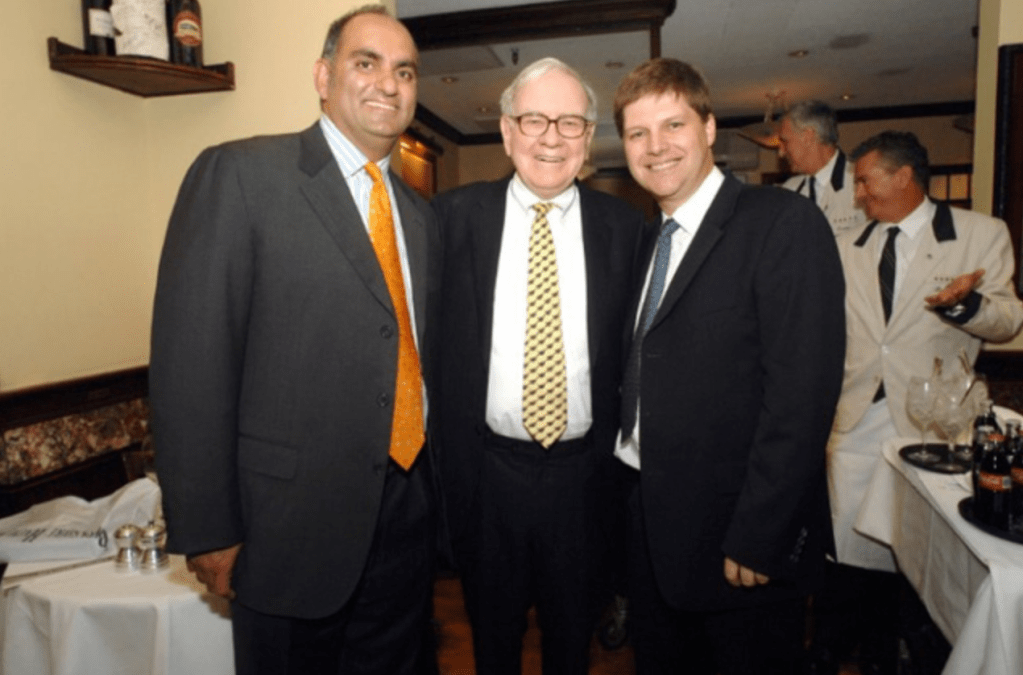
Mohnish Pabrai is an Indian-American businessman, investor, and philanthropist. He is the founder and managing partner of Pabrai Investment Funds, a family of hedge funds that has delivered outstanding returns since its inception in 1999. Pabrai’s investment approach is deeply rooted in the principles of value investing, which involves seeking undervalued companies with strong fundamentals.
The Pabrai Investment Philosophy
Pabrai’s investment philosophy is centered around the following key principles:
- Business Quality: Pabrai looks for businesses with a strong competitive advantage, talented management, and a proven track record of success.
- Margin of Safety: He insists on a significant margin of safety between the intrinsic value of a business and its market price.
- Low Risk: Pabrai prioritizes low-risk investments, focusing on companies with minimal debt, high returns on equity, and a history of profitability.
- Long-Term Focus: He adopts a patient, long-term approach, often holding onto investments for several years to allow the business to compound its value.
- Mr. Market: Pabrai takes advantage of market volatility, using price fluctuations to his advantage by buying undervalued companies during periods of market stress.

Key Takeaways for Individual Investors
While Pabrai’s investment approach may not be suitable for every individual investor, there are several valuable lessons that can be applied to improve one’s own investment strategy:
- Focus on Business Fundamentals: When evaluating investment opportunities, prioritize companies with strong business fundamentals, such as competitive advantages, talented management, and a proven track record.
- Be Patient: Adopt a long-term perspective, avoiding the temptation to time the market or make impulsive decisions based on short-term market fluctuations.
- Demand a Margin of Safety: Insist on a significant margin of safety between the intrinsic value of a business and its market price to minimize the risk of permanent capital loss.
- Stay Disciplined: Stick to your investment approach, even during periods of market stress or when others are deviating from their strategies.
Mohnish Pabrai’s value investing philosophy offers valuable lessons for individual investors seeking to improve their investment approach. By focusing on business fundamentals, being patient, demanding a margin of safety, and staying disciplined, investors can increase their chances of success in the markets.
Pabrai’s Lunch with Warren Buffett

When it comes to personal finance, few stories are as inspiring as the legendary lunch between Mohnish Pabrai and Warren Buffett. In 2007, Pabrai, an accomplished investor and philanthropist, paid $650,100 to have lunch with the Oracle of Omaha. This high-profile event was part of a charity auction benefiting the Glide Foundation, which provides support for the homeless in San Francisco.
A Strategic Investment
At first glance, spending over half a million dollars for a single meal may seem extravagant. However, Pabrai viewed the lunch as an investment in knowledge and inspiration. As a staunch follower of Buffett’s value investing principles, Pabrai knew this meeting was a rare opportunity to gain insights directly from one of the greatest investors of all time. The staggering sum was not only a donation to a worthy cause but also a strategic move to enhance his financial philosophy.
Key Takeaways from Buffett’s Wisdom
One of the most significant lessons Pabrai took away was Buffett’s emphasis on simplicity in investing. Buffett advised focusing on businesses that are easy to understand and avoiding unnecessary complexity. This reinforced Pabrai’s existing approach of sticking to his circle of competence—investing only in industries and companies he thoroughly understands.
Another pivotal insight was Buffett’s unwavering belief in long-term thinking. Buffett stressed the importance of patience and staying invested in quality companies, regardless of short-term market fluctuations. For Pabrai, this lesson further solidified his commitment to value investing and underscored the importance of discipline in achieving financial independence.
The Dhandho Framework: Heads I Win, Tails I Don’t Lose Much
Pabrai laid out his method in The Dhandho Investor, and the framework is more specific than “buy cheap stocks.” Dhandho is a Gujarati word for the business ethos of creating wealth through enterprise, and Pabrai modeled it on the Patel motel owners who turned tiny down payments into small empires. The rules:
First, invest only in simple, understandable businesses with durable economics. If you cannot explain how the company makes money in one sentence, it is outside your circle of competence. Second, make few bets and bet heavily when the odds are in your favor; Pabrai runs a concentrated portfolio, often around ten positions, because diversification is protection against ignorance and he would rather remove the ignorance. Third, demand asymmetric payoffs, his famous formulation: “Heads I win, tails I don’t lose much.” Buy when uncertainty has crushed the price but the underlying business risk is low, so the downside is capped and the upside is open. Fourth, be a shameless cloner. Pabrai calls himself a shameless cloner of Warren Buffett, and he means it as a compliment: copying the best ideas in value investing beats inventing mediocre ones.
The framework explains the lunch, too. Paying $650,100 for a meal looks extravagant until you run it through Dhandho: the downside was capped at the donation, and the upside was a lifetime of insight from the greatest investor alive. Asymmetric payoff, executed perfectly.
The Track Record, Honestly Told
The numbers justify the reputation. Pabrai Investment Funds launched on July 1, 1999. A $100,000 investment at inception was worth $659,700 by December 31, 2006, an annualized return of 28.6 percent net of all fees, in a period when the S&P 500 barely moved. From inception through December 2023, the funds compounded at 12.6 percent annualized versus 7.2 percent for the S&P 500.
The honest telling includes the drawdowns, because concentration cuts both ways. Pabrai Investment Fund 3 fell 60.9 percent in 2008 and 41.9 percent in 2018, then rose 125 percent in 2009 and 109.2 percent in 2017. That is the price of the “few bets, big bets” approach: years that look like genius and years that look like recklessness, averaging out to market-beating over decades. It is not a strategy for anyone who checks their portfolio daily.
The other half of the story is what the money is for. Pabrai founded the Dakshana Foundation, which gives gifted underprivileged students in India free coaching for the country’s elite engineering and medical entrance exams. Buffett himself acknowledged the foundation’s mission in March 2022. The Dhandho framework ends where it began: wealth as a tool, not a scoreboard.
The Ripple Effect
The lunch with Buffett had a profound impact on Pabrai’s career and personal philosophy. He has often spoken about how the experience deepened his understanding of humility, generosity, and the power of giving back. The meeting also reinforced his belief in living a frugal life, focusing on long-term wealth creation, and helping others along the way.









 Winchell House
You must be logged in to post a comment.