
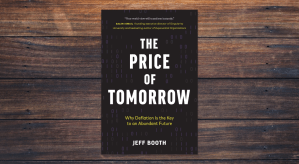
In The Price of Tomorrow: Why Deflation is the Key to an Abundant Future, Jeff Booth challenges readers to rethink how money, technology, and inflation interact in the modern economy. The book makes a compelling argument that deflation (not inflation) is the natural byproduct of exponential technological progress and that fighting it may actually harm long-term prosperity. It’s a unique read for anyone interested in macroeconomics, financial systems, or the future of money.
Who is Jeff Booth?
Jeff Booth is a Canadian entrepreneur and technology leader who co-founded BuildDirect, an online platform for home improvement products. His experience leading tech startups gives him a front-row view of how innovation is disrupting traditional business models. Booth brings this perspective to the global economy in The Price of Tomorrow, warning that outdated financial systems are clashing with modern technological realities.
Key Lessons from The Price of Tomorrow
Deflation is not the enemy
Booth argues that we are living in a time of accelerating technological deflation; think cheaper software, automation, and artificial intelligence. However, instead of embracing lower costs and greater abundance, governments are fighting deflation with money printing, artificially propping up the economy through inflation.
Exponential tech will outpace linear thinking
Technology evolves exponentially, but human systems, especially government policy and central banking, evolve linearly. This mismatch creates systemic risks, including debt bubbles, rising inequality, and economic fragility.
Fiat currency is under pressure
Booth discusses how the current fiat monetary system is unsustainable in the long run, given the rate of debt accumulation and currency debasement. He suggests that individuals should consider how to protect their wealth in an uncertain financial future.
The importance of adaptability
Rather than resisting change, The Price of Tomorrow encourages readers to adapt to it. Understanding how technological deflation impacts money, jobs, and markets can help individuals make better personal finance decisions.
Criticisms of the Book
While The Price of Tomorrow offers a fresh and thought-provoking take on economic trends, it is not without its critics. Some readers may find the book too high-level, with fewer actionable steps for individuals looking to change their financial habits. Others argue that Booth is overly critical of central banks and too optimistic about how quickly society can transition to a new system.
Additionally, the book leans heavily on theory, which may not resonate with those looking for more traditional personal finance advice like budgeting tips or investment strategies. It’s more of a macroeconomic framework than a how-to manual.
Should You Buy It?
If you are interested in the intersection of technology, money, and the future of the global economy, The Price of Tomorrow is a worthwhile read. It can help readers understand the broader forces that may influence personal finance decisions in the years ahead. While it won’t teach you how to manage a budget or choose a financial advisor, it provides important context for why those decisions matter more than ever.
However, if you’re just starting your financial journey and looking for practical tips, The Price of Tomorrow may be better as a second or third read, after covering foundational books on money management and investing.
Final Thoughts
The Price of Tomorrow is a provocative book that encourages readers to think differently about inflation, technology, and the future of money. While it may not appeal to everyone, it offers a valuable perspective for those seeking to understand the larger economic trends shaping our financial lives.
For readers building a strong financial foundation, it’s worth pairing this book with practical tools like a budgeting app, a high-yield savings account, and an S&P 500 investment strategy. Books like this one expand your financial worldview and that’s essential for long-term success.




 Winchell House
You must be logged in to post a comment.