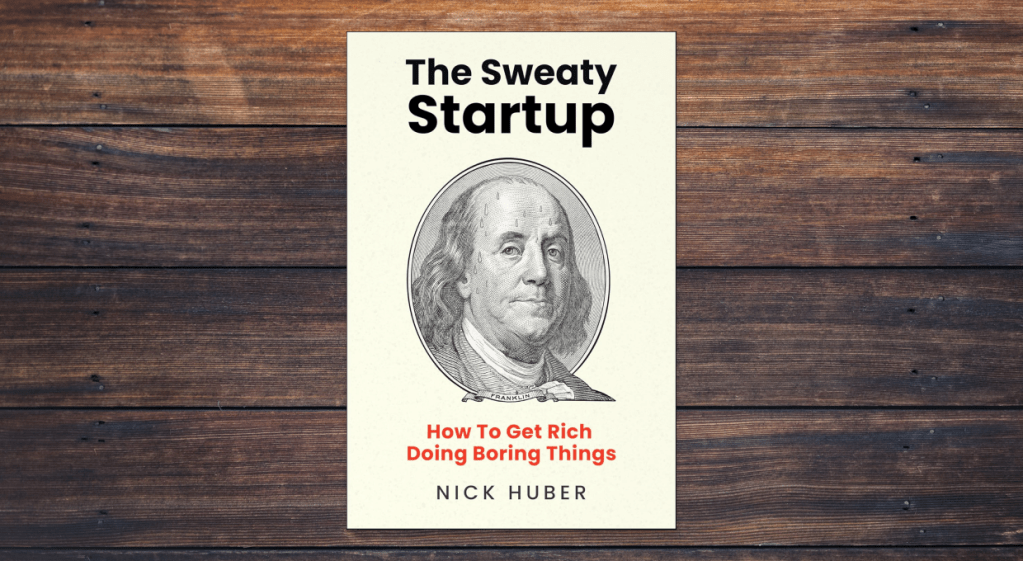
The Sweaty Startup is a practical, no-frills guide to building wealth through simple businesses that most people overlook. Nick Huber, the author, is known for championing the idea that success doesn’t require flashy tech startups or a genius product idea. Instead, he argues that financial independence is well within reach for those willing to get their hands dirty—often quite literally—with unglamorous, service-based work.
Who is Nick Huber?
Nick Huber is an entrepreneur, real estate investor, and creator of the Sweaty Startup brand. He first found success by starting a student storage business while still in college, which eventually grew into a multi-million-dollar company. He then shifted focus to self-storage real estate, where he continues to build wealth. Huber is also active on X and in podcasting, where he offers blunt, no-nonsense advice on entrepreneurship and financial growth. His direct tone and contrarian views have earned him a large following… and a fair amount of criticism.

Key Lessons from The Sweaty Startup
One of the central themes of The Sweaty Startup is that most people overlook obvious business opportunities because they seem too “boring.” Huber encourages readers to stop chasing passion and instead look for inefficiencies in their own neighborhoods (think landscaping, pressure washing, cleaning services, moving companies, and HVAC repair). These are the kinds of businesses that often have high profit margins, repeat customers, and low competition.
Another key lesson is that you don’t need to wait to start. Huber emphasizes speed over perfection and recommends taking action before you feel ready. His own story is a case study in just starting, learning on the fly, and improving as you go.
The Sweaty Startup also pushes back on the romanticized idea of being a visionary founder. Instead of trying to invent the next big thing, Huber recommends identifying simple, profitable problems that already exist and solving them with consistent, reliable service.
Finally, there is a strong message about financial discipline. Huber encourages reinvesting profits, avoiding lifestyle inflation, and building equity through assets like real estate or a well-run service business.
Criticisms of the Book
While The Sweaty Startup offers a lot of tough-love wisdom, it’s not without its flaws. Some readers may find Huber’s tone too abrasive or his advice too generalized. The book assumes a level of privilege, such as having access to startup capital, flexible time, or a network of skilled labor. Not everyone can drop everything to start a pressure-washing business.
Another common critique is that the book lacks depth in areas like marketing, hiring, or financial management. It’s heavy on motivation and light on step-by-step tactical guidance. Readers looking for a detailed business plan or advanced financial modeling won’t find it here.
Additionally, Huber’s aversion to traditional career paths and higher education may come off as dismissive. While his message is valuable for self-starters, it might feel out of reach for those in more constrained situations.
Why This Book?
The Sweaty Startup stands out in a personal finance world often filled with abstract ideas and passive investing strategies. While saving money, using budgeting apps, and investing in the S&P 500 are all crucial (and recommended), Huber’s book shows how increasing your income through entrepreneurship can supercharge financial freedom. It’s a reminder that frugality and investing aren’t the only paths to wealth—sometimes, building a business can be the best accelerator.
For readers who are hungry to take control of their finances and aren’t afraid of manual work, this book offers a clear roadmap. It’s also a solid companion to traditional personal finance advice, helping readers understand that earning more and spending wisely are two sides of the same coin.
Final Thoughts
The Sweaty Startup isn’t for everyone. But for those willing to challenge their assumptions about what it means to build wealth, Nick Huber delivers a compelling case for getting into the trenches. The book doesn’t offer magic formulas or overnight success stories. Instead, it presents a grounded, practical strategy for turning hard work and overlooked opportunities into long-term financial gain.
If you’re looking for a realistic guide to making money outside the 9-to-5 grind, this is a book worth reading—and discussing.









 Winchell House
You must be logged in to post a comment.