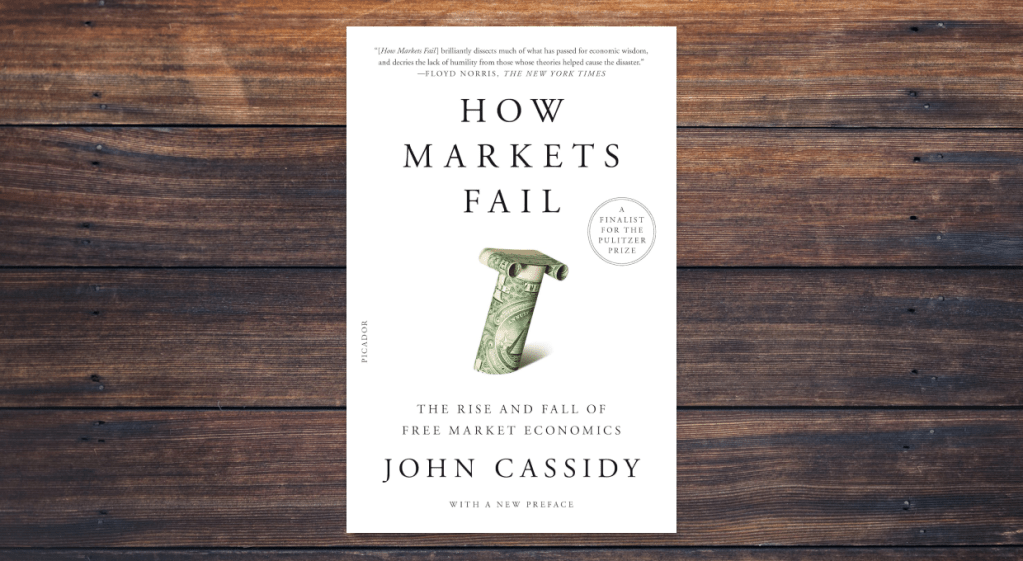
How Markets Fail by John Cassidy is an insightful, ambitious book that seeks to explain not only the 2008 financial crisis, but the broader failures of free-market ideology.
Blending history, economics, and journalism, Cassidy traces the intellectual origins of economic thought and challenges the blind faith many investors and policymakers have placed in the efficiency of markets. For readers eager to understand why financial markets sometimes spiral out of control (and how those failures are often preventable) this book is a compelling, thought-provoking read.
Who is John Cassidy?
John Cassidy is a staff writer at The New Yorker who covers economics and finance. He has also written for The Sunday Times and The New York Review of Books. Cassidy studied economics at Oxford and later earned a master’s degree in journalism from Columbia University. His background positions him well to bridge the gap between academic theory and real-world application. Unlike some economists who write for specialists, Cassidy writes clearly for a general audience, helping non-experts understand complex economic dynamics.
Lessons from the Book
One of the central themes of How Markets Fail is that the theory of the rational, self-correcting market is not only flawed, but dangerous when applied without caution. Cassidy splits the book into three parts: Utopian Economics, Reality-Based Economics, and The Great Crunch. This structure allows him to contrast idealized market models with the messy, irrational realities of human behavior and financial institutions.
Markets are not rational
Cassidy draws heavily on behavioral economics and the work of Hyman Minsky to show how speculation, herd behavior, and misaligned incentives can lead to booms and busts.
Deregulation can create systemic risk
The book argues that unregulated markets, especially in finance, tend to drift toward instability. Cassidy traces the 2008 crisis to flawed assumptions about risk, securitization, and the housing market.
Government intervention is sometimes necessary
While Cassidy doesn’t advocate for government control of markets, he makes a strong case for regulation that keeps greed and excess in check.
Understanding economic history matters
Cassidy weaves in lessons from past thinkers like Keynes, Hayek, and Friedman, helping readers see how current events echo older economic debates.
These insights make the book a valuable companion for anyone trying to make sense of financial calamities and their root causes—especially readers interested in protecting their own finances from market volatility.
Criticisms of the Book
While How Markets Fail is thorough and engaging, it has drawn criticism from both sides of the economic spectrum. Some readers feel the book leans too heavily on criticizing free-market ideas without offering enough in the way of solutions. Others argue that Cassidy underplays the benefits of markets and competition by focusing mostly on their flaws.
The book is also quite dense in parts, particularly when covering economic theory. Readers unfamiliar with Keynesianism, monetarism, or behavioral economics may find some sections challenging, though Cassidy does make an effort to explain these ideas in plain language.
Lastly, since the book was published in 2009, it doesn’t address more recent developments like the rise of cryptocurrency, the pandemic-era stimulus packages, or the persistent inflation that followed. Still, its core arguments about the fallibility of markets remain highly relevant.
Why This Book?
For readers looking to build financial literacy, How Markets Fail offers something deeper than most personal finance books: context. It encourages readers not just to learn how to budget or invest in the S&P 500, but to understand how the broader financial system operates (and where it can go wrong).
Knowing why markets crash helps people become better investors and more cautious planners. Whether you’re stashing money in a high-yield savings account or allocating funds to a diversified portfolio, understanding market dynamics can help you avoid panic during downturns and resist irrational exuberance during booms.
Final Thoughts
How Markets Fail is not a typical finance book. It won’t tell you how to choose a mutual fund or set up a budget in your favorite app. But it will challenge your assumptions about how capitalism works—and sometimes doesn’t. It’s a book for readers who want to go beyond surface-level advice and develop a richer, more nuanced understanding of the economic forces that shape our financial lives.
For anyone serious about building long-term financial resilience, reading books like this is essential. While it might not offer direct personal finance tips, it equips readers with the mental tools to think clearly during times of uncertainty. That, in itself, is a powerful form of financial literacy.



 Winchell House
You must be logged in to post a comment.