
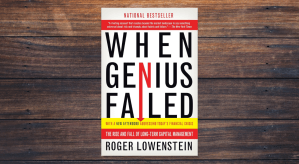
When Genius Failed: The Rise and Fall of Long-Term Capital Management is a gripping narrative of financial brilliance, hubris, and collapse. Written by financial journalist Roger Lowenstein, the book tells the story of how some of the smartest minds on Wall Street—Nobel Prize-winning economists, seasoned traders, and mathematicians—came together to form Long-Term Capital Management (LTCM), only to see their sophisticated strategies unravel in dramatic fashion.
This is not just a story about a hedge fund. It’s a case study in overconfidence, the illusion of risk control, and the dangers of financial leverage. For readers interested in learning how money really works on Wall Street, this book provides an essential education without requiring a background in finance or economics.
Who Is Roger Lowenstein?
Roger Lowenstein is an American financial journalist and author known for his clear, investigative storytelling and ability to explain complex financial topics to everyday readers. Before writing books, Lowenstein was a reporter for The Wall Street Journal for more than a decade. He’s written several respected works on finance, including The End of Wall Street and Buffett: The Making of an American Capitalist.
Lowenstein’s reporting is grounded in fact, and he has a talent for making the events he covers feel as tense and consequential as a thriller novel. His credentials make him a trusted guide through the events surrounding LTCM’s collapse.
Lessons from When Genius Failed
Intelligence Isn’t Everything
LTCM was staffed by brilliant economists and traders, including Nobel laureates Myron Scholes and Robert Merton. Their confidence in mathematical models led them to believe they could manage risk better than anyone else. But intelligence, while helpful, doesn’t guarantee success in unpredictable markets.
The Dangers of Leverage
One of the core takeaways from the book is how leverage can magnify both gains and losses. LTCM’s use of borrowed money allowed it to control massive positions in the market, but when trades went south, the losses multiplied quickly. For individuals, this is a cautionary tale against borrowing to invest or taking on more risk than you can afford.
Markets Are Not Always Rational
LTCM built its strategies on the assumption that markets would behave according to historical patterns. But in times of stress, markets can act irrationally. Diversification, humility, and a margin of safety are more important than precise predictions.
The Illusion of Control
Risk models can make investors feel protected, but as LTCM learned, real-world events often don’t match what the models predict. Personal finance decisions should be grounded in simple, time-tested principles—not overly complex systems that assume we can control every variable.
The Importance of Liquidity
LTCM couldn’t exit its trades when markets turned against them. For individuals, this highlights the value of having cash reserves, whether in a high-yield savings account or short-term treasury bills. Liquidity gives you options when others are panicking.
Criticisms of the Book
Some readers have criticized When Genius Failed for not diving deeper into the technical details of the financial instruments involved. For seasoned investors or professionals, the book may feel too light on the quantitative analysis behind LTCM’s trades.
Others argue that Lowenstein doesn’t provide enough focus on the systemic implications of LTCM’s failure. While the book does explore how the fund’s near-collapse threatened the global financial system, it stops short of a broader discussion on regulatory reform.
However, for most readers—especially those new to financial history or looking to learn more about how markets really work—the book offers a compelling, accessible narrative without getting lost in jargon.
Why This Book?
When Genius Failed is one of the most important books on money and risk ever written. It’s not a personal finance book in the traditional sense, but it teaches lessons that are deeply relevant to anyone managing their own money. Understanding how smart people can make devastating financial mistakes is crucial for avoiding similar pitfalls.
The book is also valuable because it shows that even elite financial professionals are vulnerable to the same cognitive biases and misjudgments that affect everyday investors. It reminds readers that simple strategies—like investing in the S&P 500, budgeting wisely, and avoiding unnecessary debt—are often safer and more effective than chasing complex systems promising high returns.
Final Thoughts
When Genius Failed is a must-read for anyone who wants to understand the intersection of psychology, risk, and markets. It’s a cautionary tale about believing too much in your own models and underestimating the unpredictability of the real world. For readers trying to build wealth over time through smart, frugal living and consistent investing, this book offers an essential perspective on what not to do.
Whether you’re just beginning your financial journey or have been investing for years, When Genius Failed will leave you with a deeper appreciation for humility, simplicity, and the power of sound financial judgment.




 Winchell House
You must be logged in to post a comment.