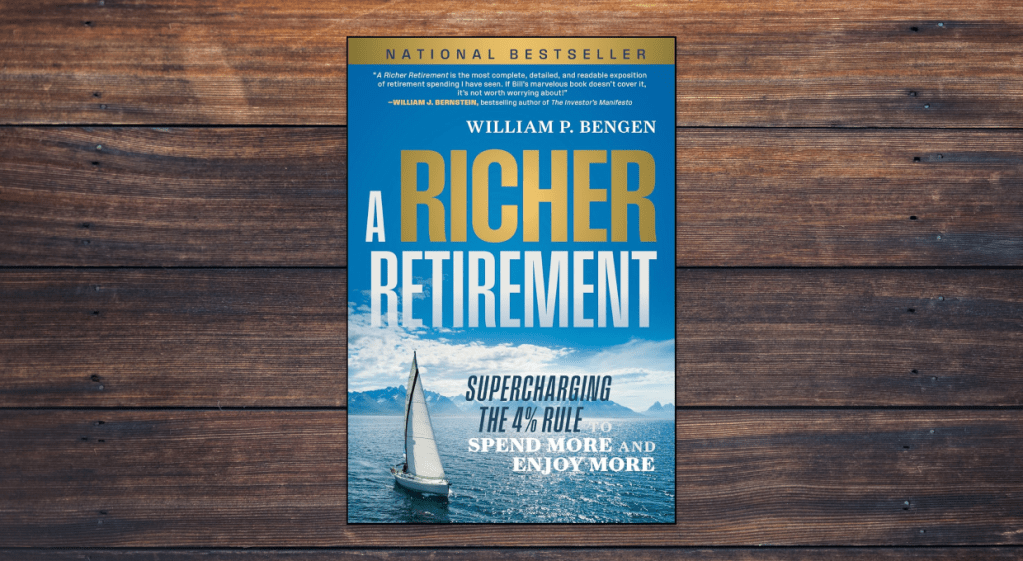
William P. Bengen’s A Richer Retirement: Supercharging the 4% Rule to Spend More and Enjoy More revisits the classic 4 percent rule—widely used for guiding retirement withdrawals—and proposes strategic enhancements.
The book offers insightful guidance for retirees and pre-retirees looking to enjoy financial freedom with reduced anxiety about running out of money.
Who is William P. Bengen?
William P. Bengen is the financial planner who originally introduced the 4 percent rule—popularized in the 1990s as a reliable benchmark for sustainable retirement withdrawals.
Bengen’s research and recommendations are considered a cornerstone in retirement planning literature, balancing growth and longevity in portfolio design.
Key Lessons from the Book
Flexibility in withdrawals
Bengen advocates adjusting your withdrawal rate based on market performance rather than rigidly adhering to 4 percent year after year. This approach aims to protect your portfolio during downturns and allow for more spending when markets flourish.
Guided adjustments, not guesses
Bengen provides clear guardrails (such as upper and lower bounds) to help readers navigate withdrawal changes intelligently, avoiding both overspending and unnecessarily tight budgeting.
Spending for enjoyment
The book is refreshingly pragmatic: it encourages retirees to recognize that retirement isn’t merely about preservation but also about living well—and that some degree of spending increases can be sustainable if managed wisely.
Criticisms of the Book
Complexity for casual readers
The strategies, while grounded in data, can feel technical and may overwhelm readers without a finance background.
Dependence on market assumptions
Bengen’s model hinges on historical market performance, which may not replicate under radically different future scenarios—such as prolonged low-growth periods or unexpected economic shifts.
Strategy overkill for modest portfolios
For individuals with smaller nest eggs, the granular withdrawal adjustments may not yield noticeably better outcomes compared to the simplicity of a fixed-rate approach.
Should You Buy It?
If you’re approaching retirement and already familiar with the basics of the 4 percent rule, this book can help refine your financial plan with smarter flexibility and confidence. Readers who are relatively new to investing or prefer straightforward, low-maintenance strategies might find the depth excessive and may benefit more from starting with simpler resources like beginner-friendly books on money and budgeting apps.
Final Thoughts
A Richer Retirement brings a thoughtful, data-driven perspective to retirement planning. It expands on a foundational concept and offers practical enhancements for managing one’s nest egg with both prudence and purpose.
While not ideal for absolute beginners, readers with moderate financial literacy will appreciate the nuanced approach to maximizing spending flexibility without compromising longevity.
For those ready to take more control of their retirement income strategy, this book is a strong and enriching addition to the shelf.









 Winchell House
You must be logged in to post a comment.