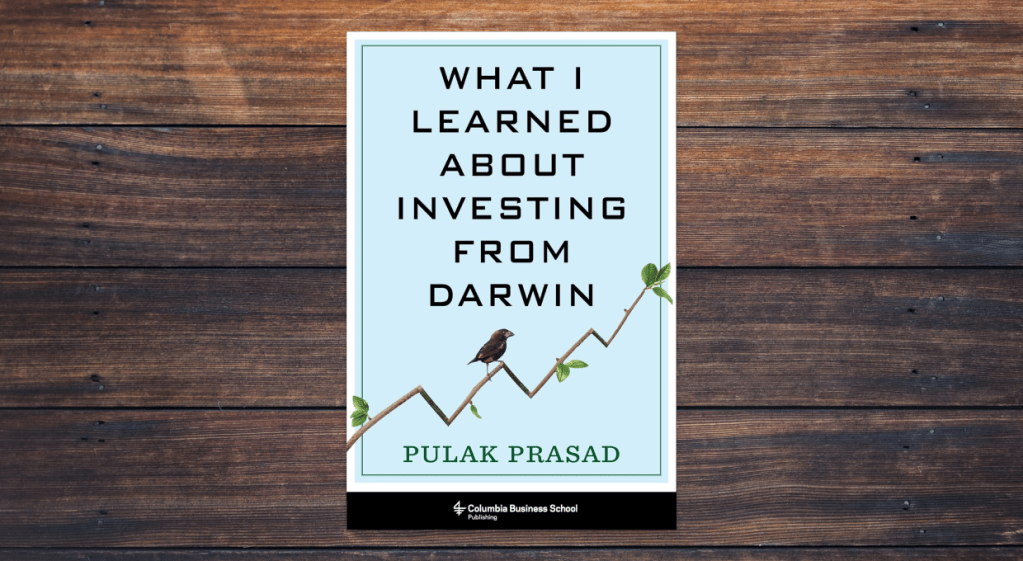
Investing books often fall into two camps. Some focus on tactics and short term market moves. Others aim to shape how readers think about risk, patience, and long term decision making. What I Learned About Investing from Darwin by Pulak Prasad clearly belongs in the second group. It is less about stock picking formulas and more about building a durable investing mindset inspired by the principles of evolution.
This review covers who Pulak Prasad is, the core lessons of the book, its limitations, and whether it deserves a place on your personal finance bookshelf.
Who is Pulak Prasad?
Pulak Prasad is an Indian fund manager and founder of Nalanda Capital, an investment firm known for its long term, concentrated approach to investing in high quality businesses. His background blends professional money management with a strong interest in systems thinking, psychology, and biology.
Rather than positioning himself as a market forecaster, Prasad frames investing as a probabilistic activity shaped by incentives, competition, and survival. That perspective heavily influences the structure and tone of the book.
Lessons from the Book
One of the central ideas in What I Learned About Investing from Darwin is that investing success is more about avoiding extinction than maximizing short term returns. Prasad borrows heavily from evolutionary biology to explain why survival, adaptability, and patience matter more than brilliance.
A major takeaway is the importance of margin of safety. Just as species that survive tend to build in redundancy and resilience, investors should prioritize businesses with strong balance sheets, durable competitive advantages, and conservative management teams. Avoiding permanent loss of capital is treated as more important than chasing high returns.
The book also emphasizes long term thinking. Evolution rewards traits that persist over time, not those that shine briefly. In investing terms, this translates to owning high quality companies for many years and allowing compounding to do the heavy lifting. Frequent trading and reacting to market noise are framed as behaviors that work against this process.
Another valuable lesson centers on incentives. Prasad argues that understanding management incentives, industry structure, and human behavior often matters more than complex financial models. Businesses run by aligned, rational decision makers tend to outperform over long periods, especially when competition is limited.
Some Criticisms and Limitations
While the evolutionary framework is thought provoking, some readers may find the analogies overused. The repeated references to biology and natural selection can feel abstract, especially for readers looking for concrete, step by step investing guidance.
The book also offers relatively few specific examples of publicly traded companies. Readers hoping for detailed case studies, valuation walkthroughs, or portfolio construction advice may come away wanting more practical detail.
Another limitation is accessibility. The concepts are intellectually rich, but the writing can feel dense at times. Beginners who are just learning about budgeting, index funds, or basic investing principles may struggle to connect the ideas to immediate action.
Should You Buy the Book?
This book is best suited for readers who already understand the basics of investing and want to deepen their thinking. Investors who appreciate Warren Buffett style discipline, long term ownership, and risk avoidance will likely find the ideas resonate.
Readers who are early in their financial journey may want to pair this book with more practical resources on budgeting, low cost index funds, and building an emergency fund. As a complement to those foundations, Prasad’s work adds valuable perspective.
For thoughtful investors who enjoy books on money that explore psychology, decision making, and first principles, the book is worth buying.
Final Thoughts
What I Learned About Investing from Darwin is not a how to manual. It is a philosophy book disguised as an investing guide. Its strength lies in reframing investing as a game of survival, patience, and rational behavior rather than prediction.
The book reinforces timeless ideas that align well with long term investing in broad market indexes like the S&P 500, maintaining a margin of safety, and resisting emotional decision making. Readers willing to engage with its abstract style will come away with a more durable framework for thinking about money and investing over decades, not quarters.



 Winchell House
You must be logged in to post a comment.