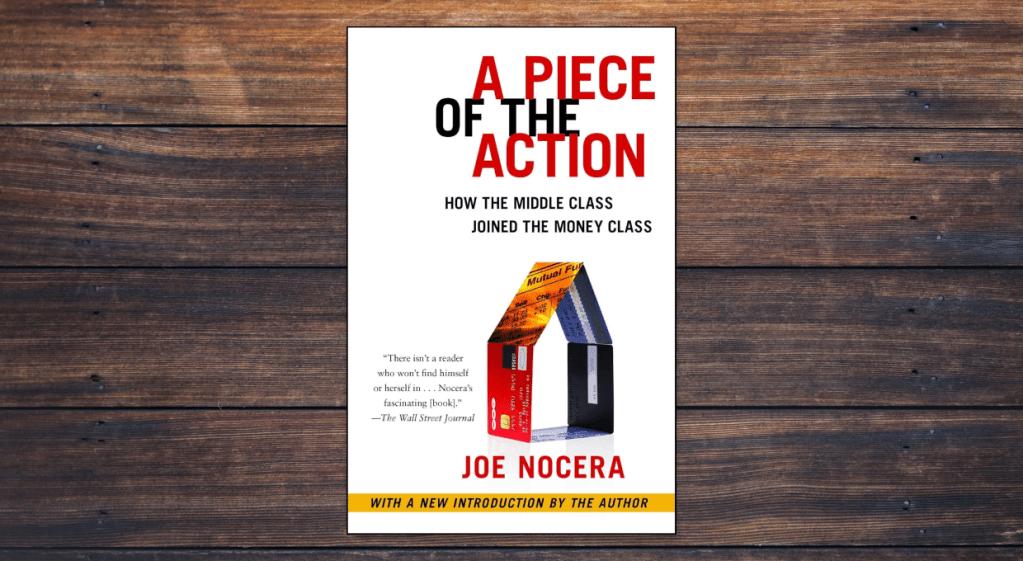
A Piece of the Action is a timely and still relevant exploration of how everyday Americans became participants in modern finance. Rather than focusing on Wall Street elites, Joe Nocera tells the story of how the middle class was gradually pulled into markets, credit systems, and financial products that reshaped household money decisions. The book sits at the intersection of history, personal finance, and financial psychology, making it a strong fit for readers interested in learning how money systems evolve and how individuals adapt to them.
Who Is Joe Nocera?
Joe Nocera is a longtime financial journalist best known for his work at The New York Times, where he wrote the influential Business section column. He has also contributed to Bloomberg, Fortune, and other major publications. Nocera is recognized for his ability to explain complex financial systems in clear, accessible language without oversimplifying the underlying incentives and risks.
His work often focuses on how institutions shape individual behavior, a theme that runs strongly through A Piece of the Action. Rather than offering tactical advice like a budgeting guide or investing manual, Nocera provides context. He helps readers understand why modern money works the way it does.
What the Book Is About
The core argument of A Piece of the Action is that financial participation is no longer optional for the American middle class. Over the last several decades, households moved from simple savings accounts and pensions toward credit cards, mortgages, mutual funds, retirement accounts, and equity markets. This shift brought opportunity but also risk.
Nocera traces the rise of consumer credit, the democratization of investing, and the growing expectation that individuals manage their own financial futures. The book explains how cultural attitudes toward debt changed, how financial products were marketed to everyday people, and how the idea of ownership expanded from homes to stocks and funds.
Key Lessons From The Book
One of the most valuable lessons in the book is that financial behavior is heavily influenced by systems and incentives, not just personal discipline. People did not suddenly become reckless or sophisticated. They responded to new tools, new norms, and new pressures.
Another takeaway is that access to financial markets cuts both ways. Investing through mutual funds and retirement accounts allowed millions to benefit from long-term stock market growth, particularly through broad market exposure like the S&P 500. At the same time, greater access to credit made it easier to overspend and harder to avoid lifestyle creep.
The book also reinforces the importance of financial education. As responsibility shifted from employers and institutions to individuals, many people were left to learn budgeting, investing, and risk management on their own. This gap helps explain why books on money, budgeting apps, and financial advisors play such a central role today.
Criticisms of the Book
One common criticism is that A Piece of the Action is more descriptive than prescriptive. Readers looking for step by step guidance on budgeting, saving, or investing will not find it here. The book explains how things came to be but rarely tells readers exactly what to do next.
Some readers may also feel that the book underplays personal accountability. While Nocera convincingly shows how systems influence behavior, critics argue that individuals still make choices and should bear responsibility for poor financial decisions.
Finally, parts of the book feel dated in a world of mobile banking, zero commission trading, and modern budgeting apps. However, the underlying themes about incentives, access, and risk remain highly relevant.
Should You Buy the Book?
If you are looking for a practical how to guide on budgeting or investing, this is not the right book. If you are interested in understanding why modern personal finance looks the way it does, it is an excellent choice.
Readers who enjoy learning through narrative, history, and analysis will get the most value. It pairs well with more tactical books on money that focus on saving automatically, using high yield savings accounts, and long-term investing in low cost index funds.
Final Thoughts
A Piece of the Action is not a manual for building wealth. It is a framework for understanding how the middle class became financially exposed, empowered, and vulnerable all at once. By explaining how ordinary people joined the money class, Joe Nocera gives readers insight into their own financial behaviors and blind spots.
For anyone serious about learning how money systems influence everyday decisions, this book remains worth reading. It adds depth to the conversation around budgeting, investing, and financial independence, and it reminds readers that personal finance is never just personal.



 Winchell House
You must be logged in to post a comment.