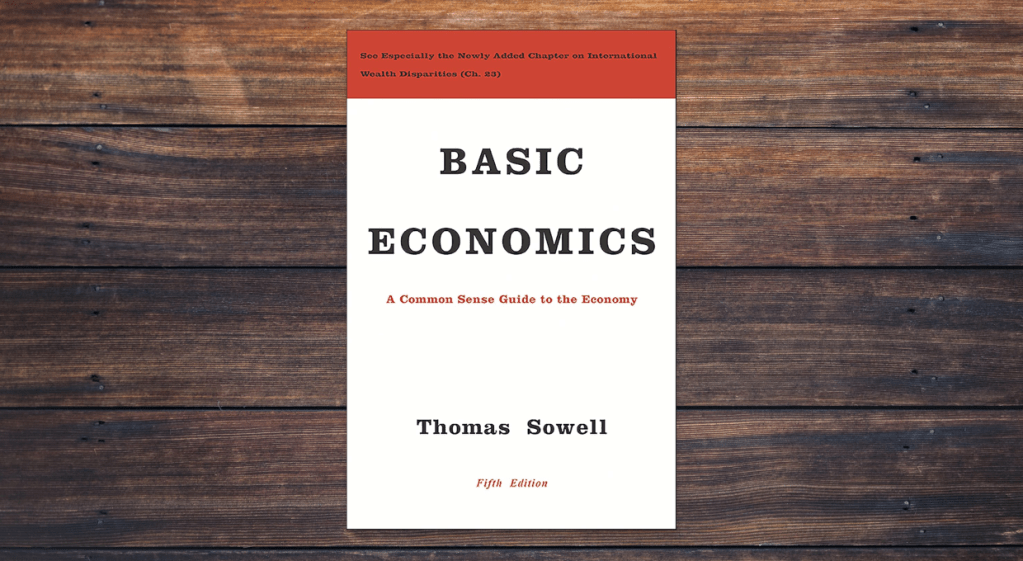
There are not many economics books that have gone through five editions, sold hundreds of thousands of copies, and remained genuinely readable from cover to cover. Basic Economics by Thomas Sowell is one of them. First published in 2000, it has outlasted countless other introductory economics texts by doing something deceptively simple: explaining how economies work in plain English, without graphs, without equations, and without assuming the reader has any prior knowledge of the subject. For anyone trying to build a real understanding of money, markets, and financial decision-making, it deserves a serious look.
Who Is Thomas Sowell?
Thomas Sowell was born in 1930 in Gastonia, North Carolina, and grew up in Harlem. He left high school without graduating, served in the Marines during the Korean War, and later earned a bachelor’s degree from Harvard, a master’s from Columbia, and a PhD in economics from the University of Chicago, where he studied under Milton Friedman. That lineage places him firmly in the free-market, classical liberal tradition of economic thought.
Sowell spent decades as a senior fellow at the Hoover Institution at Stanford University and authored more than 30 books covering economics, social policy, history, and culture. His academic work focused on Marxist economics early in his career before he shifted toward a market-oriented framework. He is a prolific and distinctly American intellectual voice, and Basic Economics is widely considered his most accessible and enduring work. He retired from writing his syndicated newspaper column in 2016.
What the Book Is About
The premise of Basic Economics is straightforward. Sowell argues that most bad economic policy, and most confused thinking about economic issues, stems from a failure to understand basic economic principles. His goal is not to push a political agenda, though his perspective is clearly present throughout. His goal is to give readers the conceptual tools to evaluate economic claims on their own terms.
The book covers a wide range of topics including prices and their role in allocating resources, the economics of housing and rent control, labor markets and minimum wage, international trade, and the role of government in the economy. Each topic is addressed through real-world examples drawn from history, policy experiments around the world, and observable outcomes rather than theoretical models.
The organizing principle of the book is a single idea that Sowell returns to repeatedly: economics is the study of the use of scarce resources which have alternative uses. That definition sounds dry, but Sowell uses it as a lens to examine why policies that seem beneficial on the surface so often produce unintended and counterproductive consequences.
Lessons Readers Can Take Away
The most durable lesson in Basic Economics is the distinction between what Sowell calls the first-order effects of a policy and its secondary and tertiary effects. Rent control is his most frequently cited example. A city caps rents to make housing more affordable. In the short run, some tenants pay less. In the longer run, landlords reduce maintenance, convert rental units to condominiums, and developers build fewer rental properties because the returns no longer justify the investment. The supply of affordable housing shrinks. The policy intended to help renters ends up harming the very people it was designed to protect. Sowell uses dozens of similar examples to illustrate the same underlying point: good intentions do not guarantee good outcomes, and ignoring second-order effects is the most common and costly mistake in economic reasoning.
A second major lesson is about the role of prices as information. Prices are not just numbers on a tag. They are signals that coordinate the behavior of millions of people who have no direct knowledge of or connection to each other. When prices are allowed to rise after a natural disaster, for example, they attract suppliers from other regions, which replenishes scarce goods faster than any centrally coordinated relief effort typically can. Price controls in those situations feel compassionate but routinely produce shortages. Understanding this mechanism changes how you evaluate a wide range of policy debates.
A third lesson is about the difference between intentions and incentives. Sowell argues that understanding economic outcomes requires analyzing what incentives a policy creates, not what goals it pursues. People respond to incentives, and when policies create incentives that conflict with their stated goals, the incentives usually win.
For personal finance readers specifically, these lessons translate into a clearer framework for evaluating financial decisions. Understanding that there are always trade-offs, that resources have alternative uses, and that second-order effects matter as much as immediate ones is valuable not just for analyzing government policy but for managing your own money.
Criticisms of the Book
Basic Economics is not without legitimate criticism, and a fair review requires acknowledging them.
The most common critique is that the book presents a particular school of economic thought, broadly market-oriented and skeptical of government intervention, as if it were settled, neutral economic science. Critics from across the political spectrum have pointed out that many of the topics Sowell addresses are genuinely contested among professional economists, and that the book sometimes presents one side of those debates more forcefully than the uncertainty in the evidence warrants.
On issues like the minimum wage, for example, Sowell’s treatment reflects older economic consensus more than current academic debate, which has become more nuanced following influential research by economists like David Card and Alan Krueger. Card won the Nobel Prize in Economics in 2021 partly for work that complicated the straightforward prediction that minimum wage increases always reduce employment.
A second criticism is that the book is long. At over 700 pages in its later editions, it tests the patience of some readers, particularly because the core arguments are made clearly and early, and later chapters sometimes feel repetitive in their application of the same principles to new contexts.
A third criticism, more philosophical, is that Sowell’s consistent focus on market mechanisms and the unintended consequences of intervention can crowd out serious analysis of market failures, externalities, and situations where the absence of regulation produces demonstrably bad outcomes. Readers who finish the book with the impression that markets always outperform intervention will have drawn a conclusion that even many free-market economists would consider too strong.
None of these criticisms make the book a bad book. They make it an incomplete one, which is true of virtually every book on economics. The appropriate response is to read it alongside other perspectives, not to avoid it.
Should You Buy This Book?
Yes, with one qualification.
Basic Economics is one of the most effective introductions to economic thinking available to a general reader. It does not require a background in math or prior knowledge of economics. It is written in clear, confident prose. And the core mental models it teaches, particularly around trade-offs, incentives, prices as information, and unintended consequences, are genuinely useful for anyone trying to think more clearly about money, policy, and financial decision-making.
The qualification is this: read it as a starting point, not an ending point. Sowell’s perspective is a valuable one, but it is a perspective. Following Basic Economics with something like Thinking, Fast and Slow by Daniel Kahneman, which explores the psychology of economic decision-making, or The Worldly Philosophers by Robert Heilbroner, which surveys the full sweep of economic thought from Adam Smith forward, will give you a more complete picture than any single book can provide.
For readers who are just beginning to learn about economics and want a foundation that will help them evaluate financial news, political claims, and their own money decisions more clearly, Basic Economics is an excellent place to start.
Final Thoughts
Thomas Sowell wrote Basic Economics because he believed most economic confusion is not a matter of complexity but of clarity. He wanted to give ordinary readers the conceptual vocabulary to cut through the noise. On that front, the book largely succeeds. Its lessons about trade-offs, incentives, and the gap between policy intentions and policy outcomes are as relevant today as they were when the first edition was published.
Building financial literacy is not just about knowing how to budget or which index fund to buy, though those things matter enormously. It is also about developing a way of thinking that helps you evaluate information critically and make decisions with a clear sense of what you are actually trading off. Basic Economics contributes meaningfully to that foundation. It is worth the time.









 Winchell House
You must be logged in to post a comment.