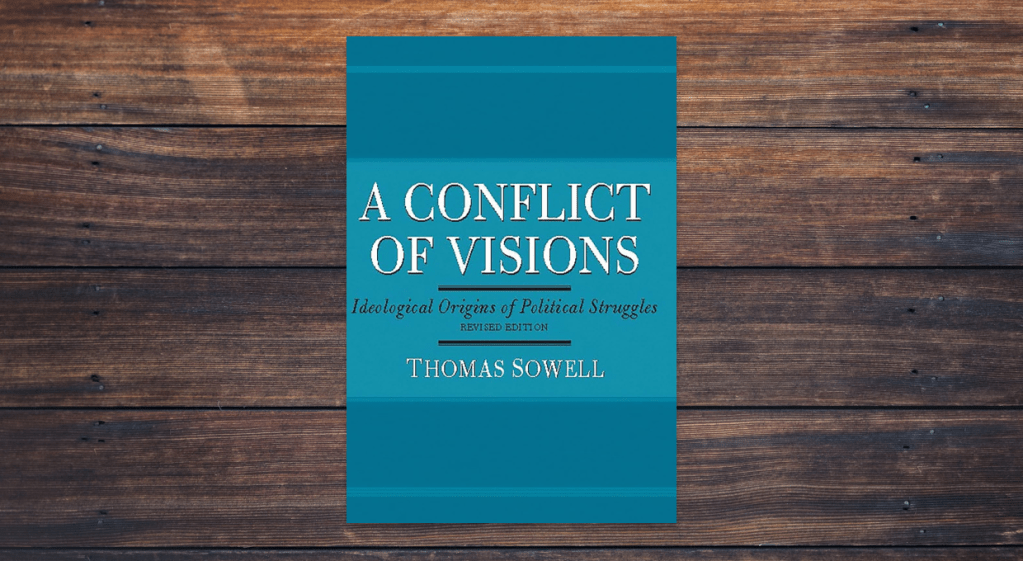
Most political arguments feel like they are about specific policies: tax rates, minimum wage laws, immigration quotas, criminal sentencing guidelines. Thomas Sowell’s A Conflict of Visions, first published in 1987, makes a compelling case that this is an illusion.
The real disagreements, he argues, run much deeper than any particular policy debate. They trace back to fundamentally different assumptions about human nature itself, assumptions so basic that most people hold them without ever having examined them consciously. That idea alone makes this one of the more genuinely illuminating books written about political and economic thought in the past half century.
Who Is Thomas Sowell?
Thomas Sowell was born in 1930 in Gastonia, North Carolina, grew up in Harlem, and came to economics through a path that included leaving high school early, working manual jobs, serving in the Marines during the Korean War era, and eventually earning a bachelor’s degree magna cum laude from Harvard, a master’s from Columbia, and a doctorate from the University of Chicago, where he studied under Milton Friedman.
He spent most of his career as a senior fellow at the Hoover Institution at Stanford University and authored more than 30 books on economics, history, culture, and social policy. His best-known work, Basic Economics, introduced millions of general readers to economic thinking without a single graph or equation. A Conflict of Visions is a different kind of book, more philosophical and more demanding, but it may ultimately be his most important contribution to how people think about ideas and ideology. He retired from his syndicated newspaper column in 2016.
What the Book Is About
The central argument of A Conflict of Visions is that the recurring disagreements between what we loosely call the political left and the political right are not primarily the result of different values, different levels of intelligence, or different amounts of compassion. They are the result of two fundamentally different visions of human nature, which Sowell calls the constrained vision and the unconstrained vision.
The constrained vision holds that human nature is essentially fixed. People are self-interested, limited in their knowledge and rationality, and prone to error in predictable ways. Because human nature cannot be meaningfully improved, social systems must be designed to work within those constraints, channeling self-interest through institutions, laws, traditions, and incentive structures rather than trying to appeal to altruism or cultivate virtue directly. The market economy, common law, and constitutional checks and balances are all examples of institutions built around the constrained vision. Adam Smith is Sowell’s primary example of a constrained vision thinker.
The unconstrained vision holds that human nature is malleable and that people are capable of significant moral and intellectual improvement given the right conditions, education, and leadership. Social problems are not inherent to human nature but are the result of flawed institutions, bad incentives, or insufficient knowledge among decision-makers. If the right people, with the right understanding, are in a position to design better systems, human welfare can be dramatically improved. William Godwin and Jean-Jacques Rousseau are Sowell’s primary examples of unconstrained vision thinkers.
Sowell is careful to note that these are not perfectly binary categories. Most people and most ideological traditions draw on elements of both visions. But he argues that one or the other tends to dominate in any given thinker’s worldview, and that the resulting differences in how people see human nature lead almost inevitably to different conclusions about trade-offs, process versus outcomes, and the role of expertise and authority in social decision-making.
The book then traces how these two visions play out across a remarkably wide range of debates, including war and peace, equality, power, and the role of law, showing how the same underlying disagreement about human nature generates consistent patterns of political disagreement across centuries and across cultures.
Lessons Readers Can Take Away
The most important lesson of A Conflict of Visions is also the most humbling: most of us walk around with a set of deep assumptions about human nature that we have never examined and that drive our political and economic opinions far more than the specific facts of any particular debate. Becoming aware of those assumptions is a genuine act of intellectual growth.
For readers interested in personal finance and economics, this has direct practical value. The constrained vision has obvious implications for how you think about your own financial behavior. If human nature is fixed and self-interest is a constant, then the most reliable financial strategies are those that work with human psychology rather than against it. Automatic contributions to a savings account or retirement fund, for example, do not rely on sustained willpower or virtue. They channel behavior through structure, which is exactly what constrained vision thinking recommends.
The unconstrained vision, by contrast, tends to produce financial advice that asks people to simply try harder, be more disciplined, and make better choices through conscious effort. That advice is not wrong, but it often underestimates how difficult sustained behavioral change is in the absence of structural support. Understanding the difference between these two approaches can help you design your own financial life more realistically.
A second lesson is about the nature of trade-offs versus solutions. Constrained vision thinkers tend to see trade-offs everywhere, because resources are limited and human nature imposes real constraints on what is achievable. Unconstrained vision thinkers tend to see problems as having solutions, if only the right policies or the right people are applied to them. In personal finance, the constrained vision is more useful. There are no solutions to the tension between spending and saving, only trade-offs. Accepting that reality is the beginning of a realistic financial plan.
A third lesson is about the value of process over outcomes. Constrained vision thinkers tend to trust evolved institutions and established processes, such as markets, legal systems, and democratic deliberation, because those systems encode accumulated knowledge that no individual fully possesses. Unconstrained vision thinkers tend to be more willing to override existing processes in favor of outcomes that seem clearly better to the experts involved. For investors, the parallel is between trusting a systematic, rules-based approach to investing, such as consistent contributions to a low-cost S&P 500 index fund, versus trying to beat the market through active management based on the belief that sufficiently smart analysts can identify the right outcomes in advance. The evidence on that particular question has generally favored the constrained vision.
Criticisms of the Book
A Conflict of Visions has earned genuine admiration across ideological lines, but it has also attracted substantive criticism that is worth engaging with honestly.
The most common critique is that Sowell’s framework, despite his stated evenhandedness, consistently portrays the constrained vision in a more favorable light. Critics point out that the constrained vision’s emphasis on evolved institutions and the limits of human reason has historically been used to defend arrangements that were not merely imperfect but actively unjust, including slavery, legal segregation, and the exclusion of women from political and economic life. The unconstrained vision’s willingness to override tradition in pursuit of better outcomes is precisely what drove the abolition movement, the suffrage movement, and the civil rights movement. A framework that treats institutional conservatism as the more intellectually humble position has to reckon with that history.
A second criticism is that the binary of constrained versus unconstrained, however useful as a rough heuristic, oversimplifies the actual diversity of political and philosophical thought. Many serious thinkers do not map cleanly onto either category, and Sowell’s assignment of historical figures to one vision or the other sometimes requires ignoring significant portions of their work.
A third critique is that the book is more descriptive than prescriptive. It explains why people disagree with remarkable clarity, but it does not ultimately tell you which vision is more correct, or how to adjudicate between them when they produce conflicting policy recommendations. Readers looking for a resolution to the tensions Sowell describes will not find one here.
These are legitimate criticisms of a serious book, and they are reasons to read widely rather than reasons to avoid this particular work.
Should You Buy This Book?
Yes, and fairly emphatically so, with the understanding of what kind of book it is.
A Conflict of Visions is not a personal finance book in any conventional sense. It will not tell you how to budget, which index funds to buy, or how to build an emergency fund. What it will do is give you a more sophisticated framework for understanding why people disagree so consistently about economic and political questions, and for examining the assumptions that drive your own opinions about money, markets, and policy.
For readers who have already worked through books like Basic Economics by Sowell himself, The Wealth of Nations by Adam Smith, or The Intelligent Investor by Benjamin Graham, A Conflict of Visions represents a natural next step in building a more complete intellectual foundation. It is the kind of book that changes how you think rather than simply adding to what you know, and those books are rarer and more valuable than any other kind.
It is worth noting that the book is academic in its pacing. It rewards careful reading rather than skimming. If you prefer books that move quickly through concrete examples and practical recommendations, this one will require some patience. The payoff is real, but it takes longer to arrive than it does in Sowell’s more accessible works.
Final Thoughts
A Conflict of Visions is one of those books that readers tend to describe as clarifying. After finishing it, you will find yourself noticing the underlying vision in op-eds, policy debates, financial arguments, and casual conversations about economics in ways you likely did not before. That kind of perceptual shift is rare and valuable.
Thomas Sowell wrote this book not to settle the debate between the constrained and unconstrained visions but to show that the debate is real, that it is coherent, and that understanding it is prerequisite to thinking seriously about almost any social or economic question. On that count, he succeeds.
The lessons it offers about human nature, trade-offs, the limits of expertise, and the value of process over outcomes translate directly into better financial thinking. The investor who trusts a systematic process over their own ability to outsmart the market, the saver who builds structure into their habits rather than relying on willpower, and the consumer who thinks carefully about second-order effects before making a major financial decision are all, in their own way, applying the constrained vision to their personal finances.
That is not a bad framework to carry with you.







 Winchell House
You must be logged in to post a comment.