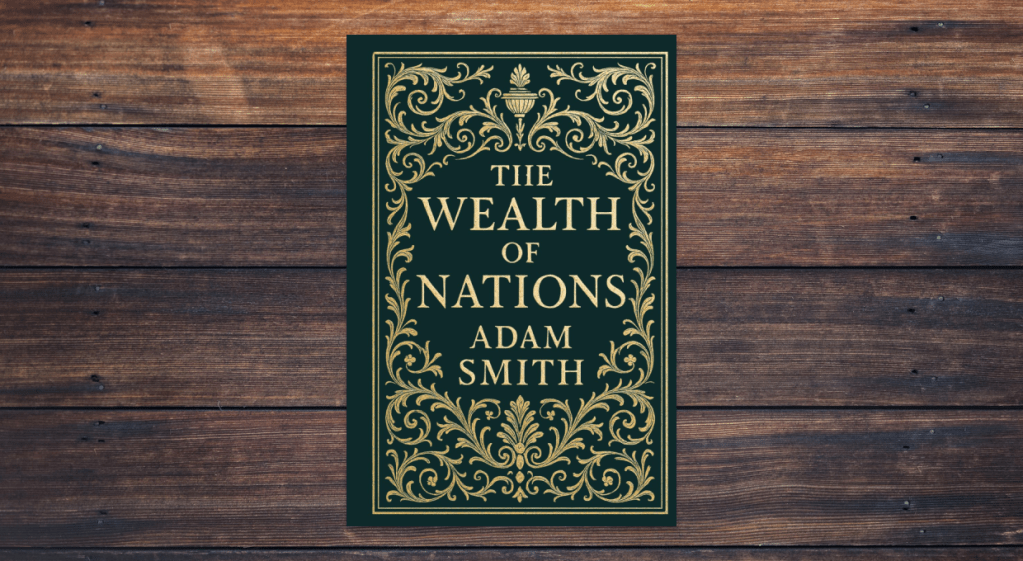
Few books on money have had the lasting impact of The Wealth of Nations. First published in 1776, this classic by Adam Smith remains one of the most influential works in economics. While it is not a quick or easy read, it continues to shape how investors, policymakers, and everyday people think about markets, trade, and wealth creation.
For readers looking to deepen their financial education, this book offers a long-term perspective that complements modern strategies like budgeting, index fund investing, and building financial independence.
Brief Summary
The Wealth of Nations is a deep exploration of how economies function. Smith examines how individuals pursuing their own interests can unintentionally benefit society as a whole. This idea, often summarized as the “invisible hand,” is one of the most widely discussed concepts in economic thought.
The book covers topics such as division of labor, productivity, free markets, taxation, and international trade. While written in the 18th century, many of its ideas still apply to modern capitalism and investing.
Who Is Adam Smith?
Adam Smith was a Scottish economist and philosopher, often referred to as the father of modern economics. He lived during the Enlightenment, a time when thinkers were challenging traditional ideas about government and society.
Smith was not just focused on money. He was deeply interested in human behavior, ethics, and how societies organize themselves. His earlier work, The Theory of Moral Sentiments, explored the psychological side of decision-making, something that remains highly relevant to personal finance today.
Lessons Readers Can Take Away
The Power of Specialization
Smith’s concept of the division of labor explains how productivity increases when people focus on specific tasks. This idea is visible everywhere today, from global supply chains to corporate structures.
For individuals, this reinforces the value of focusing on your strengths and earning power. Increasing income through specialization can be just as important as cutting expenses.
Markets Tend to Self-Regulate
The idea of the invisible hand suggests that free markets, when left largely alone, tend to allocate resources efficiently. While not perfect, this principle underpins modern investing strategies like buying the S&P 500 and letting the market work over time.
For long-term investors, this supports a passive approach rather than trying to outsmart the market.
Wealth Comes From Productivity, Not Just Money
Smith emphasized that a nation’s wealth is based on its ability to produce goods and services, not just accumulate gold or currency.
This aligns with modern investing. Real wealth is built through owning productive assets like businesses, which is exactly what index fund investing provides.
The Role of Government Should Be Limited but Important
Smith was not anti-government. He believed in roles such as national defense, justice systems, and public works. However, he warned against excessive intervention that distorts markets.
For readers, this highlights the importance of understanding how policy decisions, taxes, and regulations can affect investments and personal finances.
Criticisms of the Book
It Is Dense and Difficult to Read
One of the biggest challenges is simply getting through it. The writing style is outdated, and the book is long and repetitive at times.
For beginners looking to learn budgeting or basic financial literacy, this may not be the most practical starting point.
Some Ideas Are Over-Simplified
While the invisible hand is powerful, real-world markets are more complex. Issues like monopolies, inequality, and externalities are not fully addressed in ways that match today’s economy.
Modern readers should balance Smith’s ideas with newer perspectives.
Not a Personal Finance Guide
This is not a book about budgeting, saving, or choosing a financial advisor. It is a macro-level look at economies. Readers looking for actionable steps may find it lacking in practical advice.
Should You Buy This Book?
It depends on your goals.
If you are looking for:
- A deeper understanding of how money and markets work
- A historical foundation for modern investing ideas
- One of the most important books on money ever written
Then The Wealth of Nations is worth owning, even if you read it slowly over time.
If you are looking for:
- Simple budgeting strategies
- Step-by-step investing guidance
- Quick financial wins
You are better off starting with more modern, practical books before tackling this one.
Final Thoughts
The Wealth of Nations is not a casual read, but it is a foundational one. It explains why markets work the way they do and why long-term investing strategies, like owning the S&P 500, make sense.
For readers serious about financial independence and understanding money at a deeper level, this book provides context that modern finance books often assume but rarely explain.
It will not tell you how to build a budget or pick a savings account, but it will change how you think about wealth itself.











You must be logged in to post a comment.