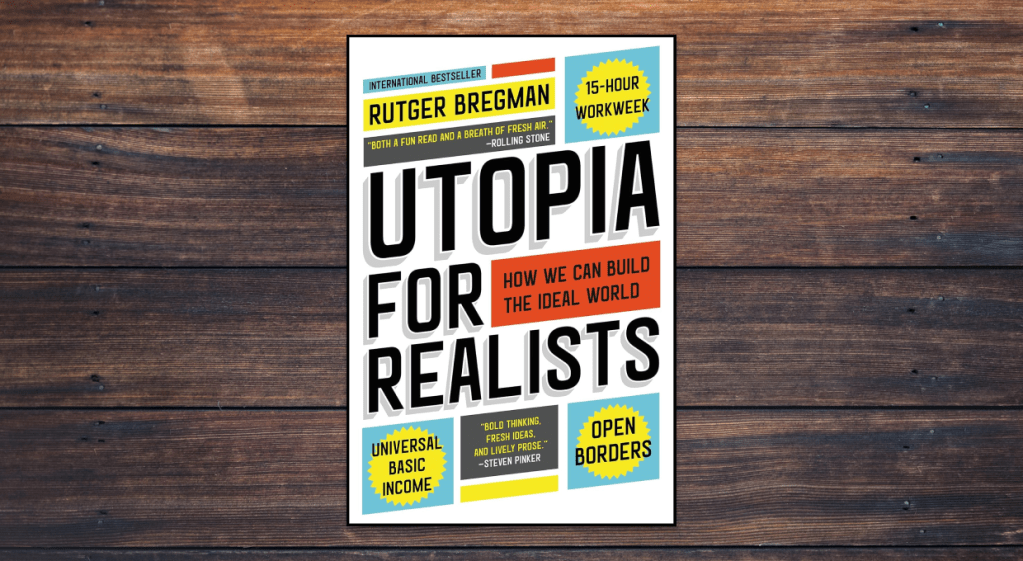
Every generation or so, a book comes along that takes ideas considered too radical for polite conversation and makes them feel not only reasonable but urgent. Utopia for Realists by Rutger Bregman is that kind of book. First published in Dutch in 2014 and translated into English in 2016, it became an international bestseller and thrust its young author into the kind of public debates that most academics only dream of entering. Whether you find yourself persuaded by its arguments or frustrated by them, it is a genuinely stimulating read that challenges some of the assumptions most of us carry about work, money, poverty, and what a well-functioning society could look like.
Who Is Rutger Bregman?
Rutger Bregman was born in 1988 in the Netherlands and studied history at Utrecht University and the University of California, Los Angeles. He is a journalist and author associated with De Correspondent, a Dutch online journalism platform focused on in-depth, ad-free reporting. He has written several books, but Utopia for Realists is by far his most widely read, having been translated into more than 30 languages.
Bregman became internationally famous in January 2019 when a video clip of his appearance at the World Economic Forum in Davos went viral. Speaking to a room full of some of the world’s wealthiest and most powerful people, he argued bluntly that the solution to inequality was higher taxes and that the assembled billionaires were avoiding that conversation. The clip was watched tens of millions of times and established him as one of the more provocative voices in contemporary debates about economics and social policy.
His subsequent book, Humankind, published in English in 2020, argued against the popular assumption that human beings are fundamentally selfish and violent, drawing on historical and social science research to make the case that people are more cooperative and decent than mainstream culture tends to assume. That optimism about human nature runs through Utopia for Realists as well.
What the Book Is About
Utopia for Realists is organized around three central proposals that Bregman argues are achievable with current levels of wealth and technology: a universal basic income, a 15-hour work week, and open borders.
The universal basic income, or UBI, is the book’s central and most developed argument. Bregman defines it as an unconditional cash payment made to every citizen regardless of employment status, income level, or behavior. No means testing, no bureaucratic gatekeeping, no strings attached. He argues that poverty is not primarily a behavioral problem requiring supervision and incentives to correct. It is a cash problem requiring cash to solve. He draws on a range of historical and contemporary experiments with guaranteed income, including programs in Namibia, Kenya, Canada, and the United States, to argue that simply giving poor people money produces better outcomes, across health, education, and employment, than the complex web of conditional welfare programs that most developed countries currently operate.
The 15-hour work week draws on a 1930 prediction by the economist John Maynard Keynes, who anticipated that rising productivity would eventually allow people in wealthy countries to work far less than they did in his time. Bregman argues that productivity gains have indeed materialized but that the benefits have been captured in consumption rather than leisure. He makes the case that shorter working hours would improve health, reduce carbon emissions, distribute paid work more equitably, and increase the time people have for family, community, and activities that are not captured in GDP but contribute enormously to human wellbeing.
Open borders is the book’s most provocative proposal. Bregman argues, drawing primarily on economic research, that allowing people to move freely between countries would be one of the most powerful poverty-reduction tools available, potentially doubling world GDP by allowing labor to move to where it is most productive. He acknowledges this is politically the most difficult of his three proposals and spends relatively less time on it than on UBI.
Lessons Readers Can Take Away
The most valuable lesson in Utopia for Realists is not any of its specific policy proposals. It is the invitation to examine the assumptions that make certain ideas feel impossible before you have actually evaluated the evidence for or against them.
Bregman is at his best when he documents the history of guaranteed income experiments and the politics that buried them. The results of those experiments were generally more positive than critics predicted and more encouraging than the public was ever told. The story of how a Nixon-era UBI proposal came within a few votes of passing the United States Senate, only to be derailed by cherry-picked research and political maneuvering, is genuinely illuminating. It demonstrates how ideas get dismissed not because the evidence is against them but because the political and economic incentives favor dismissal.
For personal finance readers, the book offers a useful provocation around the relationship between time and money. The standard assumption in American financial culture is that maximizing income is the primary goal, and that time is a resource to be converted into money as efficiently as possible. Bregman’s chapter on the 15-hour work week invites a different question: at what point does additional income stop producing meaningful improvements in wellbeing, and what would it look like to optimize for time and autonomy instead? That is a question with real practical implications for anyone thinking about financial independence, early retirement, or how to structure a working life around genuine priorities rather than default assumptions.
His discussion of poverty as a scarcity of cash rather than a scarcity of character is also worth sitting with. Research on the cognitive effects of financial scarcity, much of it drawn from the work of economists Sendhil Mullainathan and Eldar Shafir, shows that poverty itself impairs decision-making in ways that look like character flaws from the outside but are actually predictable responses to resource constraints. Understanding that dynamic produces more accurate thinking about financial behavior, both your own and other people’s.
Criticisms of the Book
Utopia for Realists has been praised widely, but it has attracted substantive criticisms that a fair review cannot ignore.
The most persistent criticism is that Bregman selects his evidence enthusiastically. The guaranteed income experiments he cites were often small in scale, short in duration, and conducted under conditions that may not generalize to a universal, permanent program. Critics argue that the behavioral and economic effects of a truly universal basic income, one large enough to replace existing safety net programs at national scale, remain genuinely unknown, and that Bregman presents the available evidence with more confidence than it warrants.
The open borders proposal, while backed by serious economic research on labor mobility and productivity, is presented with relatively little engagement with the legitimate concerns about wage effects on low-skill native workers, the political sustainability of welfare states under conditions of high immigration, and the social cohesion challenges that rapid demographic change can create. These are not fringe objections. They are raised by mainstream economists and social scientists across the ideological spectrum, and the book’s treatment of them is thinner than its treatment of UBI.
A second criticism is stylistic. Bregman is a gifted popularizer and his prose is energetic and accessible, but the book occasionally crosses from persuasive writing into advocacy in ways that sacrifice nuance for momentum. Readers looking for a balanced survey of the evidence on any of his three proposals will need to supplement this book with other sources.
A third criticism, more philosophical, is that the book’s optimism about human nature and the tractability of social problems places it squarely in what Thomas Sowell would call the unconstrained vision, the belief that with the right policies and the right information, human welfare can be dramatically improved by deliberate design. Readers who have spent time with Sowell’s A Conflict of Visions or Basic Economics will recognize the pattern and may find Bregman’s confidence in top-down solutions less convincing than he intends.
None of these criticisms make the book not worth reading. They make it worth reading critically.
Should You Buy This Book?
Yes, particularly if your usual reading leans toward traditional personal finance and free-market economics.
Utopia for Realists is valuable not because every argument in it is correct but because it forces you to examine assumptions that most personal finance content leaves completely unquestioned. The assumption that more work is always better. The assumption that poverty reflects individual failure. The assumption that the current structure of the labor market is natural rather than historically contingent. Engaging seriously with a book that challenges those assumptions, even if you ultimately reject its conclusions, makes you a more rigorous thinker about money and economic life.
It is also a fast read. Bregman writes with energy and clarity, and the book moves quickly through its arguments without the academic pacing of heavier works. You can read it in a weekend and come away with a head full of questions worth spending much longer thinking through.
Pair it with Basic Economics by Thomas Sowell for a genuinely productive intellectual tension. Sowell and Bregman represent nearly opposite ends of the spectrum on questions of human nature, government intervention, and economic design. Reading both does more for your economic thinking than reading either one alone.
Final Thoughts
Utopia for Realists is a book about what is possible, written by someone who genuinely believes the gap between what we have and what we could have is smaller than most people assume. That optimism is both its greatest strength and its greatest vulnerability. It energizes the argument and makes the book a pleasure to read, but it also leads Bregman to present contested evidence more conclusively than the research supports.
What the book gets unambiguously right is its insistence that the ideas we treat as radical today were often the common sense of a previous era, and that the ideas we treat as obvious today will likely look differently to future generations. That is a useful corrective to intellectual complacency in any domain, including personal finance.
The readers who will get the most out of this book are those willing to hold its proposals at arm’s length, neither dismissing them reflexively nor accepting them uncritically. Read it alongside Thinking, Fast and Slow by Daniel Kahneman for the behavioral economics context, alongside The Worldly Philosophers by Robert Heilbroner for the historical sweep, and alongside Sowell for the counterargument. Taken together, that reading list will give you a genuinely three-dimensional picture of how economies work, why they sometimes fail, and what it might look like to imagine them differently.





 Winchell House
You must be logged in to post a comment.