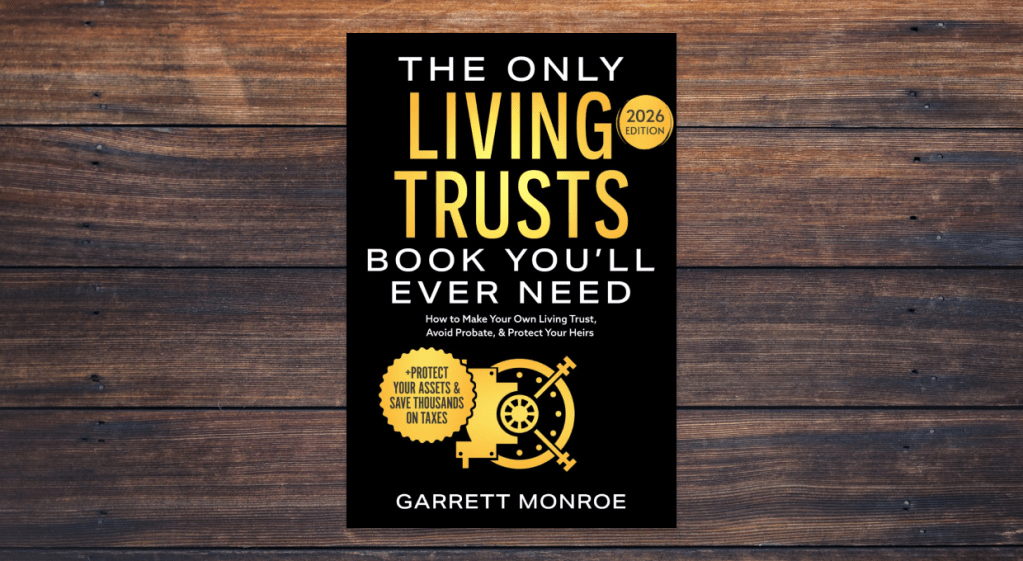
Estate planning is one of those financial topics that most people know they should deal with and almost nobody wants to think about. It involves confronting mortality, navigating legal complexity, and making decisions whose consequences you will never personally witness. The result is that millions of Americans put it off indefinitely, leaving their families exposed to probate courts, unnecessary taxes, and family disputes that could have been avoided with a relatively modest amount of planning. The Only Living Trusts Book You’ll Ever Need: How to Make Your Own Living Trust, Avoid Probate & Protect Your Heirs by Garrett Monroe positions itself as the accessible, jargon-free guide that finally makes this topic approachable for ordinary people. The question worth asking before you buy it is whether it actually delivers on that promise.
Who Is Garrett Monroe?
Garrett Monroe is a pen name used by a self-publishing author or author collective that produces personal finance and legal self-help books aimed at general readers. Monroe’s titles follow a recognizable pattern, covering topics like wills, trusts, and estate planning in a straightforward, accessible style designed to demystify legal processes for people who cannot afford or do not wish to hire professionals for every step of their financial planning.
It is worth being transparent about what this means for the reader. Monroe is not a credentialed attorney with a documented professional biography in the way that, say, an estate planning lawyer turned author would be. The books published under this name are practical guides written for a popular audience, not legal treatises authored by a recognized expert in the field. That does not automatically disqualify the content, but it is relevant context for evaluating how much weight to give the advice and where the book’s limitations are likely to appear.
What the Book Is About
The core subject of this book is the revocable living trust, one of the most commonly recommended tools in basic estate planning. A living trust is a legal arrangement in which you transfer ownership of your assets into a trust during your lifetime, name yourself as the trustee, and designate a successor trustee to manage and distribute those assets after your death or incapacitation. Because the assets technically belong to the trust rather than to you as an individual, they pass directly to your beneficiaries without going through probate, the court-supervised process of validating a will and distributing an estate.
The book walks readers through the mechanics of setting up a living trust, explaining what a trust document needs to contain, how to fund the trust by transferring assets into it, the difference between a living trust and a will, and the roles of trustee, successor trustee, and beneficiary. It also covers related documents that typically accompany a living trust, including a pour-over will, a durable power of attorney, and a healthcare directive.
The tone throughout is conversational and reassuring. Monroe’s evident goal is to make the reader feel that this is manageable territory rather than an impenetrable thicket of legal complexity. For the most part, the book succeeds at that tonal goal.
Lessons Readers Can Take Away
The most valuable lesson in this book is simply that probate is worth avoiding and that a living trust is one of the most reliable ways to do it. Probate is a public process, meaning your assets and the terms of your estate become part of the court record. It is also slow, often taking six months to two years to complete depending on the state and the complexity of the estate. And it is expensive, with court fees, executor fees, and attorney fees routinely consuming two to five percent of the gross estate value. A well-funded living trust sidesteps all of that, transferring assets to beneficiaries privately, quickly, and without court involvement.
This lesson has direct and practical financial implications. For anyone who has spent years building a nest egg through consistent S&P 500 investing, maximizing contributions to retirement accounts, and maintaining disciplined savings habits, allowing a significant portion of that wealth to be consumed by probate costs and delays is an avoidable loss. Estate planning is not just for the wealthy. It is for anyone who has accumulated meaningful assets and wants those assets to reach the people they care about efficiently.
A second lesson is about the difference between a will and a living trust, which Monroe explains clearly and usefully. Many people assume that having a will means their estate avoids probate. It does not. A will must be probated to have legal effect. A living trust, by contrast, operates outside the probate process entirely. Understanding this distinction changes how you think about what a complete estate plan actually requires.
A third lesson involves the importance of funding the trust, which Monroe correctly identifies as the step that most people get wrong. Creating a trust document is only part of the process. The trust does nothing for assets that were never transferred into it. If you set up a living trust but forget to retitle your bank accounts, investment accounts, and real estate in the name of the trust, those assets will still go through probate. The book provides practical guidance on what funding involves and why it cannot be skipped.
A fourth lesson concerns incapacity planning. A living trust is not just a death planning tool. Because you name a successor trustee, that person can step in and manage your affairs if you become incapacitated due to illness or injury, without the need for a court-appointed conservatorship. For anyone who has watched a family navigate the guardianship or conservatorship process, the value of having that succession clearly established in advance is immediately obvious.
Criticisms of the Book
The book has meaningful limitations that any prospective reader should understand before relying on it.
The most significant is the authorial credibility question raised above. Estate planning law is state-specific in important ways. Rules about trust formation, asset titling, spousal rights, Medicaid planning, and tax treatment vary considerably from state to state. A guide written for a general national audience will necessarily smooth over those variations in ways that could lead a reader to make incorrect assumptions about the rules that apply in their particular state. Monroe acknowledges in general terms that readers should consult a local attorney, but the acknowledgment can feel perfunctory given how state-dependent the details actually are.
A second criticism is that the book’s coverage of tax planning is limited. For estates that may be subject to federal estate taxes, which as of 2024 applies to estates above approximately $13.6 million per individual, a living trust alone is not a sufficient planning tool. More sophisticated strategies, including irrevocable trusts, charitable remainder trusts, and family limited partnerships, are mentioned but not meaningfully addressed. Readers with larger or more complex estates will find the book insufficient for their needs.
A third criticism is that the book is better at explaining what a living trust is and why you might want one than at providing truly actionable step-by-step guidance for creating one. The title promises readers they can make their own living trust, and the book provides useful conceptual grounding, but readers hoping for a document template they can complete and sign will find that the actual drafting of legal documents requires more than this book supplies. For that, they will still need either a licensed estate planning attorney or a reputable legal document service.
A fourth criticism is that the book, like many self-published personal finance titles, has not undergone the rigorous editorial and fact-checking process that traditionally published books receive. Some readers have noted minor inconsistencies and areas where the guidance could be more precise.
Should You Buy This Book?
Yes, with clear expectations about what it is and what it is not.
If you are starting from zero knowledge about living trusts and estate planning, this book is a genuinely useful primer. It will give you a working understanding of what a living trust is, why it matters, how it differs from a will, and what the process of setting one up involves. That foundation will make any subsequent conversation with an estate planning attorney significantly more productive, because you will arrive with a conceptual framework rather than starting from scratch.
What this book should not be is your only resource or your final step. Estate planning is one area of personal finance where the consequences of getting it wrong can be severe and irreversible, and those consequences fall not on you but on the people you care about most. After reading this book, the appropriate next step for most people is to consult a licensed estate planning attorney in their state, at least for the initial drafting and review of their documents. Many attorneys offer flat-fee estate planning packages that are more affordable than people assume, often in the range of $1,000 to $2,500 for a complete basic estate plan.
For the price of the book, which is modest, it represents good value as an educational starting point. Just do not mistake the starting point for the destination.
Final Thoughts
The Only Living Trusts Book You’ll Ever Need does something genuinely useful: it makes an intimidating subject feel approachable and gives readers enough of a foundation to start taking estate planning seriously. That alone puts it ahead of the alternative, which for most people is doing nothing at all.
The broader lesson here is one that applies across personal finance. The goal of financial self-education is not to replace professionals but to become a better-informed client when you do engage them. Reading about living trusts, just as reading about investing or tax strategy, helps you ask better questions, understand the answers you receive, and make decisions that reflect your actual priorities rather than defaulting to whatever is easiest or most familiar.
Books like The Intelligent Investor by Benjamin Graham and I Will Teach You to Be Rich by Ramit Sethi address the wealth-building side of personal finance with clarity and rigor. Monroe’s book addresses what happens to that wealth after you are gone. Both halves of that equation matter. Building a nest egg through decades of disciplined S&P 500 investing is a meaningful achievement. Making sure it reaches the people you intend it to reach, efficiently and without unnecessary loss to courts and fees, is the part of the plan that too many people leave unfinished. Don’t not leave it unfinished.



 Winchell House
You must be logged in to post a comment.