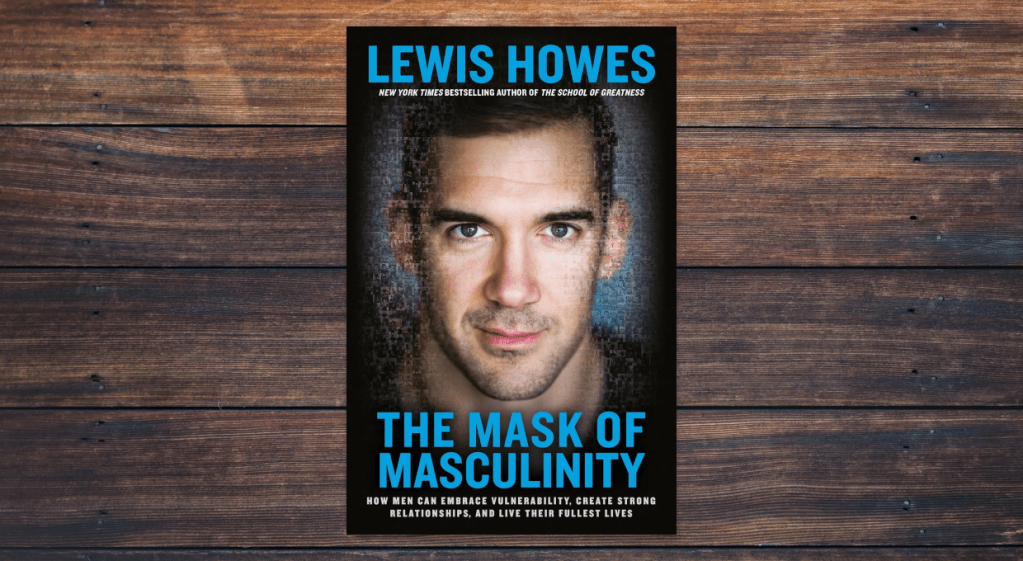
Personal finance books rarely ask men to examine their emotional lives. The genre tends to stay in safer territory: budgeting frameworks, investment strategies, debt payoff plans, and the mechanics of building wealth. But the relationship between money and psychology runs deeper than most financial advice acknowledges, and the patterns of behavior that drive financial self-destruction, the compulsive spending on status symbols, the avoidance of vulnerability that makes asking for help impossible, the need to project success rather than build it, are often rooted in exactly the kind of emotional suppression that Lewis Howes addresses in The Mask of Masculinity, published in 2017. This is not primarily a personal finance book. But for any man trying to understand why he makes the financial decisions he does, it has more to offer than most books that are.
Who Is Lewis Howes?
Lewis Howes was born in 1983 in Delaware, Ohio, and grew up in a household shaped by the conventional expectations of American masculinity: be tough, do not show weakness, earn respect through strength and achievement. He was a two-sport collegiate athlete, played professional arena football, and built a career as an entrepreneur, podcaster, and author after an injury ended his athletic ambitions.
His podcast, The School of Greatness, launched in 2013 and became one of the most downloaded podcasts in the world, known for long-form interviews with athletes, entrepreneurs, and thought leaders. He is the author of several books, including The School of Greatness published in 2015 and The Greatness Mindset published in 2023. The Mask of Masculinity sits between those two works chronologically and thematically, representing his most direct engagement with the emotional and psychological costs of the masculine identity he was raised to perform.
What gives the book its credibility is the personal nature of its disclosures. Howes writes candidly about his own experience of sexual abuse as a child, about the emotional shutdown that followed, and about the long process of recognizing how the masks he wore as protection had become obstacles to genuine connection, professional fulfillment, and personal happiness. He is not writing from a position of having all the answers. He is writing as someone who did the difficult work and wants to describe what he found.
What the Book Is About
The central argument of The Mask of Masculinity is that most men in American culture are taught, explicitly and implicitly, to suppress emotions, project strength, and define their worth through external achievement. These lessons are transmitted through families, schools, sports culture, and media, and they produce a set of behavioral patterns that Howes organizes into nine distinct masks: the stoic mask, the athlete mask, the material mask, the sexual mask, the aggressive mask, the joker mask, the invincible mask, the know-it-all mask, and the alpha mask.
Each mask represents a way of managing the fear of vulnerability by presenting a curated version of strength to the world. The material mask, for instance, is the identity built around wealth, possessions, and financial success as a proxy for self-worth. The stoic mask is the refusal to acknowledge emotional pain or ask for help. The invincible mask is the belief that needing anything from anyone is a form of weakness. The know-it-all mask is the compulsive need to project expertise and certainty even in the absence of either.
For each mask, Howes describes its origins, its costs, and what genuine strength looks like in its absence. He draws on interviews with athletes, veterans, therapists, and other men who have done the work of examining their emotional conditioning, and he uses his own story as a through-line that keeps the book grounded in personal experience rather than abstract prescription.
The book is not anti-masculine. Howes is careful to distinguish between the performance of masculinity, which he argues is costly and ultimately hollow, and genuine strength, which he defines as the capacity for vulnerability, emotional honesty, and authentic connection. His argument is that the masks men wear in pursuit of conventional masculine identity actually undermine the qualities they are meant to project.
Lessons Readers Can Take Away
The most directly relevant lesson for personal finance readers is the chapter on the material mask, which Howes defines as the use of money, possessions, and visible wealth as a primary source of identity and self-worth. This is one of the most financially destructive patterns in American consumer culture, and it operates largely below the level of conscious awareness for the men who are caught in it.
The man who buys a car he cannot afford because it signals success to his peers, the man who overspends on clothing, watches, and gadgets as a way of managing feelings of inadequacy, the man who takes on debt to maintain a lifestyle that projects wealth rather than builds it, is wearing the material mask. He is spending money not on things he genuinely values but on the image of himself he needs others to see. Understanding the psychological mechanism behind that spending is the first step toward changing it, and no budgeting app will address the root cause on its own.
A second lesson concerns the stoic mask and its relationship to financial help-seeking. One of the most reliable predictors of poor financial outcomes is the refusal to ask for help, whether from a financial advisor, a credit counselor, or simply a more financially knowledgeable friend. The cultural message that men should figure things out on their own, that asking for help is a form of weakness, keeps enormous numbers of men stuck in financial situations they could resolve relatively quickly with outside guidance. Howes makes a compelling case that the capacity to ask for help is a form of strength, not a surrender of it.
A third lesson involves the relationship between unresolved emotional pain and compulsive behavior. Howes draws on research and personal testimony to argue that many of the behaviors associated with financial self-destruction, compulsive spending, gambling, substance use, risk-taking for its own sake, are at least partly driven by emotional pain that has never been processed. The man who spends compulsively is often not making a rational economic decision gone wrong. He is managing feelings he was never taught to acknowledge. Addressing those feelings directly is the intervention that changes the behavior.
A fourth lesson is about the alpha mask and its relationship to financial competition. The need to win, to be on top, and to measure self-worth through comparison to other men drives a great deal of financially counterproductive behavior, from keeping up with peers’ consumption to taking excessive investment risks to prove capability. Howes argues that genuine confidence does not require external validation or comparative dominance, and that men who define their success by their position relative to others are on a treadmill that no amount of money ever fully resolves.
Criticisms of the Book
The Mask of Masculinity is a sincere and emotionally honest book, but it has meaningful limitations.
The most common criticism is that the book covers familiar territory without always adding significantly to what earlier and more rigorously researched works have established. Books like Iron John by Robert Bly, The Will to Change by bell hooks, and Real Boys by William Pollack addressed the psychology of masculine emotional suppression with greater depth and theoretical rigor than Howes brings to the subject. Readers familiar with that literature will find much of the ground here already covered.
A second criticism is that the book’s framework of nine masks, while accessible and memorable, can feel schematic in a way that oversimplifies the complexity of individual psychology. Real people do not map cleanly onto single mask types, and the chapter-by-chapter structure, one mask per chapter, sometimes produces a formulaic quality where each section follows a similar arc of definition, personal anecdote, interview excerpt, and prescription.
A third criticism concerns the depth of engagement with structural factors. Howes focuses primarily on individual psychology and personal transformation, which makes the book actionable but underweights the degree to which masculine emotional conditioning is reinforced by institutional and cultural structures that individual insight alone cannot change. The social pressures that drive men toward the material mask, for example, are not simply the product of personal belief systems. They are embedded in advertising, media, and workplace culture in ways that personal development work can mitigate but not eliminate.
A fourth criticism is that the book’s prescriptions, while sensible, are easier to endorse in principle than to implement in practice. Telling men to be vulnerable, seek therapy, and build authentic relationships is good advice. Translating that advice into specific behavioral change against decades of contrary conditioning requires more scaffolding than the book provides.
Should You Buy This Book?
Yes, particularly for men who are beginning to notice the gap between their outer presentation and their inner experience, and for anyone, regardless of gender, who wants to understand the psychological drivers behind financially self-destructive behavior.
The Mask of Masculinity is not a technically demanding read and does not require prior familiarity with psychology or personal development literature. It is accessible, personal, and structured around the kind of concrete archetypes that make self-recognition easy. Many readers will find themselves identified in multiple chapters, which is precisely the point.
For financial purposes specifically, the chapter on the material mask alone is worth the price of the book. The connection between masculine identity performance and financial behavior is one that almost no personal finance book addresses directly, and Howes makes it vivid and recognizable in a way that more clinical treatments of the same dynamic typically do not.
Pair it with The Psychology of Money by Morgan Housel for the financial behavior layer, and with Thinking, Fast and Slow by Daniel Kahneman for the cognitive science layer. Together, these three books give you a substantially more complete picture of why financial decisions go wrong than any of them provides on its own.
Final Thoughts
The Mask of Masculinity makes a point that personal finance education largely ignores: the numbers are rarely the real problem. The spreadsheet is not where financial self-destruction begins. It begins in the story a person tells about what money means, what it proves, and what happens to their sense of self when they do not have enough of it. For men raised in a culture that equates financial success with masculine identity, that story is particularly powerful and particularly costly.
Howes does not offer a complete solution to that problem. The book is too personal and too general to serve as a therapeutic roadmap, and its prescriptions are more motivational than operational. But it does something important: it names the masks clearly enough that men can recognize them in their own behavior, and it makes a credible case that taking them off is not a loss of identity but a recovery of one.
The financial implications of that recovery are significant. The man who no longer needs to project wealth to feel worthy of respect spends differently. The man who can ask for help without shame invests more wisely and recovers from financial mistakes faster. The man who has done enough inner work to know the difference between what he genuinely values and what he has been conditioned to perform has a meaningful advantage in every financial decision he will ever make.
That is not a small thing. Books like The Total Money Makeover by Dave Ramsey and I Will Teach You to Be Rich by Ramit Sethi provide the tactical framework for building financial stability. The Mask of Masculinity addresses the psychological foundation those tactics have to rest on. Both halves matter, and the second half gets far less attention than it deserves.











You must be logged in to post a comment.