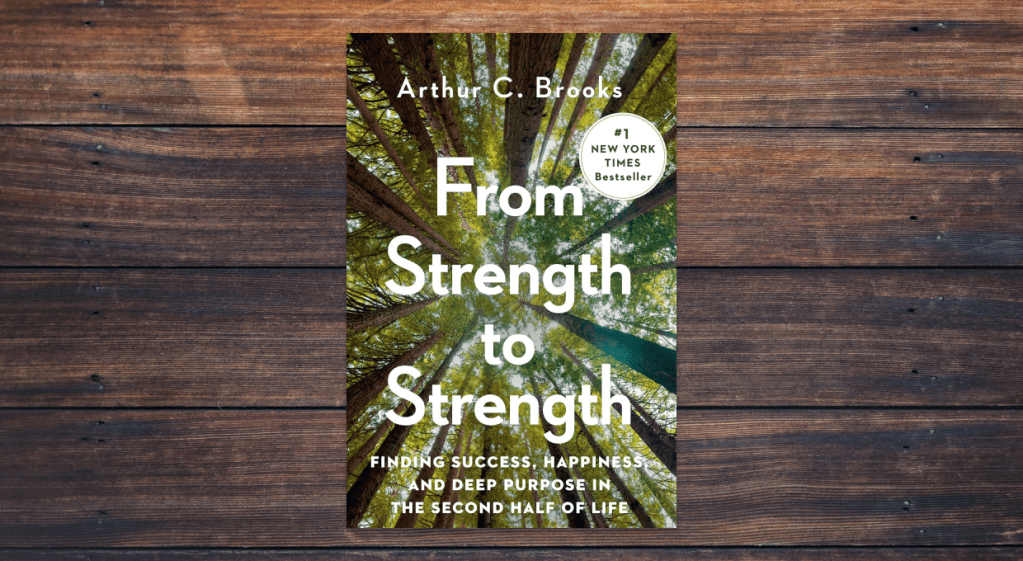
There is a particular kind of dread that high achievers rarely talk about openly. It is the creeping awareness, usually arriving sometime in the late forties or early fifties, that the skills and drive that produced success in the first half of life are beginning to fade. The career trajectory that once felt like an upward line starts to flatten or reverse. The recognition that once came easily becomes harder to earn. The question that follows, one that most ambitious people are entirely unprepared for, is what now. From Strength to Strength: Finding Success, Happiness, and Deep Purpose in the Second Half of Life by Arthur C. Brooks is written directly for that moment. It is a thoughtful, personally honest, and occasionally challenging book about how to age well and live meaningfully when the version of yourself you built your identity around starts to change.
Who Is Arthur C. Brooks?
Arthur C. Brooks was born in 1964 in Seattle, Washington. He trained as a classical musician, playing French horn professionally for the City Orchestra of Barcelona in his twenties before returning to academia. He earned a PhD in policy analysis from the Pardee RAND Graduate School and built a distinguished career as a social scientist, author, and public intellectual.
He served as president of the American Enterprise Institute, a prominent conservative think tank in Washington DC, from 2009 to 2019, a tenure during which he became one of the more visible and widely respected figures in American policy circles. He has written twelve books covering topics ranging from the economics of philanthropy to the relationship between free markets and human flourishing. His columns for The Atlantic, where he writes a regular series on happiness and human flourishing, have reached millions of readers and established him as one of the most thoughtful voices in the growing field of happiness research applied to everyday life.
He is currently a professor at Harvard Business School and Harvard Kennedy School, where he teaches courses on leadership and happiness. From Strength to Strength, published in 2022, draws on his own experience of navigating the transition from peak career performance to a different and, he argues, potentially richer form of contribution.
What the Book Is About
The central argument of From Strength to Strength is built around a distinction between two types of intelligence that the psychologist Raymond Cattell identified in the mid-twentieth century. Fluid intelligence is the ability to reason quickly, solve novel problems, and process new information rapidly. It peaks early, often in the late twenties or early thirties for most people, and declines steadily thereafter. Crystallized intelligence is the accumulated wisdom, pattern recognition, and deep knowledge that comes from decades of experience. It continues to grow well into old age.
Brooks argues that most high achievers build their identities and their careers almost entirely around fluid intelligence. When that begins to decline, as it inevitably does for everyone, they experience what he describes as a second-curve problem. The skills that produced their success are diminishing, but they have not developed the alternative strengths that could produce a different and potentially deeper form of success in the second half of life. The result is a kind of professional and existential crisis that Brooks calls the striver’s curse.
The book draws on a wide range of sources including neuroscience, psychology, sociology, economics, and ancient religious and philosophical traditions to argue that the path through this transition requires several things: detaching identity from worldly achievement, investing more deeply in relationships, developing a spiritual practice or philosophical framework that provides meaning beyond professional success, and redirecting from the accumulation of external recognition toward the transmission of wisdom and the deepening of genuine connection.
Brooks is candid throughout about his own experience of this transition and about the ways in which he has found some of these prescriptions easier to accept intellectually than to practice emotionally.
Lessons Readers Can Take Away
The most immediately applicable lesson for anyone thinking about money and long-term planning is the connection between how you define success and how you allocate your time and resources. Brooks makes a compelling case that the standard achievement orientation, working harder and longer to accumulate more recognition, money, and status, produces diminishing returns and eventually serious suffering in the second half of life. The person who has organized their entire existence around professional peak performance is in a genuinely vulnerable position when that performance inevitably peaks.
For financial independence readers specifically, this argument has a sharp relevance. The goal of financial independence is often framed as the freedom to stop working. But Brooks is asking a harder question: what do you actually want the second half of your life to look like, and are you building toward that now? Financial security is necessary but not sufficient for a meaningful later life. The emotional and relational infrastructure required for happiness in the second half needs to be built during the first, and most high earners neglect that construction entirely while focused on financial accumulation.
A second lesson concerns the value of relationships relative to achievement. Brooks draws extensively on the Harvard Study of Adult Development, one of the longest running studies of human happiness, which has consistently found that the quality of close relationships is the single strongest predictor of wellbeing in later life. More than income, more than professional success, more than health status, the people who age most happily are those with deep, maintained, reciprocal relationships. The person who sacrificed friendships and family connection on the altar of career advancement has made a trade that looks increasingly bad in retrospect as they age.
A third lesson is about what Brooks calls the idolatry of success. Drawing on religious and philosophical traditions ranging from the Psalms to the Bhagavad Gita to the writings of Thomas Aquinas, he argues that the suffering of high achievers in the second half of life is not primarily a practical problem to be solved with better life planning. It is a spiritual problem rooted in having attached ultimate meaning to things that are inherently temporary. Whether or not a reader shares any of the religious frameworks Brooks draws on, the underlying psychological observation is sound and supported by considerable secular research.
A fourth practical lesson is about the value of mentorship and teaching as a second-curve contribution. Brooks argues that the transition from fluid intelligence to crystallized intelligence points toward a natural reorientation from doing to teaching, from accumulating recognition to transmitting wisdom. Many of the most fulfilled people in the second half of life are those who have made that transition deliberately, finding meaning in helping others navigate paths they have already traveled.
Criticisms of the Book
From Strength to Strength has been widely praised, but it has attracted several legitimate criticisms worth examining.
The most common is that the book is written for a very specific audience and does not adequately acknowledge that limitation. Brooks is primarily addressing highly educated, financially successful, professionally accomplished people who are experiencing the specific anxiety of watching their peak performance decline. For the large majority of people who never achieved the kind of career prominence Brooks describes, the book’s central problem simply does not apply in the same way. A reader who spent their working life in a job rather than a calling, who never experienced a period of exceptional professional recognition to mourn the passing of, will find the book’s emotional terrain somewhat foreign.
A second criticism is that the book’s prescriptions, investing in relationships, developing a spiritual practice, redirecting from achievement to wisdom transmission, are easier to articulate than to implement, and the book does not engage deeply with the structural and psychological barriers to making those changes. Telling a driven, achievement-oriented person to simply value relationships more is not actionable advice. The mechanics of how to actually make that shift are underexplored.
A third criticism is that the book sometimes moves too quickly between scientific findings and large philosophical conclusions. Brooks is clearly well-read in both happiness research and religious philosophy, but the connections he draws between the two are sometimes more rhetorical than rigorous. A reader with a strong social science background may find some of the leaps from data to prescription unconvincing.
A fourth criticism is that the book’s spiritual recommendations, which are genuinely central to Brooks’ argument rather than peripheral to it, may not land for secular readers. He is honest about his own Catholic faith and its role in his thinking, but the book aims to be accessible across faith traditions. Some readers will find that ambition successfully achieved; others will find the religious framing more of an obstacle than an invitation.
Should You Buy This Book?
Yes, with a clear sense of who will get the most from it.
From Strength to Strength is most valuable for readers who are in or approaching the transition it describes, roughly forty-five to sixty, professionally accomplished, financially stable, and beginning to sense that the framework that organized the first half of their lives is becoming insufficient for the second. For that reader, the book can be genuinely clarifying and even therapeutic.
It is also worth reading for younger readers who are in the wealth-building phase of their financial lives, not because the midlife transition is their immediate concern but because the decisions made in the thirties and early forties about how to allocate time and energy between professional achievement and relational investment have consequences that compound over decades. Understanding what the second half of life demands before you arrive there is considerably more useful than understanding it after.
It pairs naturally with The Psychology of Money by Morgan Housel, which addresses the relationship between money and a meaningful life with similar intellectual honesty. Die With Zero by Bill Perkins, which is reviewed separately on this site, covers adjacent territory from a more explicitly financial angle and makes a good companion read.
At its length the book can be finished in a few sittings and the ideas it contains reward reflection for considerably longer than it takes to read.
Final Thoughts
Arthur Brooks wrote From Strength to Strength partly as a letter to his future self, a set of instructions for navigating a transition he could see coming and wanted to prepare for honestly. That personal stake gives the book a quality of genuine engagement that distinguishes it from most books in the happiness and life philosophy genre, which tend to be written from a position of having figured things out rather than from the middle of figuring them out.
The financial implications of the book’s argument are real and worth taking seriously. Building financial security is a necessary foundation for a good later life. But it is not the same thing as building a good later life. The people who arrive at financial independence with strong relationships, a sense of purpose that extends beyond their professional identity, and a framework for finding meaning in the ordinary dimensions of human experience are in a categorically better position than those who arrive with financial security alone.
That broader preparation, for a life rather than just a retirement account, is what From Strength to Strength is ultimately about. It is a book that asks whether you are building the right things, and it asks that question with enough warmth, intellectual seriousness, and personal honesty that most readers will find the asking genuinely useful regardless of the answer they arrive at.











You must be logged in to post a comment.