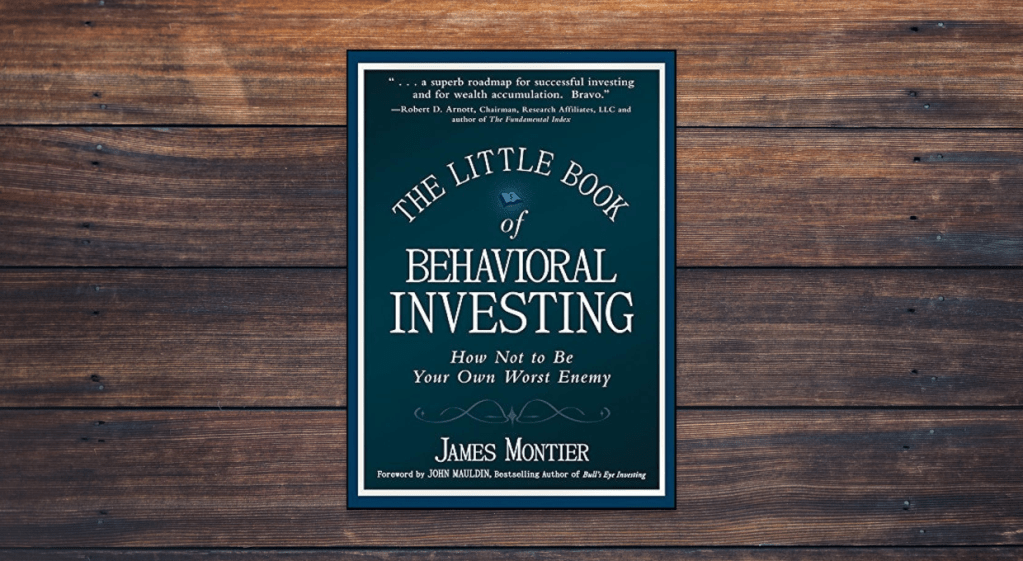
Knowing what you should do and actually doing it are two different things. This gap between knowledge and behavior sits at the heart of The Little Book of Behavioral Investing: How Not to Be Your Own Worst Enemy by James Montier, published in 2010. Where most investing books focus on how to find good investments, Montier focuses on a prior and arguably more important question: why do investors so consistently destroy the returns of their own good ideas through the decisions they make while managing those ideas? The answer he develops across this compact and rigorous book is that the enemy is not the market, not the competition, and not bad luck. It is the investor’s own psychology, operating in ways that are predictable, documentable, and at least partially manageable if you understand the mechanisms well enough to build defenses against them.
Who Is James Montier?
James Montier is a British economist, strategist, and behavioral finance researcher whose work has earned him a devoted following among institutional investors and serious individual investors alike. He studied economics at the University of Durham and holds a master’s degree from Exeter University. He built his professional reputation as a global equity strategist at Dresdner Kleinwort and later at Société Générale, where his research reports on behavioral investing were among the most widely read and cited in the institutional investment community.
He is currently a member of the asset allocation team at GMO, the Boston-based investment management firm founded by Jeremy Grantham and known for its long-term value orientation, its skepticism of market efficiency in all conditions, and its willingness to take contrarian positions based on rigorous valuation analysis. The intellectual culture at GMO aligns naturally with Montier’s commitment to evidence-based investing and his deep skepticism of the confident narratives that drive most market activity.
Montier has written several books on behavioral finance, including the longer and more technical Behavioural Investing, which covers similar territory in considerably greater depth. His Atlantic-crossing research has influenced how many professional investors think about portfolio construction, risk management, and the relationship between psychological biases and investment outcomes. He is one of the clearest and most substantive voices working at the intersection of academic behavioral finance and practical investment management.
What the Book Is About
The Little Book of Behavioral Investing is structured as a systematic tour through the major psychological biases that damage investment returns, organized around the framework of how they arise, how they manifest in practice, and what investors can do to limit their influence. The book’s subtitle, How Not to Be Your Own Worst Enemy, captures its practical orientation precisely. Montier is not primarily interested in identifying market inefficiencies that clever investors can exploit. He is interested in helping investors stop doing the things that reliably hurt them.
The biases Montier examines include overconfidence and the illusion of knowledge, the tendency for investors to believe their forecasts are more accurate than they actually are; inattentional blindness, the remarkable human capacity to miss important information that is directly in front of us when we are focused on something else; the inside view versus the outside view, the preference for building detailed models of specific situations over using base rates and historical averages that would produce more accurate predictions; empathy gaps, the inability to predict how we will feel and behave in emotionally charged situations before we are actually in them; self-attribution bias, the tendency to attribute success to our own skill and failure to external bad luck; confirmation bias, the systematic preference for information that supports our existing views; the endowment effect, the tendency to overvalue what we already own simply because we own it; and social influences, the powerful pull of consensus opinion and herd behavior on individual judgment.
Each chapter examines one or two related biases in depth, drawing on academic research, market data, and specific historical examples to illustrate how the bias operates and what it costs investors who are subject to it. The prose is direct and the examples are specific enough to be genuinely illuminating rather than vaguely cautionary.
Lessons Readers Can Take Away
The most immediately applicable lesson for any investor is what Montier calls the curse of knowledge and its relationship to overconfidence. The research he reviews shows, with a consistency that should be deeply uncomfortable for anyone who has strong views about individual stocks, that professional analysts and portfolio managers with access to enormous amounts of information, sophisticated models, and decades of experience are not reliably better than simple statistical benchmarks at predicting which stocks will outperform. In many cases they perform worse. Adding more information and more analysis to an already well-researched view does not improve accuracy in the way that intuition suggests it should. It improves confidence without improving outcomes, which is a particularly dangerous combination.
For individual investors, this finding argues directly for the kind of systematic, rules-based, broadly diversified investment approach that does not require accurate forecasting. Consistent contributions to a low-cost S&P 500 index fund are not exciting and do not generate interesting dinner party conversation, but they sidestep the overconfidence trap entirely by removing the need for a predictive view about individual securities or market timing.
A second lesson involves what Montier calls the inside view problem, drawing on work by the psychologist Philip Tetlock and the earlier research of Kahneman and Tversky. When investors evaluate a specific investment opportunity they almost universally focus on the specifics of that particular situation, building detailed models and narratives about why this company, sector, or trade is different from others. What they rarely do is consult the base rate: how often do investments with these characteristics actually perform as hoped? When you take the outside view and examine what actually happens to companies that match the profile of your investment idea, the results are almost always more sobering than the inside narrative suggests. Montier is persuasive that this discipline, asking what base rates say before constructing a specific case, would prevent a significant proportion of poor investment decisions.
A third lesson is about the empathy gap and its implications for investment risk tolerance. Montier reviews research showing that investors systematically underestimate how differently they will feel and behave when markets are falling sharply versus when markets are rising. In a rising market most investors feel confident about their risk tolerance and their ability to hold positions through downturns. When an actual sharp decline arrives, the emotional experience of watching portfolio values fall is sufficiently distressing that many investors sell, converting paper losses into realized ones, at exactly the worst possible moment. The structural solution is to set asset allocations during calm periods based on honest self-assessment and written investment policy statements, and to commit in advance to not deviating from them in response to market movements.
A fourth lesson concerns the endowment effect and the asymmetric way investors treat positions they already hold versus investments they are considering. Research shows that investors require substantially higher expected returns to buy a new position than they would accept for the equivalent risk if they already held the position. This asymmetry means that investors hold losing positions longer than they should, because selling would require acknowledging a loss, and hesitate on attractive new opportunities because the required justification for buying is higher than the required justification for holding. Recognizing this asymmetry does not eliminate it but creates a useful check: when evaluating whether to hold a current position, ask whether you would buy it today at the current price, knowing what you know, if you did not already own it.
Criticisms of the Book
The most significant criticism of The Little Book of Behavioral Investing mirrors the criticism directed at the behavioral finance field more broadly: it is considerably more effective at diagnosing problems than at prescribing solutions. Montier documents the biases clearly and persuasively. The practical guidance on how to restructure your investment process to mitigate them is less specific and less operational than a reader hoping for a complete framework will find satisfying.
A second criticism is that the book, like all entries in the Little Book series, sacrifices depth for accessibility. Montier’s longer work covers much of the same territory with greater rigor, more research citations, and more specific application to portfolio construction. Readers who find this book valuable should be aware that it is an introduction to a body of thinking rather than a comprehensive treatment of it.
A third criticism is that some of the research Montier cites has faced replication challenges in the years since the book was published. The behavioral finance literature has expanded considerably since 2010, and some of the findings that seemed robust at the time have held up better than others. A reader who wants to engage seriously with the current state of the field will need to go beyond a book published fifteen years ago.
A fourth criticism is that the book’s practical prescriptions, while sensible, tend toward the same general conclusions regardless of which specific bias is being addressed: use checklists, adopt systematic processes, consult base rates, and reduce the influence of in-the-moment emotion on investment decisions. That consistency is not wrong, but it can make the book feel somewhat repetitive in its later chapters, as different biases lead to similar structural remedies.
Should You Buy This Book?
Yes, with particular enthusiasm for investors who have already developed a basic investment strategy and want to understand the psychological forces that will work against them in executing it consistently over time.
The book is short, reads quickly, and covers material that most personal finance education completely ignores. The standard financial literacy curriculum addresses budgeting, debt management, asset allocation, and tax-advantaged accounts. It rarely addresses the question of why people with all of that knowledge still sell during market crashes, chase recent performance, hold losers too long, and make confident predictions about specific investments that turn out to be wrong at rates far above what chance would explain.
The Little Book of Behavioral Investing fills that gap. It is most valuable when read in conjunction with books that address both the theoretical framework and the practical investment strategy side of the picture. Thinking, Fast and Slow by Daniel Kahneman provides the most comprehensive and rigorously researched account of the cognitive architecture underlying the biases Montier describes. A Random Walk Down Wall Street by Burton Malkiel explains why those biases are so costly in market contexts. Thinking in Bets by Annie Duke, reviewed on this site, addresses decision quality under uncertainty with complementary insights. And Atomic Habits by James Clear provides the behavioral change framework for actually building the systematic processes Montier recommends.
Final Thoughts
James Montier’s contribution in The Little Book of Behavioral Investing is essentially this: the most important work in investing is not finding good ideas. Most investors who fail do not fail for lack of good ideas. They fail because they cannot manage their own psychological responses to the inevitable uncertainty, volatility, and social pressure that accompany any investment over its holding period. The good idea gets abandoned during a drawdown. The good strategy gets second-guessed when the crowd is doing something different. The systematic process gets overridden by a confident narrative that feels compelling in the moment.
Understanding the specific mechanisms by which those failures occur is genuinely useful, not because reading about overconfidence makes you immune to it, but because it enables you to build investment processes that are less dependent on your ability to overcome it in real time. The checklist that forces you to consult base rates before acting on a conviction. The written investment policy that commits you to maintaining your asset allocation through market downturns. The automatic contribution schedule that removes the decision of when and how much to invest from the domain of in-the-moment judgment. These structural solutions do not require you to be a better or more rational person than you are. They require you to acknowledge honestly what you are and design your investment process accordingly.
That is practical wisdom, and it is what this small book delivers more effectively than its size might suggest.









 Winchell House
You must be logged in to post a comment.