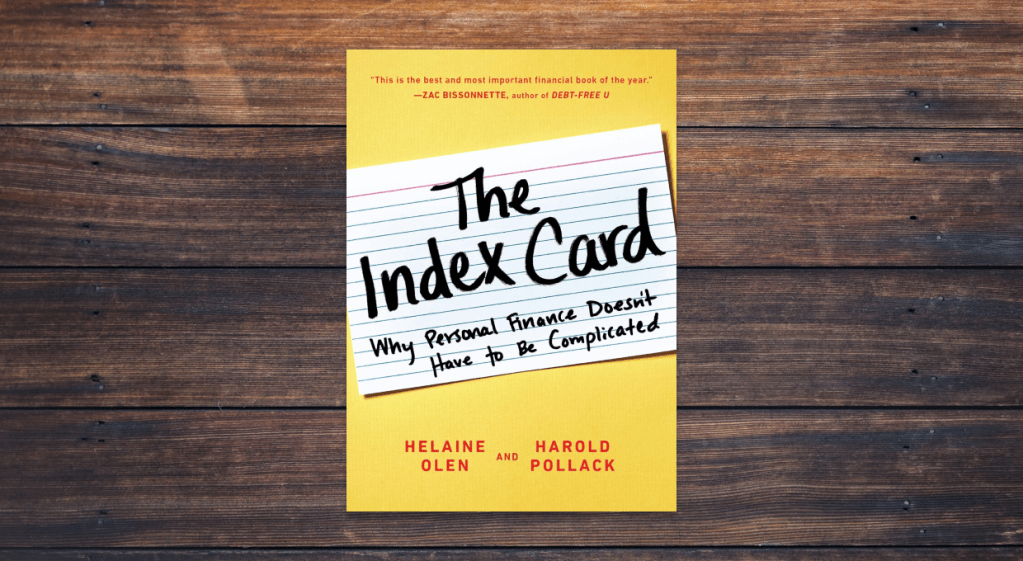
The premise of The Index Card: Why Personal Finance Doesn’t Have to Be Complicated sounds almost too good to be true. In 2013, University of Chicago professor Harold Pollack scribbled a handful of financial rules on a 4×6 index card during an interview and posted a photo of it online. The response was immediate and overwhelming. The card went viral because it captured something that the personal finance industry has a structural interest in obscuring: the core of sound financial management fits on an index card, and the complexity of the industry that has grown up around it is largely not in your interest. The book that followed, co-written with journalist Helaine Olen and published in 2016, expands on those rules with the context, explanation, and practical detail that an index card cannot provide. The result is one of the most genuinely useful introductions to personal finance available to American readers.
Who Are Helaine Olen and Harold Pollack?
Helaine Olen is a journalist, author, and commentator who has spent much of her career examining the personal finance industry with a critical eye that distinguishes her work from most of what the genre produces. She is a contributing writer at The Washington Post and has written for publications including The Atlantic, Slate, The Guardian, and many others. Her previous book, Pound Foolish: Exposing the Dark Side of the Personal Finance Industry, published in 2012, was a rigorous and deeply reported critique of the financial advice business, examining how celebrity financial advisors, investment products, and the broader personal finance media complex often serve their own commercial interests at the expense of the people they claim to help. That skeptical, consumer-protective orientation runs throughout The Index Card and gives it an intellectual honesty that sets it apart from books that are effectively advertisements for financial products dressed up as advice.
Harold Pollack is the Helen Ross Professor at the Crown Family School of Social Work, Policy, and Practice at the University of Chicago, where his research focuses on poverty, public health, mental health policy, and the intersection of social policy and health outcomes. He is not primarily a personal finance expert, which is precisely what makes his original index card so compelling. He arrived at the rules it contained not by working in the financial industry but by thinking carefully about what ordinary people actually need to know to achieve financial security, stripped of the complexity and the product recommendations that financial professionals have an interest in adding. His outsider’s clarity is one of the book’s genuine assets.
What the Book Is About
The Index Card organizes itself around the rules from Pollack’s original card, expanding each one into a full chapter that provides the context, evidence, and practical implementation guidance that the card’s brevity necessarily left out. The rules covered include saving ten percent or more of your income, paying off your credit card balance every month, buying inexpensive well-diversified index funds, never buying or selling individual stocks, building an emergency fund before investing, getting the insurance coverage you need and nothing more, contributing to tax-advantaged retirement accounts, taking advantage of employer matches on retirement contributions, paying your financial advisor with fees not commissions, promoting social insurance programs, and treating financial advisors as fiduciaries.
The organizing philosophy of the book is that personal finance is not complicated in the way that the industry presents it as being. The basic moves that produce long-term financial security are few in number, well-established by evidence, and accessible to anyone who commits to them consistently. The complexity that surrounds personal finance is largely generated by financial product manufacturers, commissioned salespeople, and media personalities who profit from the appearance of sophistication and the anxiety it produces in ordinary savers and investors.
Olen and Pollack write with a combination of warmth and intellectual rigor that makes the book both accessible and trustworthy. They acknowledge the genuine difficulty of executing simple financial rules in the face of real-world pressures, stagnant wages, housing costs, healthcare expenses, and the psychological and social forces that make saving difficult, without using those difficulties as excuses or dismissing the structural barriers that make financial security genuinely harder for some people than others.
Lessons Readers Can Take Away
The most immediately actionable lesson in the book is the case for index fund investing, which Olen and Pollack present with clarity and conviction. The chapter on why you should buy inexpensive well-diversified index funds and never buy individual stocks explains the evidence in terms that require no prior financial knowledge. Actively managed funds charge higher fees. Those fees reduce returns. The majority of actively managed funds underperform their benchmark index over long periods after fees. The mathematics of this is not a matter of debate among serious researchers. Low-cost index funds tracking the S&P 500 or the total stock market represent the single most reliable path to long-term wealth accumulation available to ordinary investors, and the simplicity of that approach is a feature rather than a limitation.
Another lesson is about the true cost of financial advice that is not provided on a fiduciary basis. The distinction between a fiduciary financial advisor, who is legally obligated to act in your interest, and a broker or commissioned salesperson, who is obligated only to recommend products that are suitable rather than optimal, is one that most people who use financial advisors do not understand. Olen and Pollack explain it clearly and draw out the practical implication: financial products recommended by commissioned salespeople are products that earn the salesperson a commission, and the fee structure of financial services means that the products generating the highest commissions are not typically the ones that best serve the buyer. Understanding this distinction is worth money over the course of a lifetime.
A third lesson concerns the emergency fund and its priority relative to investing. Olen and Pollack are clear that before you begin investing in the stock market you need a financial cushion that can absorb unexpected expenses without forcing you to sell investments at a bad time or take on high-interest debt. A high-yield savings account holding three to six months of essential expenses is the standard recommendation, and the book explains why this particular sequence, emergency fund first, then investment contributions, is the right order of operations rather than a postponement of real wealth building.
A fourth lesson involves employer-sponsored retirement accounts and the absolute priority of capturing any available employer match. The employer match on a 401k contribution is the closest thing to a guaranteed return available to most workers, because it represents an immediate one hundred percent return on the matched portion of the contribution before any market performance is considered. The book is emphatic that leaving an employer match uncaptured is one of the most straightforward and most common financial mistakes ordinary workers make, and that correcting it should be among the first priorities of anyone who has not already done so.
Criticisms of the Book
The most common criticism of The Index Card is that its simplicity, which is also its greatest strength, can leave some readers wanting more depth and more specificity. The rules on the card are correct, but real financial lives are complicated by circumstances that a chapter-length expansion of a card rule cannot fully address. Readers dealing with student loan debt and competing financial priorities, with variable income, with significant medical expenses, or with complex tax situations will find the book’s guidance useful as a starting orientation but insufficient as a complete decision framework.
A second criticism is that some of the book’s framing, particularly its consistent skepticism toward the financial industry, can occasionally tip into a one-note register that paints the industry with too broad a brush. Not every financial advisor is a commissioned salesperson whose interests conflict with yours, and the book’s treatment of financial professionals, while broadly accurate at the population level, could be more nuanced about how to identify the genuinely useful advisors from the problematic ones.
A third criticism is that the book’s chapter on promoting social insurance programs feels somewhat out of place in what is otherwise a practical personal finance guide. Olen and Pollack are clearly committed to a view that individual financial security cannot be fully separated from the policy environment that shapes it, which is a legitimate and important perspective. But readers who pick up the book for personal finance guidance may find that particular chapter a departure from the practical territory they came for.
A fourth criticism is currency. Published in 2016, the book has not been updated, and some of the specific product recommendations and platform references are dated. The principles remain sound but some of the tactical details around where to open accounts and which providers to use would benefit from a current revision.
Should You Buy This Book?
Yes, without significant hesitation, for almost any reader who has not yet established the foundational habits of sound personal finance.
The Index Card is one of the best entry-level personal finance books available to American readers. It is short, readable, intellectually honest, and structured around evidence rather than product recommendations or ideological commitments. The combination of Olen’s journalistic skepticism and Pollack’s policy researcher’s clarity produces a book that is both accessible and trustworthy in a genre where trustworthiness is not always the dominant characteristic.
It pairs naturally with The Automatic Millionaire by David Bach, reviewed on this site, which provides a detailed look at the mechanics of automating savings and investment contributions. The Simple Path to Wealth by JL Collins, also reviewed here, develops the index fund investing case in greater depth for readers who want a more complete treatment. The Psychology of Money by Morgan Housel addresses the behavioral and psychological dimension of why executing simple financial rules is harder than it sounds.
For readers who have already established their core financial habits and are looking for more sophisticated guidance on portfolio construction, tax strategy, or retirement planning, the book will cover ground that is already familiar. But as an introduction and a reality check it has few equals.
Final Thoughts
Harold Pollack scribbled those rules on an index card because someone asked him, in the context of a conversation about poverty and public health, what ordinary people actually need to know about personal finance. His answer, the product of careful thinking rather than industry expertise, turned out to resonate with millions of people precisely because it was not produced by someone with a financial product to sell.
That origin story is worth keeping in mind when evaluating the book that followed. The Index Card is not a sophisticated investment manual. It is not a guide to building a multi-million dollar portfolio through clever asset selection or tax optimization strategies. It is a clear, honest, consumer-protective guide to the foundational financial behaviors that, practiced consistently over time, produce security and independence for ordinary people regardless of where they start.
The financial services industry is large, complicated, and frequently profitable at the expense of the people it serves. The rules on Pollack’s card are not complicated, and they are not profitable for anyone in that industry. They are profitable for you, and that is the point. Understanding why those simple rules work, and committing to them with the same consistency you bring to any other important long-term project in your life, is what this book is designed to help you do. Most personal finance books promise more than they deliver. This one delivers more than it promises.









 Winchell House
You must be logged in to post a comment.