
Burton Malkiel is one of the most consequential figures in the history of American investing, not because he managed a famous fund or built a financial empire, but because he wrote a book that changed how millions of ordinary people think about the stock market. His argument, that most investors would be better served by buying a low-cost index fund than by trying to pick winning stocks or hire active managers to do it for them, was considered controversial when he first made it in 1973. Decades of evidence have since proven him right, and the index fund revolution that now moves trillions of dollars has his intellectual fingerprints all over it.
Early Life and Education
Burton Gordon Malkiel was born on August 28, 1932, in Boston, Massachusetts. He grew up during the Great Depression and World War II, a formative backdrop for anyone who would spend their career thinking seriously about risk, markets, and the limits of human prediction.
He earned his bachelor’s degree from Harvard College in 1953 and went on to complete his MBA and PhD in economics from Princeton University. Princeton would become the central institution of his academic life, and he would return there as a professor and eventually as the Chemical Bank Chairman’s Professor of Economics, a position he held for decades before being named professor emeritus.
Career in Academia and Finance
Malkiel’s career has always operated on two tracks simultaneously: rigorous academic economics and practical engagement with the financial world. That combination, the willingness to bring serious research to bear on questions that actually matter to ordinary investors, is what distinguishes his work from most academic economics.
He served as a member of the President’s Council of Economic Advisers under President Gerald Ford from 1975 to 1977, bringing his perspective on markets and monetary policy directly into the policy arena. He served as dean of the Yale School of Management from 1981 to 1988, one of the most prominent business school leadership roles in the country. He also served on the board of directors of several major corporations and financial institutions, including Vanguard, the index fund company whose philosophy aligns most closely with the investment approach Malkiel has spent his career advocating.
His association with Vanguard is particularly significant. John Bogle, the founder of Vanguard and the creator of the first index mutual fund available to individual investors, and Malkiel were intellectual allies whose work reinforced each other. Bogle built the institutional apparatus to make low-cost index investing accessible to ordinary Americans. Malkiel provided much of the theoretical and empirical foundation that explained why it worked.
Later in his career Malkiel also served as chief investment officer of Wealthfront, a robo-advisory firm, demonstrating a genuine commitment to applying his investment principles in modern technological contexts rather than simply theorizing about them from a distance.
A Random Walk Down Wall Street
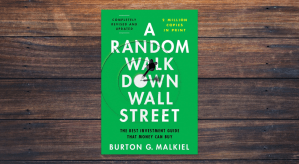
Malkiel’s most important and most widely read work is A Random Walk Down Wall Street, first published in 1973 and now in its thirteenth edition. It is one of the few investment books that can genuinely claim to have changed the world in a measurable way, and it remains as relevant today as it was when it first appeared.
The title comes from the random walk hypothesis, a concept from mathematics describing a path in which each step is independent of the ones before it. Applied to financial markets, the hypothesis holds that stock prices incorporate all available information so rapidly and so completely that future price movements cannot be reliably predicted from past ones. If that is true, and Malkiel argues at length that it largely is, then the entire enterprise of stock picking and market timing is a losing game after costs.
The book covers a sweep of financial history including some of the most famous speculative manias on record, from the Dutch tulip bulb craze of the seventeenth century to the dot-com bubble, making the case that intelligent people have always been capable of convincing themselves that this time is different. It explains the theoretical underpinnings of market efficiency, evaluates the evidence for and against both technical and fundamental analysis, and arrives at a practical conclusion that remains the book’s most lasting contribution: most investors should buy and hold a diversified, low-cost index fund and ignore the noise.
Over its fifty-plus year publishing history, A Random Walk Down Wall Street has been updated through multiple market cycles including the 1987 crash, the dot-com collapse, the 2008 financial crisis, and the COVID-19 market disruption. In each case the evidence has reinforced rather than undermined the book’s central argument.
Investment Philosophy
Malkiel’s investment philosophy can be summarized in a handful of principles that he has articulated consistently across decades of writing, teaching, and public commentary.
The first is that markets are largely efficient. Not perfectly efficient, not efficient in every corner at every moment, but efficient enough that the average investor cannot expect to consistently identify and profit from mispriced securities after accounting for the costs of attempting to do so. This is not a statement about market perfection. It is a practical observation about the extraordinary difficulty of beating a market composed of millions of sophisticated participants all trying to do the same thing.
The second is that investment costs matter enormously over long periods. The difference between a fund that charges one percent annually and one that charges a tenth of a percent looks trivial in any given year. Compounded over thirty years of saving and investing, it translates into a substantial reduction in ending wealth. Minimizing fees is one of the few investment decisions that reliably and predictably improves long-term outcomes.
The third is that diversification reduces risk without necessarily reducing returns. Holding a broadly diversified portfolio, across asset classes, geographies, and sectors, smooths out the volatility associated with any individual holding without giving up the long-term growth that equity markets have historically provided.
The fourth is that most investors should keep their strategy simple. Regular contributions to a low-cost index fund, maintained through market cycles without constant adjustments in response to short-term news or performance, is not a concession to mediocrity. It is the approach that the evidence most consistently supports.
Influence and Legacy
The practical influence of Malkiel’s work is difficult to overstate. The index fund industry, which now accounts for the majority of assets in American equity mutual funds, rests in significant part on the intellectual foundation that A Random Walk Down Wall Street helped establish. The tens of millions of Americans who invest through low-cost index funds in their 401k plans and IRAs are, in a meaningful sense, beneficiaries of his arguments.
His work has influenced generations of economists, financial journalists, and investment professionals. It is regularly assigned in university finance courses and remains a standard reference for anyone trying to understand why passive investing has so thoroughly outperformed the active management industry over long periods.
Beyond the index fund argument, Malkiel’s contribution to financial literacy more broadly has been substantial. He has spent fifty years explaining difficult ideas in accessible language, engaging with evidence honestly, and maintaining intellectual consistency even when the consensus view ran against him. That combination of rigor and accessibility is rarer in financial writing than it should be.
Other Written Work
Beyond A Random Walk Down Wall Street, Malkiel has authored several other books worth noting. The Inflation Beater’s Investment Guide, published in 1980, addressed investment strategy during the high-inflation environment of that era. Global Bargain Hunting, co-authored with J.P. Morgan, examined international investing opportunities in emerging markets. The Elements of Investing, co-authored with Charles Ellis and published in 2009, distills the case for simple, low-cost, long-term investing into an accessible and concise format that is particularly useful for readers who want the essential argument without the full apparatus of A Random Walk Down Wall Street.
Where to Start
For readers new to Malkiel’s work, A Random Walk Down Wall Street is the natural starting point, and the most current edition is the right one to buy since each revision updates the evidence and engages with new market developments. The core argument has not changed across editions because the evidence supporting it has continued to accumulate, but the later editions are more comprehensive and more current in their examples.
The Elements of Investing, co-authored with Charles Ellis, whose own book Winning the Loser’s Game is reviewed on this site, is a useful companion for readers who want a shorter and more distilled version of the same principles.
Malkiel’s work pairs naturally with The Little Book of Common Sense Investing by John Bogle and Stay the Course, also by Bogle, both reviewed on this site. Together these books make the most comprehensive and most rigorously argued case for low-cost, broadly diversified, long-term index fund investing available in the accessible investment literature.









 Winchell House
You must be logged in to post a comment.