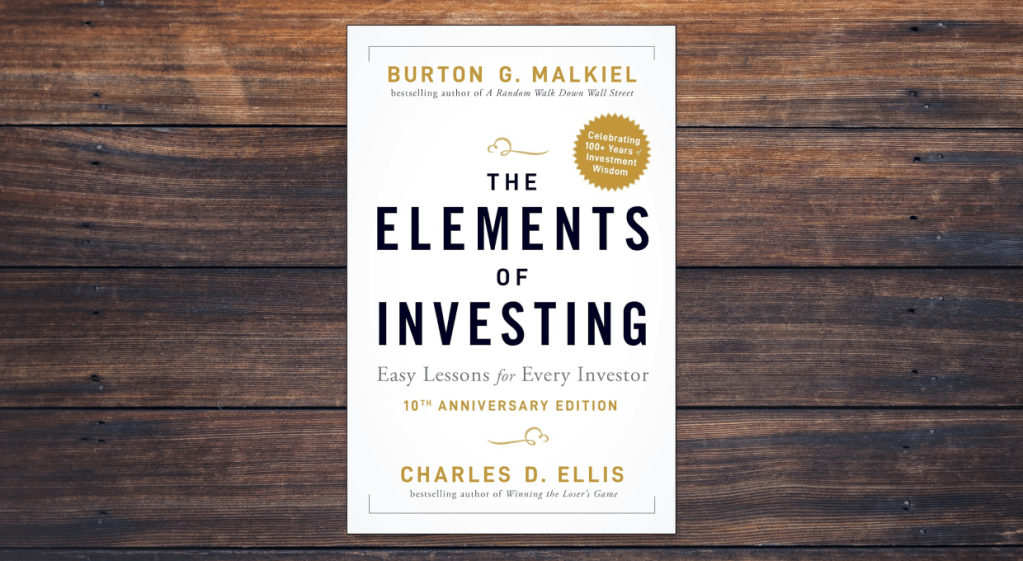
There is a version of investing advice that takes five hundred pages to deliver and a version that takes fifty. The Elements of Investing: Easy Lessons for Every Investor by Burton Malkiel and Charles Ellis belongs firmly to the second category, and it makes no apologies for that. Published in 2009 and updated in subsequent editions, it is a deliberately compact distillation of two careers spent studying what actually works for ordinary investors. Both authors have written longer and more comprehensive books on the same subject. This one exists because they recognized that most people will not read those books, and that the core of what matters can be said briefly without losing the substance. They are right on both counts.
Who Are Burton Malkiel and Charles Ellis?
Burton Malkiel is the Chemical Bank Chairman’s Professor of Economics Emeritus at Princeton University, where he spent the majority of his academic career. He earned his undergraduate degree from Harvard and his PhD from Princeton. He served on the President’s Council of Economic Advisers under President Gerald Ford and as dean of the Yale School of Management from 1981 to 1988. He is best known as the author of A Random Walk Down Wall Street, first published in 1973 and now in its thirteenth edition, which makes the case for low-cost index fund investing with more rigor and historical depth than almost any other book in the investment literature. He also served on the board of directors of Vanguard, the index fund company whose investment philosophy closely mirrors the principles he has spent his career advocating.
Charles Ellis was born on October 22, 1937, in Roxbury, Boston, Massachusetts. He attended Phillips Exeter Academy and then Yale College, where he earned a BA in art history in 1959. He graduated with distinction from Harvard Business School in 1963 and went on to earn a PhD from New York University. In 1972, Ellis founded Greenwich Associates, an international strategy consulting firm focused on financial institutions, which he led as managing partner for three decades. His article “The Loser’s Game,” published in 1975, won the investment profession’s Graham and Dodd Award and became the intellectual foundation for his most widely read book, Winning the Loser’s Game, which argues that active investing is a losing proposition for most investors after fees. He served as a director of the Vanguard Group from 2001 to 2009 and chaired the investment committee at Yale University alongside David Swensen. The CFA Institute recognized him as one of only twelve individuals honored for lifetime contributions to the investment profession.
Together, Malkiel and Ellis represent two of the most credentialed and most consistent advocates for passive, low-cost, long-term investing in the history of American finance. Their collaboration on this book is the natural meeting point of two parallel careers that arrived at the same conclusions by different routes.
What the Book Is About
The Elements of Investing is organized around a small number of principles that the authors argue are sufficient, if followed consistently, to produce better long-term outcomes than the vast majority of investors achieve in practice. The book is short by design, running to fewer than two hundred pages in most editions, and it moves through its material without extended digressions or the historical and theoretical scaffolding that characterizes the authors’ longer individual works.
The core argument will be familiar to anyone who has read either author separately but is presented here in its most distilled form. Markets are largely efficient. Most active managers underperform their benchmark indexes over long periods after fees. Investment costs compound over time into enormous differences in ending wealth. Diversification reduces risk without necessarily reducing returns. And the emotional and behavioral failures that lead investors to buy high and sell low are as damaging to long-term returns as the fees they pay. The solution to all of these problems is the same: buy low-cost, broadly diversified index funds, contribute to them regularly and automatically, rebalance occasionally, and do not sell in response to market volatility.
The book covers saving, diversification, index fund selection, rebalancing, and the behavioral discipline required to stay the course through market downturns. It also addresses tax efficiency and the role of tax-advantaged retirement accounts in a long-term investment strategy.
Lessons Readers Can Take Away
The most immediately actionable lesson in the book is the authors’ emphasis on saving rate as the foundation of everything else. Malkiel and Ellis argue with characteristic directness that investment returns matter but saving behavior matters more, especially in the early stages of wealth building. The investor who saves fifteen percent of their income and earns average market returns will accumulate far more wealth than the investor who saves five percent and earns above-average returns. That is a mathematical fact that most financial media, which focuses relentlessly on investment selection and market performance, consistently obscures.
The practical implication is that before worrying about which funds to buy, what your asset allocation should be, or how to respond to current market conditions, the most important financial decision you can make is to automate a meaningful savings rate and resist reducing it when other spending pressures arise. High-yield savings accounts and automatic contribution schedules are not merely convenient. They are structurally important mechanisms for removing savings decisions from the domain of willpower and placing them in the domain of system.
A second lesson concerns the compounding cost of investment fees, which both authors treat as one of the most important and most underappreciated factors in long-term outcomes. The arithmetic is relentless: a fund charging one percent annually versus one charging a tenth of a percent appears to differ by only nine-tenths of a percentage point in any given year. Over forty years of saving and investing, the difference in ending wealth is substantial, because every dollar paid in fees is a dollar that does not compound for the remainder of the investment horizon. The authors are explicit that this mathematics makes low-cost index funds the rational default choice for most investors regardless of market conditions.
A third lesson concerns rebalancing, which the authors present as one of the few investment behaviors that genuinely adds value without requiring any predictive skill. A portfolio that begins at a target allocation will drift as different asset classes perform differently over time. Returning periodically to the original allocation forces the investor to sell what has risen and buy what has fallen, which is the opposite of what emotional impulse recommends but precisely what evidence-based investing supports.
A fourth lesson addresses the behavioral gap between investment returns and investor returns, which both authors identify as one of the most financially consequential and least discussed phenomena in personal finance. The average investor earns substantially less than the funds they own because they buy after prices have risen and sell after they have fallen. Eliminating that behavioral error through systematic, automatic investment strategies is not merely psychologically beneficial. It is financially decisive.
Criticisms of the Book
The most consistent criticism of The Elements of Investing is its brevity. The book covers its subject at a level of generality that some readers find insufficient. The authors acknowledge that real financial lives involve complications that a book of this scope cannot fully address, but they do not always provide clear guidance for readers dealing with student loan debt, variable income, or complex tax situations. The framework is sound but the application requires supplementary reading.
A second criticism is that the book covers ground both authors have addressed more thoroughly elsewhere. Readers who have already worked through A Random Walk Down Wall Street or Winning the Loser’s Game will find little that is new. The value of The Elements of Investing is its accessibility and concision rather than its originality, which makes it a better starting point for new readers than a meaningful addition to the library of experienced ones.
A third criticism is that some specific guidance, particularly around asset allocation and the role of bonds, reflects assumptions that have been challenged by both the extended low-rate environment following 2008 and the sharp rate increases that followed in 2022. The underlying principles remain sound, but some of the specific numbers in earlier editions aged less gracefully than the core argument.
A fourth criticism is that the book does not engage seriously with behavioral finance beyond acknowledging that emotional mistakes are costly. Readers who want a deeper understanding of why investors behave badly and what structural changes can help are better served by Thinking, Fast and Slow by Daniel Kahneman or the behavioral investing books of James Montier, both reviewed on this site.
Should You Buy This Book?
Yes, particularly for readers who are new to investing or who want the essential argument for index fund investing in the most compact and accessible format available.
The Elements of Investing does what it sets out to do: it takes two careers’ worth of investment wisdom and compresses it into a format that almost anyone will finish in a single sitting. The core principles it covers, save consistently, minimize costs, diversify broadly, rebalance systematically, and stay the course through market volatility, are sufficient to produce excellent long-term outcomes for the vast majority of investors.
For readers who want more depth, A Random Walk Down Wall Street by Malkiel and Winning the Loser’s Game by Ellis are the natural next steps. The Little Book of Common Sense Investing and Stay the Course by John Bogle, both reviewed on this site, make the same essential argument from a different perspective and complement this book well.
The book is short, inexpensive, and widely available. The investment of time and money is minimal relative to what it offers.
Final Thoughts
Malkiel and Ellis wrote The Elements of Investing because they believed that the most important things to know about investing are not complicated, and that the proliferation of complex financial products and sophisticated-sounding strategies has created a misleading impression that good investing requires expertise that ordinary people do not possess. Their book is an argument against that impression, made by two people who have spent their careers accumulating precisely that expertise and who have concluded that most of it is not what matters.
What matters, they argue, is simple: spend less than you earn, save the difference automatically, put it in low-cost broadly diversified index funds, avoid high fees, avoid emotional decisions in response to market movements, and give the whole thing enough time to compound. That is not a sophisticated strategy. It is, however, the strategy that the evidence most consistently supports, and it is the strategy that this short, honest, and well-argued book exists to recommend.









 Winchell House
You must be logged in to post a comment.