
Arthur C. Brooks is a Harvard professor, social scientist, and bestselling author who has spent the past two decades studying one of the most searched and least understood topics in human life: happiness. His work sits at the intersection of hard social science, practical philosophy, and personal development, and it has reached millions of readers through his books, his column in The Atlantic, and his courses at Harvard. For anyone interested in the relationship between money, success, and genuine wellbeing, Brooks is one of the most intellectually serious and practically useful voices available.
Early Life and an Unconventional Path
Arthur C. Brooks was born on May 21, 1964, in Spokane, Washington, and grew up in Seattle. His path to becoming one of America’s leading social scientists and public intellectuals is among the more unconventional in recent academic life.
He left college at nineteen to pursue a career as a professional French horn musician, spending years performing and recording in the United States and Spain, including time with the City Orchestra of Barcelona. He was a working classical musician for roughly twelve years before academic ambitions reasserted themselves. While still performing, he returned to school in his late twenties and earned a bachelor’s degree in economics through distance learning from Thomas Edison State College.
At thirty-one he left music entirely, earning an MPhil and PhD in policy analysis from the RAND Graduate School in Santa Monica, California, while simultaneously working as a military operations research analyst for the RAND Corporation’s Project Air Force. That combination of artistic immersion, rigorous quantitative training, and practical policy research is visible throughout his writing, which moves fluidly between empirical research, philosophical tradition, and personal narrative.
Academic Career and AEI
After completing his doctorate in 1998, Brooks began his academic career as an assistant professor of public administration and economics at Georgia State University. He later moved to Syracuse University’s Maxwell School of Citizenship and Public Affairs, where he rose to full professor and held the Louis A. Bantle Chair in Business and Government. During his decade in academia he published sixty peer-reviewed articles and several books, establishing himself as a serious researcher before becoming a prominent public voice.
In 2009, Brooks became the eleventh president of the American Enterprise Institute, one of the most influential policy think tanks in Washington DC. He served in that role for ten years, during which time the institution significantly expanded its revenue, deepened its research portfolio, and broadened its public profile. Under his leadership AEI expanded its work on poverty, happiness, and human potential, topics that reflected his own intellectual evolution during that period. He was selected during this time as one of Fortune magazine’s fifty World’s Greatest Leaders.
In 2019 Brooks left AEI to join Harvard University, where he currently holds appointments at both the Harvard Kennedy School and Harvard Business School. He serves as the Parker Gilbert Montgomery Professor of the Practice of Public Leadership at the Kennedy School and as Professor of Management Practice at the Business School, where he teaches courses on leadership, happiness, and nonprofit management. He also runs the Leadership and Happiness Laboratory at Harvard’s Center for Public Leadership.
Books and Written Work
Brooks is the author of fifteen books spanning public policy, economics, social science, and personal development. His earlier works, including Who Really Cares, Gross National Happiness, and The Battle, addressed American social policy, philanthropy, and the relationship between free enterprise and human flourishing. These books established his reputation as a rigorous and often contrarian analyst of American social life.
His focus shifted substantially toward happiness science following his move to Harvard. Love Your Enemies, published in 2019 and a national bestseller, argued against the culture of contempt in American political life and offered a behavioral and philosophical case for productive disagreement. It was included in Politico’s Top Books of 2019.
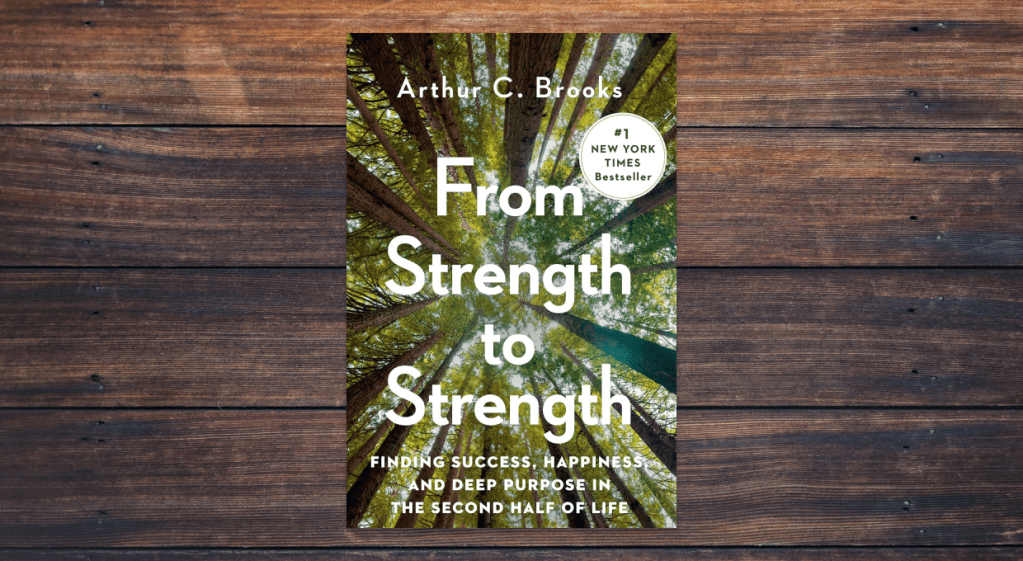
From Strength to Strength: Finding Success, Happiness, and Deep Purpose in the Second Half of Life, published in 2022, became a number one New York Times bestseller and is widely considered his most personally revealing and philosophically ambitious work. It draws on social science, philosophy, and theology to address the experience of professional decline and the search for meaning in the second half of life. The book is reviewed separately on this site.
In September 2023, Brooks co-authored Build the Life You Want: The Art and Science of Getting Happier with Oprah Winfrey. The book debuted at number one on the New York Times bestseller list and organizes the research on happiness around four pillars: family, friendship, work, and faith. It is also reviewed on this site.
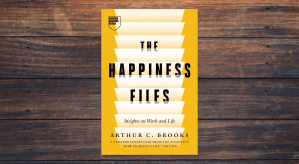
The Happiness Files, published in 2025, collects and expands on insights from his Atlantic column and podcast work, offering accessible explorations of specific happiness research findings for general readers.
His most recent book, The Meaning of Your Life: Finding Purpose in an Age of Emptiness, was released in 2026 and continues his examination of what makes human life feel worthwhile in an era of rising anxiety and disconnection.
The Happiness Column and Media Work
Brooks began writing his column “How to Build a Life” for The Atlantic in 2019, and it quickly became one of the publication’s most widely read regular features. The column applies social science research, philosophy, and religious tradition to the practical questions of how to live well, and it reaches millions of readers monthly. He has since moved his column to The Free Press, where he writes the weekly column “The Pursuit of Happiness.”
He is also a contributor to CBS News and hosts the podcast “Office Hours with Arthur Brooks,” which extends the conversations from his writing and teaching into an audio format accessible to a broader audience.
Why His Work Matters for Personal Finance
Brooks is not a personal finance writer in any conventional sense. He does not discuss index funds, savings rates, or tax-advantaged accounts. But his work addresses a set of questions that personal finance education almost entirely ignores: what is money actually for, and does accumulating more of it produce the wellbeing people expect it to?
The research Brooks presents consistently shows that the relationship between income and happiness, while real at lower income levels where additional money genuinely expands options and reduces stress, weakens significantly above a moderate threshold. People systematically overestimate how much financial achievement will improve their sense of satisfaction, and they tend to underinvest in the domains that research shows actually predict wellbeing at higher income levels, particularly close relationships and meaningful work.
For anyone building a long-term financial plan, that finding has direct and practical implications. Financial independence is a tool in service of a life, not a destination that delivers happiness automatically upon arrival. Understanding what the research shows about what actually produces wellbeing alongside building financial security is one of the more important things a financially literate person can do.
Where to Start
For readers new to Brooks’s work, From Strength to Strength is the most cohesive and personally engaging entry point. It is intellectually ambitious without being inaccessible, and it addresses questions about success, meaning, and the second half of life that most readers find directly relevant regardless of where they are in their financial journey.
Build the Life You Want, co-authored with Oprah Winfrey, is the most practical and the most accessible of his major works, organized around concrete tools for improving wellbeing across the four pillars of family, friendship, work, and faith. It is a natural companion to The Psychology of Money by Morgan Housel, also reviewed here, which addresses the relationship between money and a meaningful life with comparable accessibility and intellectual honesty.









 Winchell House
You must be logged in to post a comment.