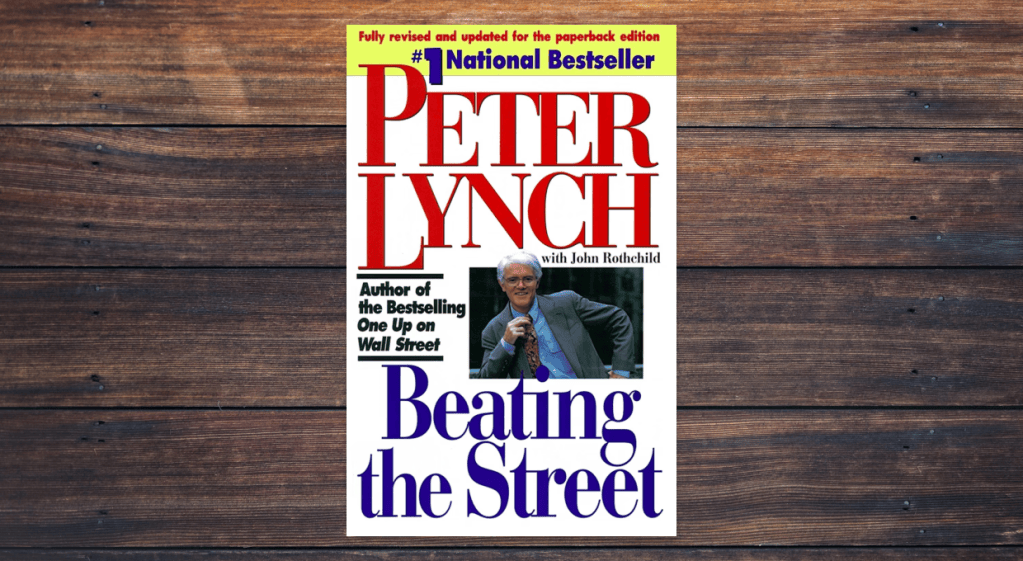
Peter Lynch is the rare fund manager with both a legendary record and a readable book. Beating the Street (1993) is the follow-up to One Up On Wall Street, and it’s the more practical of the two: less philosophy, more “here’s how I actually picked stocks at Magellan.”
Brief Book Summary
Lynch ran Fidelity’s Magellan fund from 1977 to 1990, compounding at 29% a year. Beating the Street is his detailed account of how: the categories of stocks (slow growers, stalwarts, fast growers, cyclicals, turnarounds, asset plays), the research process, and the discipline of doing your own homework. It’s packed with real examples: the winners, the losers, and what he learned from both.

Who is Peter Lynch?
Peter Lynch managed Fidelity’s Magellan Fund from 1977 to 1990, delivering 29% annualized returns and making it the best-performing mutual fund in the world. He wrote One Up On Wall Street and Beating the Street to argue that ordinary investors can beat the pros by doing their own research. He’s the rare legend who retired at the top and spent his later years explaining how he did it in plain English.
The six categories are the real system
Lynch’s most durable contribution isn’t a stock tip. It’s the taxonomy: slow growers, stalwarts, fast growers, cyclicals, turnarounds, and asset plays. Each category has a different risk profile, a different holding period, and a different way it can go wrong. A fast grower that stops growing is a disaster; a turnaround that doesn’t turn is a value trap. The point isn’t to memorize the labels. It’s to force yourself to answer: what kind of business is this, and what has to go right? That question alone puts you ahead of most people buying stocks on vibes.
The ideas that stick
The core message: individual investors have advantages over professionals. You see products in stores, you notice trends, you’re not forced to own 1,400 stocks. Lynch’s “tenbagger” hunt (stocks that rise 10x) is the fun part, but the real lesson is process: know what you own, know why you own it, and don’t panic. His line that “everyone has the brainpower to make money in stocks, but not everyone has the stomach” is the book in one sentence.
Read it as a business book, not a stock-picking manual
Here’s the honest framing: the evidence says most people shouldn’t pick individual stocks. Index funds win for the vast majority. Lynch himself would probably tell you that. So why read a stock-picker’s book? Because the underlying skill, understanding how businesses make money, makes you a better investor in any vehicle. When you know what a cyclical is, you understand why your index fund drops in recessions. When you grasp the tenbagger mindset, you appreciate why patience matters. Read Beating the Street to learn how to think about companies, then buy the index anyway.
The stomach quote is the whole book
Lynch’s most quoted line, that everyone has the brainpower but not everyone has the stomach, deserves unpacking. The “stomach” is temperament: the ability to hold through a 30% drawdown, to buy when others panic, to do nothing when doing something feels urgent. It’s the same trait every great investor keeps naming. The practical version for non-stock-pickers: automate your index fund contributions, stop checking prices daily, and let time do the work. The stomach isn’t about courage. It’s about systems that remove the need for it.
What it’s not
It’s dated in places: the examples are 80s and 90s companies, and the market structure has changed. It’s also unapologetically pro-stock-picking, which sits uneasily next to the index-fund evidence. Read it as a masterclass in how to think about businesses, not as proof you should try to beat the market.
Anyone interested in individual stocks, or who wants to understand how a great investor actually thinks.
Final Thoughts
Beating the Street won’t teach you to beat the market, and that’s fine. It will teach you to think like an owner, to categorize what you own, and to respect the stomach it takes to hold through drawdowns. For a frugal index investor, that’s the useful part: understand the machine, then let it run automatically.











You must be logged in to post a comment.