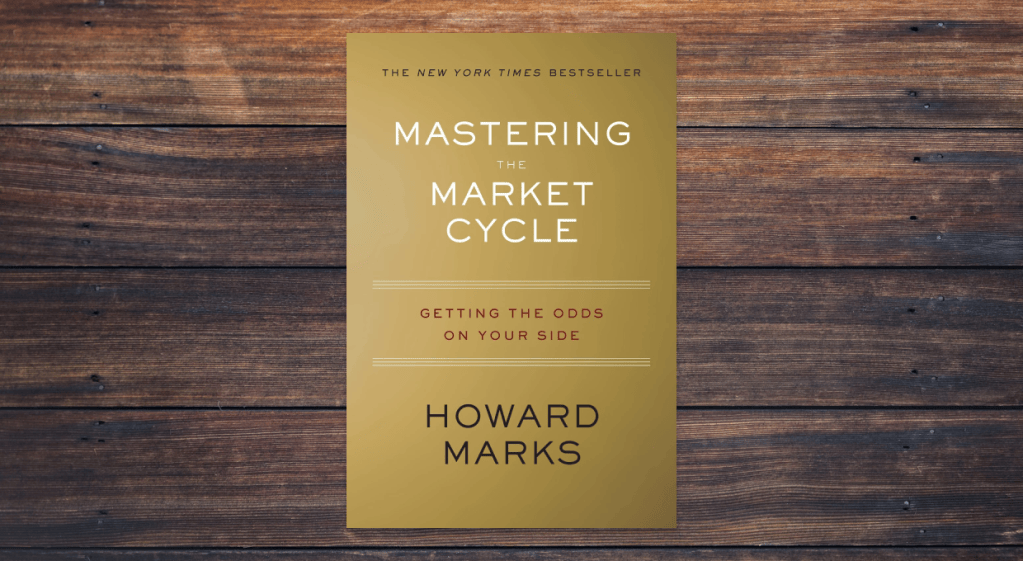
You can’t predict the market. But according to Howard Marks, you can figure out where you are in it, and that changes everything about how you should invest. Mastering the Market Cycle, published in 2018, distills decades of Marks’s famous investor memos into a framework for reading the market’s mood and positioning your portfolio for what comes next. It’s the rare investing book that gets more useful the more experienced you become.
Book Summary
Mastering the Market Cycle is the follow-up to Marks’s The Most Important Thing, and it takes that book’s central insight, that risk is the probability of loss, and puts it in motion. Markets move in cycles: economies expand and contract, credit loosens and tightens, and investor psychology swings between euphoria and despair like a pendulum. Marks walks through each type of cycle, explains what causes the swings, and shows how the same forces repeat with different costumes every decade.
The book’s punchline is practical, not philosophical. You will never predict the turning points, Marks insists, and anyone who claims to is selling something. But by studying the patterns, you can make a reasonable assessment of where you stand: are investors greedy or fearful, is credit easy or tight, are asset prices high or low relative to fundamentals? When the pendulum has swung to euphoria, you play defense. When it has swung to despair, the bargains of a generation go on sale, and you should be buying. The book is essentially a field guide to contrarian positioning, built from memos Marks wrote in real time through multiple booms and busts.
Who is Howard Marks?
Howard Marks is the co-founder and co-chairman of Oaktree Capital Management, which he started in 1995 and built into one of the world’s largest distressed-debt and value investors, managing well over $100 billion. Since 1990 he has written investor memos, published free for anyone to read, that have become required reading on Wall Street. Warren Buffett has said of them: “When I see memos from Howard Marks in my mail, they’re the first thing I open and read. I always learn something, and that goes double for his book.” Marks specializes in buying when others are forced to sell, and his September 2007 memo warning that “it’s all good” couldn’t last is now legendary for calling the top before the financial crisis.
Lessons From Mastering the Market Cycle
The first lesson of Mastering the Market Cycle is the sentence Marks repeats like a mantra: we never know where we’re going, but we ought to know where we are. Forecasting is a fool’s errand, but assessing the present, how optimistic investors are, how loose credit is, how high prices are, is entirely possible. Superior investing comes from having a better sense of the range of possible outcomes than the crowd does, not from predicting the single outcome.
Second, risk is highest precisely when it feels lowest. When everyone is optimistic, prices are high, and caution has been abandoned, that is when the probability of loss peaks. Conversely, the safest time to invest is when fear is rampant and prices have collapsed. This inversion, buy when there’s blood in the streets, even if some of it’s your own, is the emotional core of the book, and the reason most investors fail at it.
Third, the credit cycle drives everything else. Marks argues that the availability of credit is the single most important force in markets: easy credit inflates every boom, and its withdrawal triggers every bust. Watch the credit markets and you can see the rest coming. His framework for the stages of a bull market, from skepticism through acceptance to euphoria, gives investors a checklist for diagnosing market mood in real time.
Fourth, being too far ahead of your time is indistinguishable from being wrong. Calling the top too early loses just as much money as missing it, which is why Marks counsels adjusting your portfolio’s aggressiveness gradually rather than making all-or-nothing bets. Tilt toward defense when risk is high, toward offense when bargains abound, and let the cycle do the heavy lifting.
Fifth, second-level thinking wins. First-level thinkers see a good company and buy the stock; second-level thinkers ask what everyone else thinks, whether that view is already priced in, and what happens if they’re wrong. Mastering the Market Cycle is ultimately a 300-page argument that outperformance comes from thinking differently, not from working harder at the same analysis everyone else is doing.
Criticisms of the Book
The fairest criticism of Mastering the Market Cycle is that it can feel repetitive. The pendulum metaphor gets applied to the economic cycle, the credit cycle, the psychology cycle, and several more, and by the later chapters the structure starts to blur together. Readers who absorb the core idea early may find the middle of the book slow.
A second criticism is that the book is better at diagnosis than prescription. Marks is brilliant at describing where you are in a cycle and frustratingly vague about exactly what to do about it, beyond general tilts toward offense or defense. There’s a tension the book never fully resolves: “assess where you are and adjust” can look uncomfortably like the market timing Marks himself warns against.
Finally, it’s written by and for professional investors. The examples assume familiarity with credit markets, distressed debt, and institutional portfolio management. A buy-and-hold index investor will take away the psychology lessons but little that’s directly actionable, and a beginner should read The Most Important Thing first.
Who is This Book For?
Mastering the Market Cycle is for investors who have lived through at least one full boom and bust and want a framework for the next one. It’s ideal for contrarians, value investors, and anyone managing their own portfolio through volatile markets. Readers of The Most Important Thing will find this the natural second volume. It’s not for beginners, who should start with Marks’s first book, and not for strict passive investors, who’ve already opted out of the game Marks is teaching.
Final Thoughts
Mastering the Market Cycle won’t tell you what the market will do next year. No honest book can. What it does is rarer: it teaches you to read the market’s emotional temperature and adjust your own behavior accordingly, which is the closest thing to an edge most investors will ever get. For anyone serious about investing through full market cycles rather than just bull markets, it’s essential reading, and the perfect companion to The Most Important Thing.











You must be logged in to post a comment.