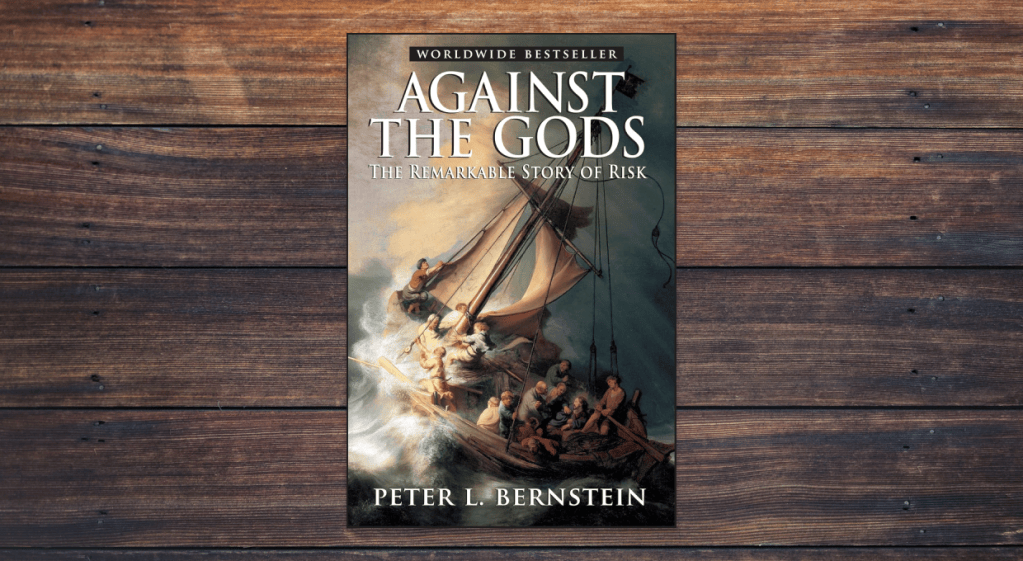
Most investing books tell you what to buy. Against the Gods tells you something more fundamental: how humanity learned to think about the future at all. Peter L. Bernstein’s thesis is that the dividing line between the modern world and everything before it is the mastery of risk — the revolutionary idea that the future is not simply a whim of the gods, but something that can be measured, priced, and managed. First published in 1996, it won the Edwin G. Booz Prize and remains the best single history of how probability became the operating system of finance.
Book Summary
Bernstein tells the story of risk as intellectual history, beginning with the ancient Greeks and Romans — brilliant mathematicians who never developed probability theory because they saw the future as fate. The breakthrough came from gamblers: Cardano, the Renaissance mathematician who first wrote systematically about games of chance, then Pascal and Fermat, whose 1654 correspondence on the “problem of points” founded probability theory. From there Bernstein traces the chain — Graunt’s mortality tables, Bernoulli’s law of large numbers, Bayes’ theorem, Gauss’s normal distribution, Galton’s regression to the mean — until probability collides with finance in the twentieth century: Markowitz’s portfolio theory, the Black-Scholes option model, and finally Kahneman and Tversky’s prospect theory, which showed that the human brain is a systematically flawed risk calculator. The book closes with a warning that reads as eerily prescient: as derivatives and mathematical models grow more powerful, the temptation to confuse the model with reality grows with them.
Who is Peter L. Bernstein?
Peter L. Bernstein (1919–2009) was an economist, money manager, and financial historian. He founded the consulting firm Peter L. Bernstein, Inc. in 1973, served as the founding editor of The Journal of Portfolio Management in 1974, and spent decades translating academic finance for practitioners. He wrote nine books on economics and finance, including Capital Ideas, his history of modern Wall Street, but Against the Gods is the one that made him famous outside the industry — a book that treats the history of an idea as seriously as most historians treat the history of nations.
Lessons From Against the Gods
Risk is the price of the modern world. Bernstein’s central argument is that nothing about modern economic life — insurance, pensions, stock markets, mortgages — is possible without the mathematics of probability. Every time you diversify a portfolio or buy insurance, you are using ideas that took two thousand years to develop. Understanding that history makes you less likely to take the machinery for granted.
Your brain is a bad risk calculator. The chapter on Kahneman and Tversky is the most directly useful part of the book for investors. Prospect theory showed that people feel losses roughly twice as intensely as equivalent gains, overweight tiny probabilities, and make different choices depending on how a risk is framed. Every panic sale and every lottery-ticket stock purchase in your brokerage account is prospect theory in action. Knowing the bias does not eliminate it, but it gives you a fighting chance against it.
Diversification is old math with new power. Markowitz’s 1952 insight — that what matters is how assets move together, not just how each one performs — was built on centuries of probability theory. Bernstein shows it as the culmination of a long intellectual arc rather than a bolt from the blue, which is exactly why it has survived: it is math, not fashion.
Models are maps, not territory. The book’s closing warning is its most important lesson for investors. Mathematical models of risk work until they don’t — usually at the worst possible moment, because everyone is using the same model. Bernstein wrote this before the 2008 crisis; the crisis was, in a sense, his warning coming true. Use models as guides, never as oracles, and always ask what the model assumes away.
Every generation thinks it has solved risk. From the first life insurance tables to portfolio insurance to modern derivatives, each era’s cleverest minds believed they had finally tamed uncertainty — and each era was wrong in a new and instructive way. The humility this history teaches is itself an investing edge: the investor who expects to be surprised loses less than the one who expects to be right.
Criticisms of the Book
This is intellectual history, not a how-to guide, and readers looking for portfolio advice will need to extract the lessons themselves — Bernstein never hands you an asset allocation. Some stretches, particularly the early chapters on Renaissance mathematics, are dense going for readers without a taste for history. The book was also written before the 2008 financial crisis, so its warning about model hubris reads as prescient but stops short of the confirmation the crisis provided. Finally, the book focuses almost entirely on risks that can be measured; the deeper problem of Knightian uncertainty — risks you cannot even quantify — gets less attention than it deserves.
Who is This Book For?
Investors who want to understand the why behind the tools they use every day — diversification, expected value, risk-adjusted returns — rather than just the how. If you have read Fooled by Randomness or The Black Swan and want the deeper history behind Taleb’s ideas, or Thinking, Fast and Slow and want the story of the probability theory Kahneman built on, this is the prequel to all of them. It is also the right book for anyone who lived through 2008 and wants to understand, at the level of ideas, what actually went wrong.
Final Thoughts
Against the Gods will not tell you what to buy, and that is precisely its value. It gives you the one thing most investing books skip: an understanding of what risk actually is, where our tools for handling it came from, and why every generation overestimates its control over the future. Read it when you are ready to think about investing at the level of ideas rather than tickers.











You must be logged in to post a comment.