Book Summary
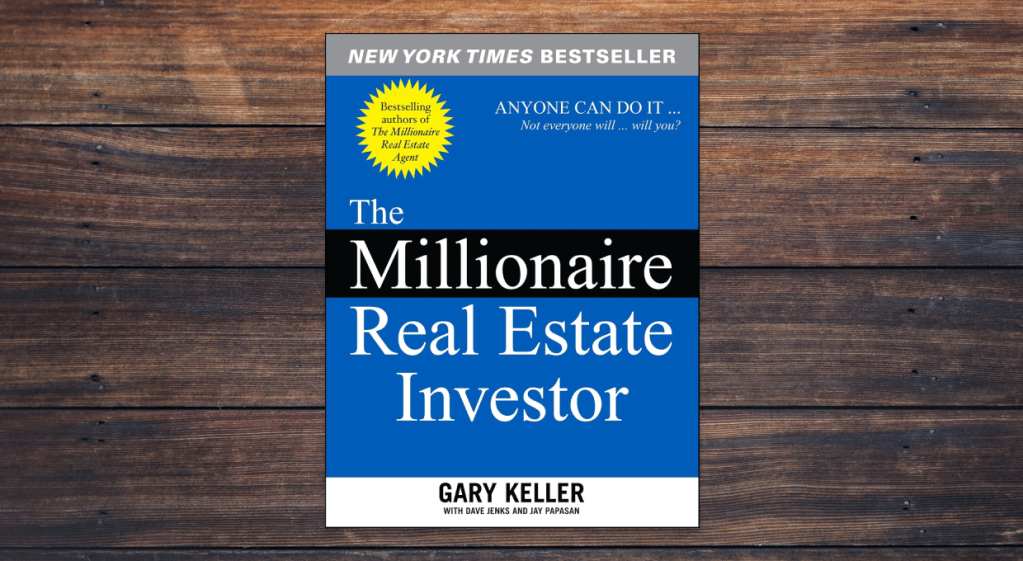
The Millionaire Real Estate Investor is Gary Keller’s attempt to answer a simple question: what do actual millionaire real estate investors do differently from everyone else? Rather than theorizing, Keller interviewed more than 100 of them and distilled their habits into a repeatable model. The result is less a book about picking properties and more a book about thinking like an investor first, then building a system that turns that thinking into a portfolio.
The book’s backbone is a four-stage path: Think a Million, Buy a Million, Own a Million, and Receive a Million. Think is about mindset and financial literacy — defining why you’re investing and what “wealthy” actually means for you. Buy is about amassing a portfolio with a market value of a million dollars or more, using strict criteria so you make money on the purchase, not the sale. Own is about turning those properties into an asset-based business with growing net worth. Receive is the endgame: a portfolio throwing off serious passive income, up to a million dollars a year in Keller’s framing. The book closes with 21 profiles of real investors and a set of worksheets for tracking your own numbers.
Who is Gary Keller?
Gary Keller is the co-founder of Keller Williams Realty, which he started with Joe Williams in Austin in 1983 and grew into the largest real estate franchise in the world by agent count. He earned his BBA in Real Estate and Finance from Baylor University in 1979, sold five houses in his first month as an agent, and later became executive chairman of kwx, the holding company behind Keller Williams. He’s also a bestselling author several times over — The Millionaire Real Estate Investor (2005) sits alongside The Millionaire Real Estate Agent, SHIFT, and The ONE Thing. Unlike a lot of real estate gurus, Keller’s fortune comes from actually building a brokerage and investing, not from selling courses about investing.
Lessons From The Millionaire Real Estate Investor
Investing isn’t risky — speculating is. The book opens by attacking what Keller calls “MythUnderstandings” about money. His core claim: investing, done properly, is not risky by design. Risk comes from ignorance and emotion, not from the asset. Millionaire investors take luck out of the game by following proven models instead of hunches.
The Dynamic Trio: Criteria, Terms, Network. Every deal in The Millionaire Real Estate Investor is filtered through three questions: does it meet your Criteria, do the Terms protect you, and does your Network support the deal? Criteria keep you disciplined about what you buy. Terms — price, financing, contingencies — are where you lock in your profit. Network is your “dream team” of agents, lenders, contractors, and property managers. Keller argues that most investors fail on at least one of the three.
Your net worth is the number that matters. Keller’s Net Worth Model treats net worth, not cash flow, as the master metric. His analogy: cash flow is the milk, but net worth is the cow. Grow the cow — the equity in your properties — while keeping debt at safe levels, and the milk takes care of itself. This is a useful corrective for investors who chase monthly cash flow while ignoring whether their equity is actually compounding.
Lead generation is the real job. The book is blunt that finding deals is the bottleneck, not financing them. Keller cites a 100:10:3:1 buying ratio — investigate 100 properties, seriously consider 10, make 3 offers, buy 1. That ratio forces a pipeline mentality: if you’re not looking at enough deals, you can’t be selective, and if you can’t be selective, you overpay.
Buy for cash flow or equity — know which. Keller distinguishes multifamily properties (bought for cash flow) from single-family homes (bought for equity growth), and insists you know which game you’re playing before you buy. Mixing up the two is how investors end up with properties that neither cash flow nor appreciate.
Criticisms of the Book
The most obvious knock is age. Published in 2005, many of The Millionaire Real Estate Investor‘s examples, interest-rate assumptions, and market anecdotes come from a different era. The models still hold up, but you’ll need to translate the numbers into today’s market yourself.
It’s also US-centric and assumes a starting position — decent credit, some capital, a functioning local market — that not every reader has. The book doesn’t spend much time on what to do if you’re starting from zero, and its tax and legal guidance is deliberately surface-level. Finally, the motivational “think big” passages can feel like filler between the genuinely useful frameworks. If you want pure tactics, you’ll skim some chapters.
Who is This Book For?
This book is for someone who wants to build wealth through rental real estate and is willing to treat it as a business, not a hobby. It’s especially useful if you’ve read something like Rich Dad Poor Dad and want the actual operating manual that book never provided. Pair it with The Book on Rental Property Investing for tactics and Tax-Free Wealth for the tax side, and you’ve got a solid starter curriculum. It’s not for flippers looking for a quick score, and it’s not for stock-market purists — Keller’s whole premise is that real estate rewards patience in a way paper assets don’t.
Final Thoughts
The Millionaire Real Estate Investor earns its place as a foundational real estate book because it’s built on research rather than one person’s story. The four-stage model and the Criteria/Terms/Network filter give you something you can actually run every deal through. Dated in places, US-centric, and occasionally preachy — but the core frameworks are the kind you keep coming back to. For a patient investor who wants a system instead of tips, it’s one of the best starting points in the genre.











You must be logged in to post a comment.