Book Summary
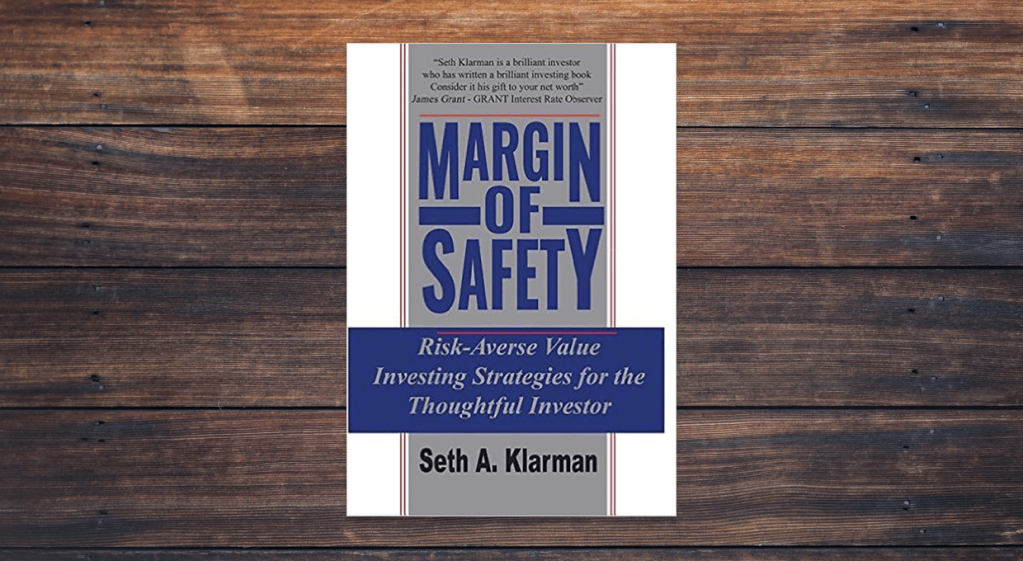
Margin of Safety is Seth Klarman’s 1991 treatise on risk-averse value investing, and it has become the most famous out-of-print book in finance. Published by HarperBusiness and never reprinted, used copies routinely sell for hundreds or even thousands of dollars. The book is organized into three long chapters — “Where Most Investors Stumble,” “A Value Investment Philosophy,” and “The Value Investment Process” — and it makes one argument with unusual force: risk is not volatility, it is the permanent loss of capital, and the only reliable defense is to buy assets at a large discount to what they are actually worth. Klarman spends the first chapter dismantling the investment industry’s bad habits — speculation dressed up as investing, slavish benchmarking, the pretense that anyone can forecast the economy — and the rest of the book building the value investor’s alternative: bottom-up analysis, absolute rather than relative returns, and the patience to wait for the fat pitch.
Who is Seth Klarman?
Seth Klarman is the founder and CEO of the Baupost Group, the Boston-based investment partnership he started in 1982 that has compounded at roughly 20% a year for decades, making him one of the most successful investors of his generation. A Cornell undergraduate and Harvard MBA, he worked alongside value investor Max Heine at Mutual Shares before striking out on his own. Often called “the Oracle of Boston,” Klarman is famously press-shy — he gives almost no interviews, and Margin of Safety remains essentially the only place he has laid out his philosophy in full. Alongside Warren Buffett and Li Lu, he is one of the investors whose approach serious students of value investing study first.
Lessons From Margin of Safety
Risk is permanent loss, not volatility. The foundation of Margin of Safety is a redefinition: academics and Wall Street define risk as price fluctuation, but Klarman argues the only risk that matters is losing money for good. An investment that swings wildly but never impairs your capital was never risky; a “safe” bond bought above its worth was. Once you accept this, the whole game changes from maximizing return to first avoiding loss.
The margin of safety is the central concept of investing. Borrowed from Benjamin Graham, the margin of safety means buying a security for substantially less than its conservatively estimated intrinsic value — buying dollar bills for fifty cents. The discount does two jobs at once: it creates the profit potential, and it absorbs your inevitable errors in analysis. Klarman is blunt that valuation is imprecise, which is exactly why the cushion must be large.
Most of the industry is not actually investing. The opening chapter is a demolition of professional money management: managers hug benchmarks to protect their careers rather than their clients’ capital, consultants reward short-term performance, and forecasters sell certainty about an unknowable future. Klarman argues these institutional incentives make true value investing structurally difficult for professionals — and therefore structurally available to independent investors willing to be different.
Demand absolute returns, not relative ones. Value investors should not care about beating the market this quarter; they should care about not losing money, ever, and compounding sensibly over years. Klarman treats holding cash as a legitimate — even honorable — position when nothing meets his standards. A portfolio that sits in Treasury bills for a year while waiting for bargains is succeeding, not failing.
Be bottom-up and catalyst-aware. Margin of Safety argues for analyzing individual securities rather than betting on macroeconomic predictions, and for preferring investments with a catalyst — a spin-off, restructuring, bankruptcy emergence, or buyback — that will close the gap between price and value on a timetable you can see. Without a catalyst, cheap can stay cheap for a very long time.
Patience is the scarce resource. Underneath the valuation techniques is a temperament argument: good opportunities are rare, and the investor’s job is mostly waiting. Klarman writes that investing is the intersection of economics and psychology, and the psychological half — resisting greed, fear, and the urge to “do something” — is where most people fail. Discipline, he insists, is a larger determinant of results than brilliance.
Criticisms of the Book
Margin of Safety was written in 1991, and it reads like it — the examples predate the internet era, and some of the institutional detail feels frozen in time. It is also dense and academic in stretches; this is a textbook for serious students, not a breezy weekend read. More fundamentally, critics note that much of the philosophy is Graham restated with Klarman’s sharper prose — readers of The Intelligent Investor will recognize the architecture. The biggest practical criticism is accessibility itself: because Klarman has never allowed a reprint, the book costs a fortune secondhand, which means its lessons circulate mostly as summaries and pirated PDFs. Finally, the approach demands a temperament most investors don’t have — years of holding cash and looking wrong in bull markets — and the book is honest about that cost without making it any easier to bear.
Who is This Book For?
Serious students of value investing are the core audience — if you have read Graham and Buffett and want the strictest statement of the creed, this is it. Patient individual investors who manage their own portfolios will find a complete operating system for thinking about risk. It is also essential background for anyone who follows Baupost or Klarman’s rare public letters. It is not for traders, momentum investors, or anyone looking for stock tips; there are no picks in Margin of Safety, only a way of thinking. Index-fund investors curious about what the other side believes will find it a worthy, if demanding, afternoon.
Final Thoughts
Margin of Safety earns its legend. It is the clearest, least sentimental statement of value investing ever written for practitioners — risk defined correctly, the margin of safety as first principle, and an unflinching account of why the industry makes good investing so hard. The dated examples and the absurd secondhand price are real drawbacks, but the ideas have not aged a day. For anyone who wants to invest rather than speculate, it belongs on the short shelf next to Graham and Buffett.











You must be logged in to post a comment.