Book Summary
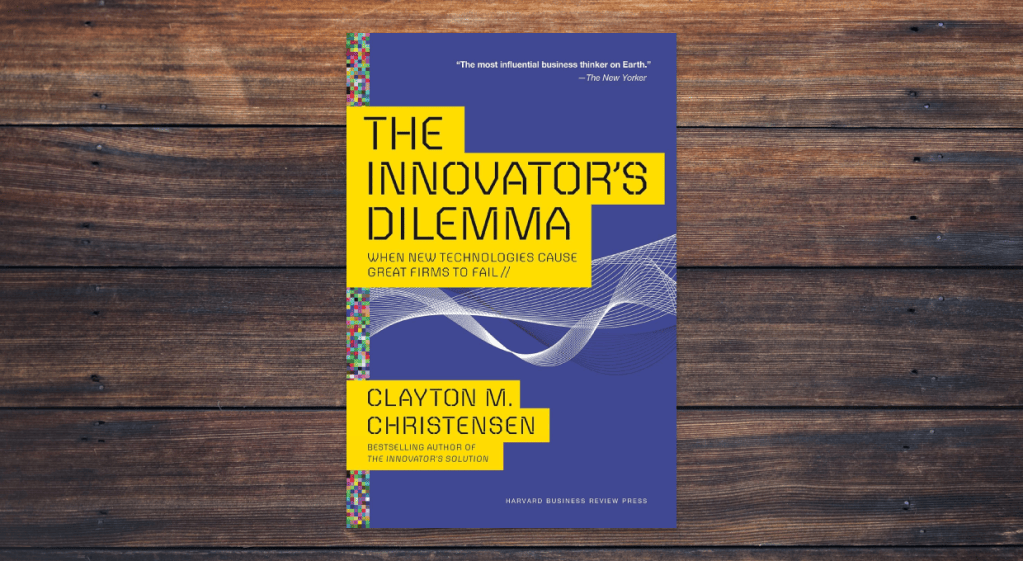
The Innovator’s Dilemma: When New Technologies Cause Great Firms to Fail is Clayton Christensen’s answer to one of business’s great puzzles: why do excellent companies — well-managed, customer-focused, profitable — get destroyed by newcomers with worse products? Christensen’s answer, drawn from the disk-drive industry and extended across dozens of industries, is that good management itself is the culprit. Listening to your best customers, investing in higher-margin products, and allocating capital rationally are exactly the behaviors that blind incumbents to disruptive technologies creeping up from below. Disruptors start with cheaper, worse products that incumbents rationally ignore — until the disruptors get good enough to eat the whole market. It’s one of the most influential business books ever written; Steve Jobs reportedly kept it close, and its vocabulary (disruption, sustaining vs. disruptive innovation) now structures how the entire tech industry thinks.
Buy The Innovator’s Dilemma on Amazon
Who is Clayton Christensen?
Clayton Christensen was a Harvard Business School professor, consultant, and the originator of disruptive innovation theory. Before academia, he worked at Boston Consulting Group and helped found Ceramics Process Systems. The Innovator’s Dilemma (1997) grew out of his doctoral research on the disk-drive industry and won the Global Business Book Award. His later books — The Innovator’s Solution, The Innovator’s Prescription, and the personal How Will You Measure Your Life? — extended the framework. Christensen died in 2020, but his ideas run the modern innovation playbook: every startup pitch deck invoking “disruption” is, knowingly or not, speaking his language.
Lessons From The Innovator’s Dilemma
Good management causes failure. This is the book’s central, unsettling claim. The companies that died weren’t badly run — they were superbly run. They listened to customers, invested aggressively in new technology, and carefully studied market trends. The problem: their best customers didn’t want disruptive products (too cheap, too simple, too low-margin), so rational capital allocation starved the disruptors inside the company. Excellence at the current game is precisely what prevents you from playing the next one.
Sustaining vs. disruptive innovation. Sustaining innovations make good products better — faster chips, sharper cameras — and incumbents win at these. Disruptive innovations start worse by every conventional measure but are cheaper, simpler, or more convenient. Incumbents cede the low end because the margins are terrible; then the disruptor’s trajectory of improvement intersects the mainstream market, and it’s over. The pattern repeats in steel (minimills vs. integrated mills), excavators, retail, and now software.
Listen to non-customers. Your best customers will never ask for the disruptive product — by definition, it’s not good enough for them yet. The insight is to watch the customers you don’t have: the ones who find your product too expensive, too complex, or overkill. That’s where disruption breeds. For investors, this reframes competitive analysis: the threat to a beloved holding rarely looks like a better version of the same thing.
Spin out the disruptor. Christensen’s prescription for incumbents: create an independent organization with its own cost structure, profit expectations, and freedom to cannibalize the parent. An internal skunkworks still answers to the same P&L logic that kills disruption. (This is also why the lean-startup method of Eric Ries’s The Lean Startup — small teams, rapid iteration, permission to be wrong — works: it’s structurally what Christensen prescribed, imported into startup culture.)
Resource dependence shapes strategy. Companies don’t really choose their strategies; their customers and investors choose for them. Capital flows to the highest-return opportunities, which are always the sustaining ones — until they aren’t. Understanding who really controls a company’s resource allocation is, for the investor, a way to predict which incumbents are structurally incapable of responding to disruption.
Buy The Innovator’s Dilemma on Amazon
Criticisms of the Book
The word “disruption” has been so abused — applied to every startup with an app — that The Innovator’s Dilemma‘s precise meaning is often lost; Christensen himself complained about this late in life. More substantively, critics led by Jill Lepore have argued the theory is built on handpicked case studies and that many supposed disruptions were really just ordinary competition, while some “disrupted” incumbents (IBM, Microsoft) survived just fine. The disk-drive evidence, the theory’s foundation, has been questioned on its details. There’s also a survivorship problem: we remember the disruptors that won, not the cheap-and-simple entrants that stayed cheap and simple forever. And the book underplays how often incumbents do adapt — sometimes good management plus a crisis is enough. None of this kills the framework, but it means “disruption” is a tendency to watch for, not a law of nature.
Who is This Book For?
This book is for investors, founders, and executives who need to think about competitive threats on a ten-year horizon. If you own dominant companies — the kind with wide moats and fat margins — The Innovator’s Dilemma is the essential skeptical voice: it teaches you to ask what cheap, inferior alternative your customers might eventually prefer. It’s drier and more academic than most business bestsellers — the disk-drive chapters are genuinely technical — but the payoff is a mental model you’ll use forever. Not recommended as a first business book; very highly recommended as a tenth.
Final Thoughts
The Innovator’s Dilemma earned its reputation. It explains more about why great companies die — and how to spot the killing blow early — than any other business book, and it does it with real research rather than anecdotes. The framework has genuine predictive power for investors: when you see an incumbent dismissing a cheaper competitor as a toy, pay attention, because you’ve seen this movie before. Read it alongside the hype with Lepore’s criticisms in mind, and you’ll come away with something rare in business literature — an idea that is both original and true, even if it’s not the whole truth. For anyone allocating capital for the long term, that’s worth far more than the cover price.










