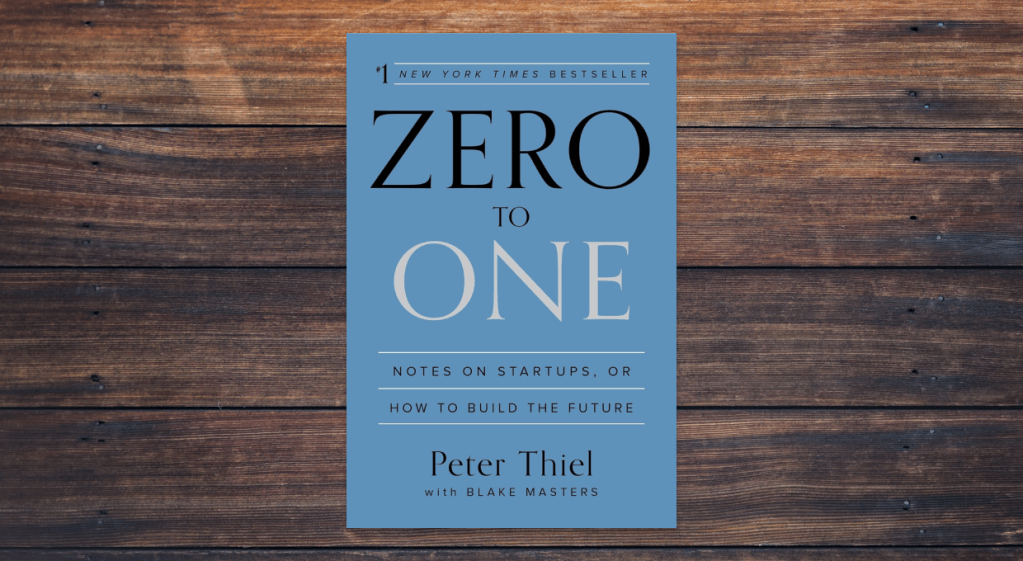
Book Summary
Zero to One: Notes on Startups, or How to Build the Future is Peter Thiel’s argument that real progress comes from doing something entirely new — going from zero to one — rather than copying what already works, which is going from one to n. Drawn from his legendary Stanford lectures on startups, the book is a contrarian’s field guide to building companies that create new things: why monopolies are good, why competition is for losers, why most startups fail at sales, and why definite optimism beats the indefinite kind. It is short, dense, and deliberately provocative — Thiel would rather be interesting and wrong than boring and right, though he is right more often than his critics admit.
Who is Peter Thiel?
Peter Thiel is the billionaire co-founder of PayPal and Palantir, the first outside investor in Facebook, and one of the most contrarian thinkers in Silicon Valley. As part of the so-called PayPal Mafia, he helped seed a generation of companies including SpaceX, LinkedIn, YouTube, and Yelp. His venture fund, Founders Fund, backed Airbnb, Stripe, and Spotify early. Thiel is famous for asking founders the interview question at the heart of Zero to One: “What important truth do very few people agree with you on?” The book grew out of the course he taught at Stanford in 2012, with class notes taken by Blake Masters that became a viral sensation before Thiel expanded them into the book.
Lessons From Zero to One
Monopolies are good; competition is for losers. This is the book’s most famous and most misunderstood claim. Thiel argues that every great business is a monopoly in some important dimension — Google owns search, Facebook owned social. Competition destroys profits; monopoly profits fund the long-term thinking that produces real innovation. The lesson for investors: look for companies with durable, defensible advantages, not companies fighting bloody price wars.
Go from zero to one, not one to n. Copying an existing business model — opening another restaurant, another dry cleaner — moves the world from one to n: more of the same. Building something genuinely new moves it from zero to one. The returns, Thiel argues, accrue almost entirely to the zero-to-one bets. This is why venture capital follows a power law: one massive winner pays for all the failures.
Definite optimism beats indefinite optimism. Thiel divides the world into optimists and pessimists, and into the definite and the indefinite. A definite optimist (the 1950s engineer) believes the future will be better and knows how to build it. An indefinite optimist (much of modern America) believes the future will be better but has no plan — so he saves, diversifies, and hopes. The investor’s version: have a thesis. Know what you believe and why, instead of spraying money at index-like diversification of startups.
Sales matters as much as product. Engineers in Silicon Valley love to believe that a great product sells itself. Thiel calls this a lie. Distribution — sales, marketing, the unglamorous work of getting customers — is at least as important as the product. Companies fail not because the product is bad but because nobody hears about it. For investors, this means: beware the brilliant technical team with no distribution plan.
Start small and monopolize. Don’t try to capture 1% of a trillion-dollar market. Start with a tiny market you can dominate completely — PayPal started with eBay power sellers; Facebook started at Harvard — then expand outward in concentric circles. Domination of a small market is the seed of domination of a large one.
The power law governs everything. In venture capital, one investment in a fund of fifty returns more than the other forty-nine combined. Thiel extends this beyond startups: in your career, in your portfolio, in life, a few decisions matter enormously and most barely matter at all. Act accordingly — concentrate, don’t diversify your attention into meaninglessness. (This pairs interestingly with the lean-startup orthodoxy of Eric Ries’s The Lean Startup, which Thiel both respects and argues against: Ries says iterate toward product-market fit; Thiel says have a vision worth iterating toward in the first place.)
Secrets still exist. Thiel believes the world still contains undiscovered truths — about nature, about people, about business — and that finding them is the source of all great companies. The contrarian question is a tool for finding secrets: what do you believe that almost nobody agrees with you on? If you can answer it with specifics, you may be onto something.
Criticisms of the Book
Zero to One is stronger as provocation than as manual. Critics note that Thiel’s monopoly apologetics sit uneasily next to his libertarian politics — celebrating monopoly power while distrusting government power is a tension the book never fully resolves. The advice is also aimed squarely at a narrow audience: founders of venture-scale technology companies. If you run a local business or invest in public equities, much of it doesn’t directly apply. Some of the historical claims are breezy — Thiel’s grand theories of definite versus indefinite optimism flatten a lot of complicated history into a 2×2 matrix. And the book’s disdain for competition can read as self-serving from a man whose fortune came from network-effect monopolies. Still, even the critics tend to admit the book changed how Silicon Valley talks about startups, which is a rare achievement for 200 pages.
Who is This Book For?
This book is for founders and would-be founders, startup employees deciding where to work, and investors trying to understand how venture capital actually works. It’s also for anyone who enjoys having their assumptions rearranged — Thiel is wrong about some things, but he’s never boring about any of them. If you’re looking for step-by-step instructions on incorporating a company, look elsewhere; if you want a framework for thinking about what makes companies valuable, Zero to One is the sharpest short book on the subject. Public-market investors will get less direct utility than venture investors, but the monopoly framework and the power law are worth the price of admission alone.
Final Thoughts
Zero to One is the rare business book that is both genuinely original and genuinely short. You can read it in an afternoon, and you’ll be arguing with it for weeks — which is exactly what Thiel wants. Not every lesson survives contact with reality, but the core insight is durable: the biggest returns go to the people who build something new, not to the people who build a slightly better version of something old. For investors, the takeaway is to hunt for the monopolies of tomorrow and to respect the power law in your own portfolio — a few great decisions will matter far more than many good ones. Twelve years after publication, it remains the best articulation of the venture mindset ever put between covers.










