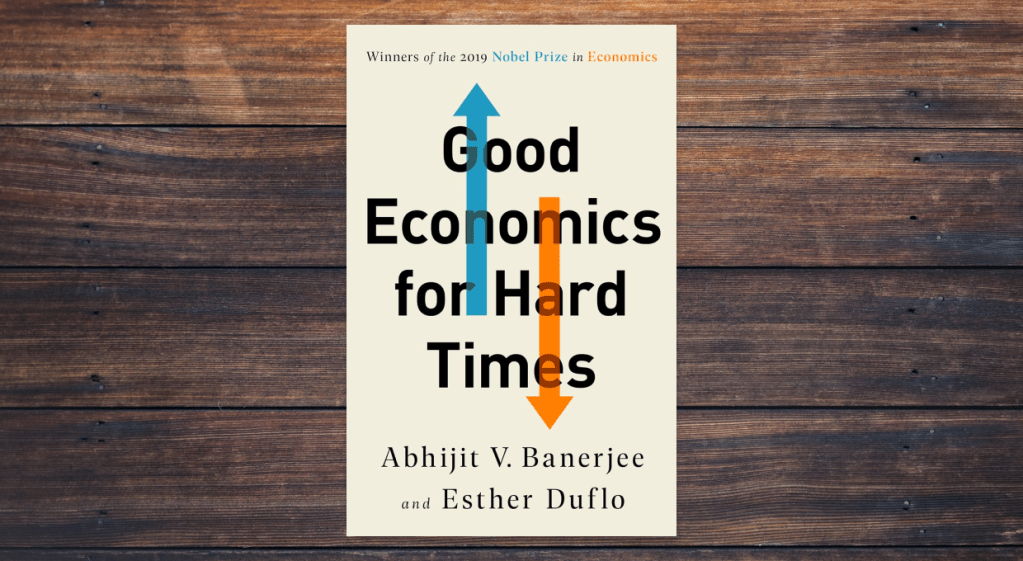
Good Economics for Hard Times is a timely and thought-provoking book by Nobel Prize-winning economists Abhijit V. Banerjee and Esther Duflo. Released in 2019, the book explores some of the most pressing economic and political issues of our time (inequality, immigration, globalization, and climate change) with clarity, nuance, and a deep respect for data.
Unlike many personal finance books that focus on individual wealth-building, Good Economics for Hard Times zooms out to examine how entire societies can function more fairly and efficiently.
While Good Economics for Hard Times is not a step-by-step guide to building a budget or paying off credit card debt, it does offer insights that are relevant to anyone interested in economic justice, financial independence, and smart public policy.
Who Are Abhijit Banerjee and Esther Duflo?
Abhijit Banerjee and Esther Duflo are professors at MIT and recipients of the 2019 Nobel Prize in Economic Sciences for their work in alleviating global poverty. They’re known for pioneering the use of randomized controlled trials in economics, a method borrowed from clinical research that brings scientific rigor to economic questions.
Their previous book, Poor Economics, focused on global poverty and development. Good Economics for Hard Times builds on that work, addressing how economic ideas are often misused in public debates and how better research could lead to better outcomes for all.
Lessons for Everyday Readers
Even though Good Economics for Hard Times is written by academics, it’s surprisingly accessible. Here are a few key takeaways that resonate with people thinking seriously about personal finance and long-term security:
- Inequality isn’t inevitable: The authors argue that many policies framed as “pro-growth” often exacerbate inequality. A strong economy doesn’t require leaving people behind.
- Immigration doesn’t hurt wages: A fear often echoed in political rhetoric is that immigrants “steal” jobs. Banerjee and Duflo show that the economic data simply doesn’t support this claim.
- We need to think long-term: Good Economics for Hard Times repeatedly urges policymakers (and by extension, readers) to zoom out and look beyond the next election cycle or quarterly earnings report. Whether it’s tackling climate change or fixing broken safety nets, long-term thinking is crucial—a mindset that also applies to building a S&P 500 nest egg or investing in treasury bills.
- Economists don’t have all the answers: In fact, one of the most humanizing aspects of the book is its humility. Banerjee and Duflo admit where economics falls short and where common sense and empathy might do better.
Good Economics for Hard Times offers a macroeconomic lens that complements your personal money goals. Understanding the broader systems at play can help you make smarter choices—not just for your wallet, but also at the ballot box.
Criticisms of the Book
While Good Economics for Hard Times has been widely praised, it’s not without its critics:
- Dense in places: Even though the authors try to simplify complex ideas, some chapters can still feel heavy or academic. This isn’t a beach read.
- Policy-heavy: If you’re not particularly interested in politics or public policy, some parts of the book may not feel relevant to your day-to-day financial concerns.
Should You Buy It?
If you’re curious about the big-picture forces shaping our economy and how those forces might affect your personal finances over time, then yes, Good Economics for Hard Times is worth buying. It’s especially relevant if you’re working toward financial independence and want to understand how economic systems and policies can either support or hinder that journey.
Final Thoughts
Good Economics for Hard Times doesn’t tell you how to manage your money. But it does something just as important, it helps you think critically about the systems and ideas that influence financial opportunity, security, and inequality.
Whether you’re new to economics or simply looking to expand your understanding of global financial issues, Banerjee and Duflo have delivered a compelling read that might just change how you see the world… and your place in it.











You must be logged in to post a comment.