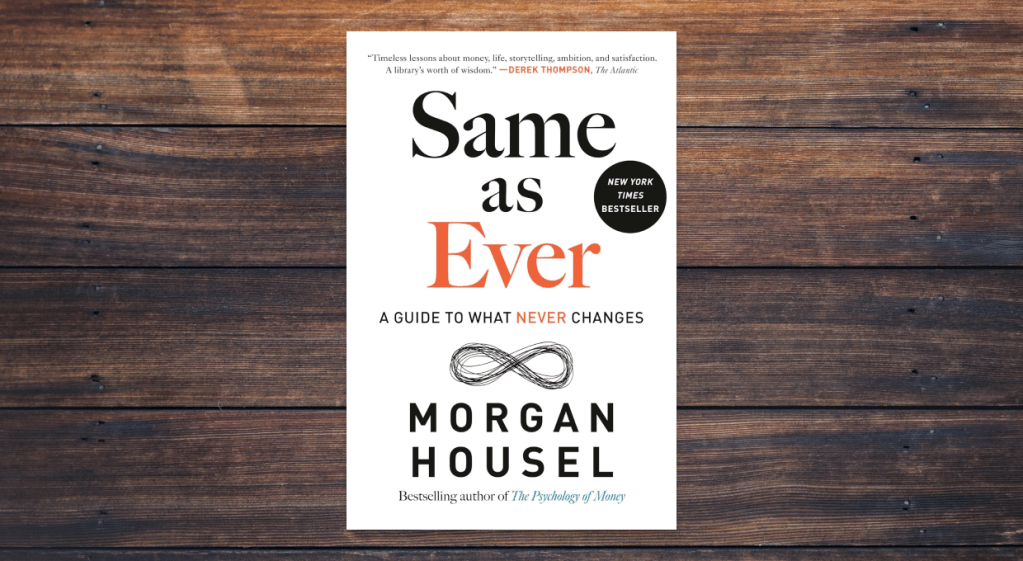
Most personal finance advice focuses on what is new. New investing strategies, new budgeting apps, new asset classes, new economic forecasts. Same as Ever: A Guide to What Never Changes takes the opposite approach. Morgan Housel argues that the most important lessons about money, behavior, and decision making are rooted in patterns that repeat over and over again.
Rather than predicting the future, the book encourages readers to focus on the timeless aspects of human psychology that shape financial outcomes. For anyone interested in books on money, long term investing, and understanding why people make the financial choices they do, this book fits naturally into a thoughtful personal finance library.
Who is Morgan Housel?

Morgan Housel is one of the most respected financial writers of the past decade. He is best known as the author of The Psychology of Money, a book that helped popularize the idea that financial success has more to do with behavior than intelligence or complex models.
Housel previously worked as a columnist for The Wall Street Journal and The Motley Fool, where he developed a reputation for explaining complex financial ideas in plain language. His writing consistently blends investing history, psychology, and real world examples, making his work accessible to beginners while still valuable to experienced investors and financial advisors.
Same as Ever continues this approach. Instead of focusing narrowly on markets, the book explores how people think about risk, opportunity, luck, fear, and time.
What is the Book About?
The central thesis of Same as Ever is simple. While technology, markets, and economies change constantly, human behavior changes very little. Because money is inseparable from human decision making, understanding what never changes can be more useful than trying to predict what will happen next.
The book is structured as a series of short chapters, each focused on a specific idea. These ideas are supported by historical anecdotes, business stories, and observations about everyday life. Readers are not given step by step financial plans or specific stock picks. Instead, the book aims to improve how readers think, which in turn improves financial outcomes over time.
Key Lessons Readers Can Take Away
Human Behavior Drives Financial Outcomes
One of the strongest themes in the book is that emotions often matter more than spreadsheets. Fear, greed, optimism, and overconfidence shape financial decisions in predictable ways. Markets may change, but people tend to overreact during booms and panic during downturns.
For investors focused on the S&P 500 or other broad market strategies, this lesson reinforces the importance of staying the course. Long term investing success depends less on timing the market and more on avoiding self destructive behavior during stressful periods.
The Power of Long Term Thinking
Housel repeatedly emphasizes time as the most underappreciated advantage in finance. Compounding works slowly at first and then accelerates. Many people abandon good strategies because they expect quick results.
This lesson aligns well with frugal living, automatic saving, and consistent investing. Whether someone is building an emergency fund in a high yield savings account or investing excess income in index funds, patience plays a critical role.
Risk Is Always Present, Even When It Feels Invisible
Another recurring idea is that risk never disappears. It simply changes form. Periods of apparent stability often encourage complacency, which can lead to larger problems later.
Readers who rely on budgeting apps, cash reserves, or short term treasury bills can apply this insight by maintaining flexibility. Planning for uncertainty is not pessimism. It is realism.
Stories Shape How We Learn About Money
Housel argues that people understand stories better than statistics. This explains why dramatic financial narratives often influence behavior more than dry data. Investors remember crashes, scandals, and overnight successes, even if those events are rare.
Recognizing this bias can help readers make better decisions. Just because a financial story is compelling does not mean it is representative. Learning to separate emotional impact from probability is a valuable skill for anyone managing money.
Writing Style and Accessibility
One of the book’s strengths is its readability. Chapters are short and focused, making the book easy to pick up and put down. The language is clear and conversational, avoiding jargon without oversimplifying ideas.
This makes Same as Ever suitable for readers who are early in their financial journey, as well as those who already understand investing basics. It also works well for people who enjoy reflective books on money rather than technical manuals.
Criticisms of Same as Ever
While the book offers many useful insights, it is not without limitations.
Some readers may find that the themes feel familiar, especially if they have already read The Psychology of Money. The emphasis on behavior, patience, and long term thinking overlaps significantly with Housel’s earlier work.
Others may wish the book offered more concrete financial guidance. There are no detailed discussions of asset allocation, budgeting frameworks, or how to choose a financial advisor. Readers looking for tactical advice may feel unsatisfied.
The book also leans heavily on anecdotes. While the stories are engaging, readers who prefer data driven analysis may want more empirical support behind certain claims.
Should Readers Buy the Book?
For readers interested in improving how they think about money, Same as Ever is worth reading. It does not replace practical tools like budgeting apps, retirement calculators, or investment plans. Instead, it complements them by addressing the mental side of financial decision making.
The book is especially valuable for people who struggle with consistency, market anxiety, or unrealistic expectations. Understanding what never changes can make it easier to stick with sensible strategies like saving automatically, avoiding lifestyle creep, and investing in broad market indexes.
Those who already own and loved The Psychology of Money will still find value here, though the incremental insights may feel smaller. Readers completely new to Morgan Housel’s work may find this book an excellent entry point.
Final Thoughts
Same as Ever: A Guide to What Never Changes is a thoughtful reminder that financial success is rarely about finding secret knowledge. It is about managing behavior in a world that constantly tempts people to overreact.
By focusing on timeless principles rather than predictions, Morgan Housel offers readers a framework that can be applied across market cycles, careers, and life stages. For anyone building a long term financial plan grounded in simplicity, patience, and self awareness, this book earns its place on the shelf.











You must be logged in to post a comment.