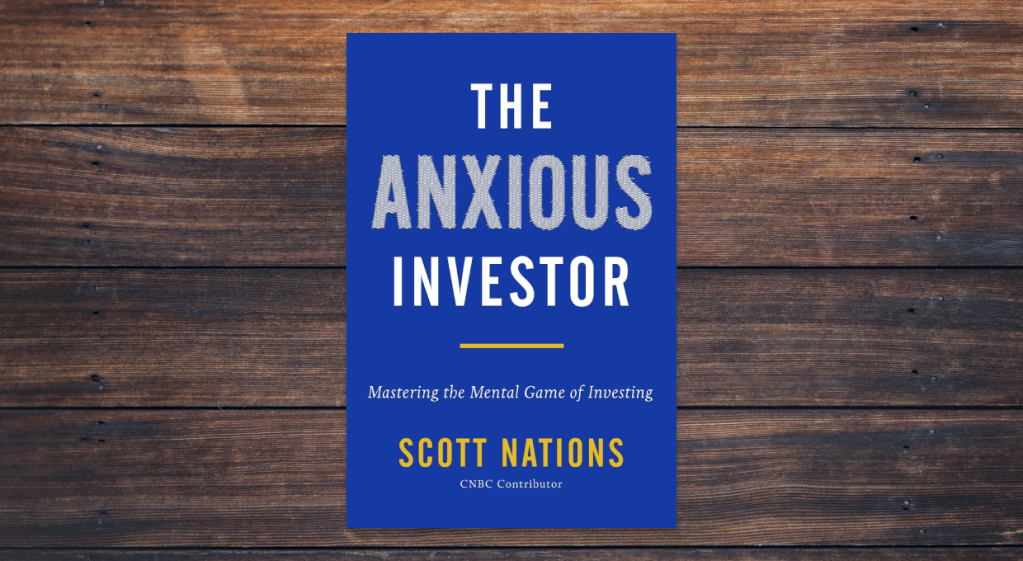
Investing is often framed as a math problem, but in reality it is just as much a psychological one. Fear, uncertainty, and overreaction drive many poor financial decisions, especially during periods of market volatility. The Anxious Investor by Scott Nations focuses squarely on this emotional side of investing, aiming to help readers understand why they feel anxious about money and how to invest more rationally despite those feelings.
This book is written for everyday investors who feel overwhelmed by market noise, financial media, and the constant temptation to act when doing nothing might be the better choice.
Who is Scott Nations?
Scott Nations is a financial professional with decades of experience in the markets. He has worked as a trader, market commentator, and educator, frequently explaining complex financial topics to a general audience. Nations is well known for translating market mechanics into plain English, particularly when it comes to volatility, risk, and investor behavior.
His background shows throughout the book. Rather than writing from a purely academic perspective, he draws on real market events, personal experience, and behavioral finance research to explain why investors feel anxious and how that anxiety can sabotage long-term results.
Key Lessons from The Anxious Investor
One of the book’s central messages is that anxiety is a normal and unavoidable part of investing. Markets go down. Headlines become alarming. Portfolios fluctuate. Nations argues that the problem is not anxiety itself, but how investors respond to it.
A major takeaway is the importance of understanding risk before investing. Many investors say they can tolerate risk, but their actions during downturns suggest otherwise. The book encourages readers to be honest about their emotional limits and to build portfolios that align with their true risk tolerance, not an idealized version of themselves.
Another lesson is the danger of short-term thinking. Nations repeatedly emphasizes that reacting to daily market movements is a losing strategy for long-term investors. Constantly checking account balances, watching financial news, or chasing hot investments increases stress and often leads to poor timing decisions.
The book also highlights the role of simplicity. Complicated strategies, frequent trading, and overconfidence tend to amplify anxiety. A straightforward approach that includes broad diversification, automatic investing, and a long-term focus can reduce stress while improving outcomes. This aligns well with the idea of using low-cost index funds, such as an S&P 500 fund, and letting compounding do the heavy lifting.
Finally, Nations stresses the value of process over prediction. No one can consistently forecast market tops, bottoms, or recessions. Investors who accept uncertainty and focus on controllable factors like savings rate, fees, and discipline are far more likely to succeed.
Criticisms of the Book
While The Anxious Investor offers valuable insights, it may feel repetitive for readers already familiar with behavioral finance concepts. Ideas like staying the course, avoiding emotional decisions, and ignoring market noise are reinforced frequently, sometimes without adding much new depth.
Some readers may also find that the book spends more time diagnosing anxiety than offering concrete, step-by-step solutions. While the guidance is sound, those looking for detailed portfolio construction advice or tactical investment strategies may find the content somewhat high level.
Additionally, experienced investors who already follow a disciplined, long-term plan may feel that much of the material confirms what they already know rather than challenging their assumptions.
Should You Buy The Book?
For newer investors, or for anyone who feels stressed, uncertain, or reactive when markets move, this book is a worthwhile read. It serves as a reminder that investing success is less about intelligence and more about behavior.
Readers who struggle with market downturns, worry excessively about their portfolios, or feel tempted to constantly adjust their investments will likely find reassurance and clarity in Nations’ approach. It can also be a useful companion to other books on money and investing that focus more on strategy than psychology.
If you are already comfortable with volatility and have internalized the principles of long-term investing, the book may feel less essential, though still validating.
Final Thoughts
The Anxious Investor succeeds in addressing one of the most underappreciated challenges in personal finance: managing your own emotions. Scott Nations does not promise market-beating returns or secret strategies. Instead, he offers something more realistic and more useful, a framework for understanding anxiety and preventing it from derailing your financial goals.
For investors focused on learning, budgeting, and building wealth steadily through disciplined investing, this book reinforces the idea that the best investment decision is often the one that helps you stay invested. In a world full of noise, that perspective alone makes The Anxious Investor a valuable addition to a personal finance library.











You must be logged in to post a comment.