
There are very few public intellectuals who have written with equal authority about economics, history, culture, education, and social policy across a career spanning more than five decades. Thomas Sowell is one of them. Whether you agree with his conclusions or not, engaging seriously with his ideas is a worthwhile exercise for anyone trying to develop a more rigorous understanding of how economies work, why policies succeed or fail, and how to think clearly about trade-offs. For readers interested in building genuine financial literacy, Sowell’s work represents one of the most accessible and substantive entry points available.
Early Life and Education
Thomas Sowell was born on June 30, 1930, in Gastonia, North Carolina. He was the youngest of five children, and his father died before he was born. His family moved to Harlem in New York City when he was a young child, as part of the broader Great Migration of Black Americans from the rural South to northern cities during the early and mid-twentieth century.
Sowell grew up in poverty. He left Stuyvesant High School, one of New York City’s most competitive public schools, before graduating, citing economic necessity. He worked various jobs, including as a photographer’s assistant and a Western Union messenger, before being drafted into the United States Marine Corps during the Korean War era. His time in the Marines, where he worked as a photographer, gave him his first sustained exposure to a meritocratic environment that he later credited with shaping his views on the relationship between incentives, effort, and outcomes.
After leaving the Marines, Sowell pursued his education with remarkable intensity. He earned a bachelor’s degree magna cum laude in economics from Harvard University in 1958, a master’s degree in economics from Columbia University in 1959, and a doctorate in economics from the University of Chicago in 1968. At Chicago, he studied under Milton Friedman, one of the most influential economists of the twentieth century and a central figure in the free-market tradition that would shape much of Sowell’s subsequent thinking.
Early Career and Intellectual Evolution
Sowell’s intellectual journey is itself one of the more interesting features of his biography. As a young man and early in his academic career, he held broadly left-leaning and Marxist views. His doctoral dissertation examined Marxist economics, and he approached economic questions from a perspective sympathetic to government intervention and redistribution.
His thinking shifted significantly during his late twenties and early thirties, partly as a result of what he observed working as an economist for the federal government during a summer internship at the Department of Labor. What he found, by his own account, was that government bureaucracies were frequently more concerned with their own institutional interests than with the welfare of the people they were supposed to serve. That experience planted a seed of skepticism about the mechanisms of government intervention that grew considerably over the following decades.
By the time he completed his doctorate and began his academic career in earnest, Sowell had moved firmly into the free-market, classical liberal tradition associated with the Chicago School. He held faculty positions at several institutions, including Cornell University, Brandeis University, and UCLA, before joining the Hoover Institution at Stanford University in 1980. He remained at the Hoover Institution as a senior fellow for the rest of his active career, retiring from his syndicated newspaper column in 2016.
The Scope of His Work
Sowell has authored more than 30 books, a body of work that is unusual both for its volume and its range. His writing spans technical academic economics, accessible popular economics, social history, cultural analysis, and commentary on education, race, and public policy. A brief survey of his major works gives a sense of how wide that range actually is.
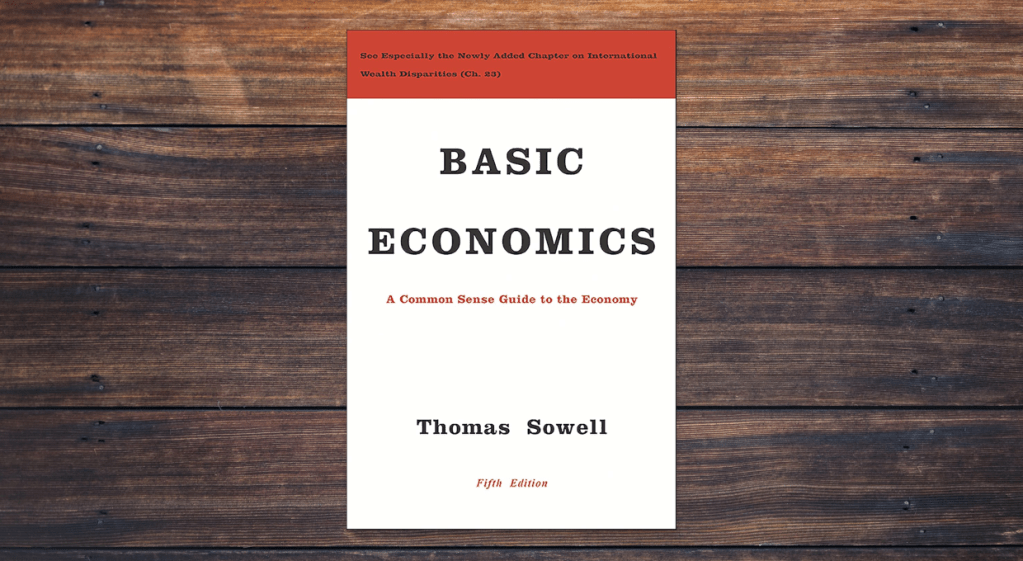
Basic Economics, first published in 2000 and now in its fifth edition, is probably his most widely read book. It is an introduction to economic thinking written entirely without graphs, equations, or jargon, aimed at general readers who want to understand how markets work and why so many well-intentioned policies produce counterproductive results.
A Conflict of Visions, published in 1987, is perhaps his most intellectually ambitious work. In it, Sowell argues that most political and ideological disagreements ultimately trace back to two fundamentally different assumptions about human nature, what he calls the constrained vision, which holds that human nature is fixed and that social systems must work within those limits, and the unconstrained vision, which holds that human beings are capable of substantial improvement through the right institutions and education. This framework has influenced thinkers across the ideological spectrum and is worth reading regardless of where you fall politically.
The Vision of the Anointed, published in 1995, applies that framework to contemporary social policy, arguing that a certain class of intellectuals and policymakers systematically ignore evidence that contradicts their preferred conclusions. Intellectuals and Society, published in 2009, extends that argument further.
His three-volume work on cultural history, Race and Culture, Migrations and Cultures, and Conquests and Cultures, published in the 1990s, examines how geographic, cultural, and historical factors have shaped economic outcomes across different populations and regions of the world. These books are dense and require patience, but they offer a genuinely distinctive perspective on questions of inequality and economic development.
The Thomas Sowell Reader, published in 2011, is a useful anthology for readers who want a curated introduction to his thinking across multiple domains before committing to his longer works.
His Core Ideas
Several themes run consistently through Sowell’s work and are worth understanding as a foundation for engaging with his books.
The most central is the idea of trade-offs. Sowell argues repeatedly that there are no solutions, only trade-offs. Every policy choice, every resource allocation, every financial decision involves giving something up in order to get something else. The failure to reckon honestly with those trade-offs, he believes, is the root cause of most bad policy and most muddled economic thinking. For personal finance readers, this is a principle with direct practical application. Every dollar spent is a dollar not saved or invested. Every financial decision has an opportunity cost.
A second core idea is the distinction between intentions and results. Sowell is relentlessly focused on outcomes rather than motives. He argues that evaluating a policy by the good intentions behind it, rather than by the evidence of its actual effects, is a form of intellectual dishonesty. This applies to government policy and to personal financial decisions alike.
A third theme is the importance of knowledge, specifically its dispersal and limits. Drawing on the work of Friedrich Hayek, Sowell argues that no central authority, whether a government agency or a corporate board, can possess the full range of local, specific, and constantly changing knowledge that is distributed across millions of individuals in a functioning economy. Prices, in this view, are not just numbers but information systems that coordinate behavior across vast networks of people who will never meet or communicate directly. Interfering with price signals, even with good intentions, disrupts that coordination in ways that are difficult to predict and often costly.
Criticism and Controversy
Sowell is not without his critics, and a fair assessment of his work requires acknowledging where the pushback comes from.
The most substantive criticism is that his writing often presents a particular school of economic thought as settled economic science when many of the questions he addresses remain genuinely contested among professional economists. On topics like the minimum wage, rent control, and immigration, Sowell tends to present the market-oriented position with a confidence that critics argue is not fully warranted by the empirical evidence.
His work on race and culture has drawn criticism from scholars who argue that he underweights the role of systemic discrimination and historical injustice in explaining economic disparities, focusing instead on cultural and behavioral factors in ways that, critics contend, can shift moral responsibility in misleading directions. These are serious debates with serious people on both sides, and readers are best served by engaging with multiple perspectives rather than treating any single author as the final word.
What is less contested is that Sowell is a careful, clear, and intellectually serious writer who forces his readers to examine their assumptions. That alone makes his work valuable, even for those who ultimately disagree with his conclusions.
Why His Work Matters for Financial Literacy
Building genuine financial literacy is not only about mastering spreadsheets, understanding index funds, or knowing what a high-yield savings account is, though all of those things matter. It is also about developing a framework for thinking clearly about economic claims, policy proposals, and financial decisions under uncertainty.
Sowell’s work contributes to that framework in concrete ways. His insistence on thinking through second-order effects, his focus on incentives rather than intentions, and his emphasis on the limits of centralized knowledge all translate directly into more disciplined personal financial thinking. The investor who asks not just what a financial product promises but what incentives it creates for the person selling it is applying a distinctly Sowellian lens. So is the person who evaluates a budgeting strategy not by how good it feels in the first week but by whether the incentive structure it creates is sustainable over years.
Basic Economics is the natural starting point for readers new to his work. From there, A Conflict of Visions offers a deeper engagement with the philosophical underpinnings of his thinking. Paired with books like The Wealth of Nations by Adam Smith, Thinking, Fast and Slow by Daniel Kahneman, and The Worldly Philosophers by Robert Heilbroner, Sowell’s work forms part of a reading foundation that will serve any serious student of money and markets for a long time.
A Life’s Work in Perspective
Thomas Sowell turned 90 in 2020. His career spans a period of extraordinary change in American economic life, from the postwar expansion through the stagflation of the 1970s, the market liberalization of the 1980s, the technology boom of the 1990s, the financial crisis of 2008, and the economic disruptions of the pandemic era. He wrote about all of it, consistently and with a clarity of purpose that is rare in any field.
Whether you read him as a guide, a foil, or simply a rigorous thinker worth arguing with, Thomas Sowell is one of the most important economic writers of the past century. His books are widely available, inexpensive, and written to be understood. For anyone serious about financial literacy, that combination is hard to pass up.









 Winchell House
You must be logged in to post a comment.