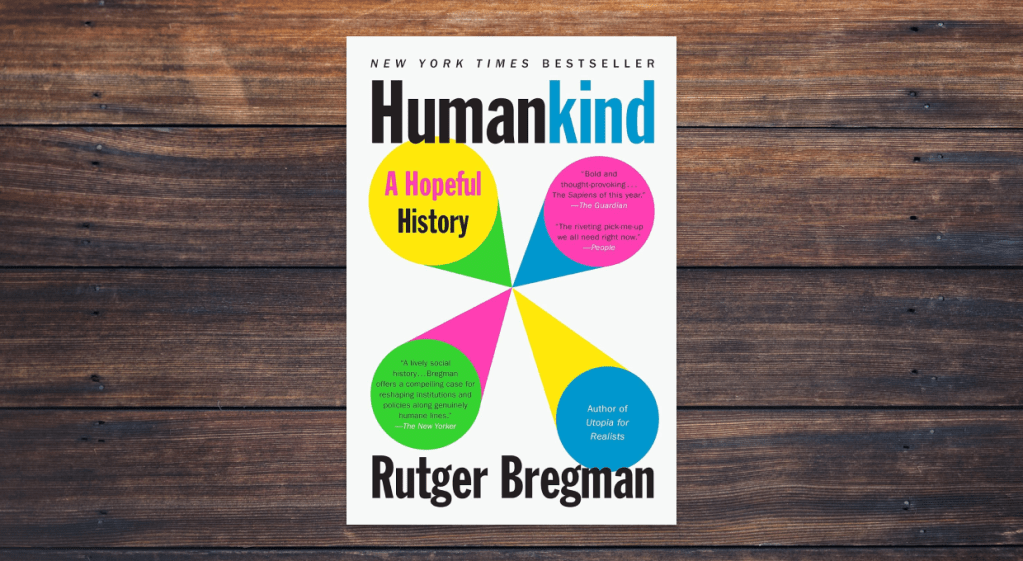
There is a story most of us have internalized about human nature, one that shows up in political philosophy, economic theory, news coverage, and casual conversation. The story goes something like this: people are fundamentally selfish, that civilization is a thin veneer over a violent and chaotic core, and that without laws, institutions, and the constant threat of punishment, human society would quickly descend into something resembling Lord of the Flies. Rutger Bregman’s Humankind: A Hopeful History, published in Dutch in 2019 and in English in 2020, sets out to dismantle that story. He argues, with considerable energy and a formidable stack of research, that the pessimistic view of human nature is not only wrong but demonstrably, consequentially wrong, and that replacing it with a more accurate picture would change how we design our institutions, our workplaces, our schools, and our financial systems. It is a provocative, readable, and genuinely important book that deserves serious engagement even from readers who ultimately find its optimism incomplete.
Who Is Rutger Bregman?
Rutger Bregman was born in 1988 in the Netherlands and studied history at Utrecht University and UCLA. He works as a journalist and author for De Correspondent, a Dutch platform known for long-form, in-depth journalism funded by readers rather than advertisers. He has written several books, but his two most widely read works in English are Utopia for Realists, published in English in 2016, which argued for universal basic income, a 15-hour work week, and open borders, and Humankind, which represents a deeper philosophical project concerned with the underlying assumptions about human nature that shape those and other policy debates.
Bregman became internationally recognizable in 2019 when a video of him challenging the assembled billionaires at the World Economic Forum in Davos to pay more taxes went viral, accumulating tens of millions of views. That moment captured something essential about his public persona: a willingness to say plainly what many economists and journalists are reluctant to say in rooms where it might be unwelcome. Humankind reflects the same directness applied to a question that is at once more fundamental and more personal than tax policy.
What the Book Is About
Humankind is a work of popular history and social science that challenges what Bregman calls the veneer theory of civilization, the idea that human decency is superficial and that our true nature is selfish, aggressive, and tribalistic. He argues that this view, which he traces through thinkers from Thomas Hobbes to Sigmund Freud to Richard Dawkins, has shaped modern institutions in ways that are self-defeating, creating systems premised on distrust that actually bring out the worst in people rather than the best.
Bregman builds his case by revisiting some of the most famous studies and stories that have been used to support the pessimistic view of human nature and arguing that many of them are misrepresented, methodologically flawed, or outright fabricated. His examination of the Stanford Prison Experiment, Stanley Milgram’s obedience studies, and the story of Kitty Genovese, whose 1964 murder was long cited as evidence that bystanders will not intervene to help strangers, are among the most compelling sections of the book. In each case, he argues that the popular version of the story is significantly different from what the evidence actually shows.
He supplements these debunkings with a wide range of positive examples, from archaeological evidence suggesting that early human societies were more peaceful and egalitarian than previously assumed, to case studies of organizations and communities that have thrived by extending trust and autonomy to people rather than treating them as problems to be managed. His examples include a Norwegian prison system premised on rehabilitation and mutual respect, a school in the Netherlands that replaced hierarchical administration with student and teacher autonomy, and a Dutch nursing home that gave elderly residents and their caregivers control over their own schedules and decisions.
The book’s central argument is not that people are angels or that conflict does not exist. It is that humans have a deep evolved capacity for cooperation, empathy, and prosocial behavior that has been systematically underestimated, and that building institutions around that capacity rather than around the assumption of selfishness produces better outcomes.
Lessons Readers Can Take Away
The most important lesson in Humankind for anyone thinking seriously about money and financial behavior is the relationship between the assumptions we make about people and the systems we design as a result. Economics has long been built around the model of homo economicus, the rational, self-interested actor who maximizes personal utility in every decision. Bregman argues that this model is not just incomplete but actively misleading, and that designing financial and social systems around it tends to crowd out the cooperative and altruistic behaviors that people are also genuinely capable of.
For personal finance readers, this has a practical dimension. Research in behavioral economics, including work by Nobel laureates Daniel Kahneman and Richard Thaler, has consistently shown that people are not the purely rational actors classical economics assumes. They are influenced by social norms, loss aversion, present bias, and a genuine concern for fairness that cannot be reduced to self-interest. Understanding that your financial decisions are shaped by these deeply human tendencies, rather than by cold calculation, is the first step toward designing a financial life that works with your nature rather than against it.
Automatic savings contributions, for example, work precisely because they remove the decision from the domain of willpower and rational calculation. Investment strategies built around simplicity and consistency, such as regular contributions to a low-cost S&P 500 index fund, work partly because they reduce the opportunities for anxiety, overconfidence, and social comparison to interfere with good long-term behavior. These are not just tactical recommendations. They reflect an accurate understanding of what human beings are actually like, which is exactly what Bregman is arguing for.
A second lesson concerns the corrosive effect of institutional distrust. Bregman documents multiple cases in which organizations that replaced surveillance, rigid rules, and top-down control with trust and autonomy saw dramatic improvements in productivity, wellbeing, and outcomes. The parallel for personal finance is the difference between budgeting systems built around shame and restriction versus those built around awareness and intentional choice. Tools like YNAB are effective partly because they frame budgeting as a tool for clarity and agency rather than a mechanism of punishment. That framing matters more than most financial advice acknowledges.
A third lesson is about the news media and its effect on financial anxiety. Bregman devotes considerable attention to the psychological effects of consuming news that is systematically biased toward conflict, crisis, and the worst examples of human behavior. This has direct relevance for investors. Financial media is similarly biased toward alarm, and the investors who check their portfolios daily, consume financial news constantly, and react to every market fluctuation tend to dramatically underperform those who invest systematically and look away. Bregman’s argument that the news gives us a distorted picture of reality is a useful reminder that the financial picture painted by cable news and financial media is equally distorted.
Criticisms of the Book
Humankind has been widely praised, but it has attracted substantive criticism that a fair review must engage with honestly.
The most serious criticism is that Bregman occasionally overreaches in his debunkings. His treatment of the Milgram obedience experiments, for example, draws on legitimate critiques of the original methodology but arguably overstates the degree to which the new research undermines Milgram’s broader conclusions. Critics have pointed out that more recent replications of similar paradigms continue to find troubling levels of compliance with authority, even if the specific dynamics differ from Milgram’s original framing. Similarly, his revisionist account of the Stanford Prison Experiment, while drawing on genuine and important critiques, sometimes presents emerging scholarship as more settled than it actually is.
A second criticism is that Bregman’s selection of positive examples, the Norwegian prisons, the Dutch schools, the self-managing nursing homes, is subject to the same selection bias he accuses pessimists of applying to their negative examples. For every institutional experiment built on trust that succeeded, there are others that struggled or failed, and the book does not engage seriously with the conditions under which trust-based systems break down or are exploited.
A third criticism, familiar from Utopia for Realists, is that the book’s optimism about human nature places it in what Thomas Sowell would call the unconstrained vision, and that it shares that tradition’s tendency to underweight the genuine constraints that human nature also imposes. Cooperation, empathy, and prosocial behavior are real and important features of human psychology. So are tribalism, in-group favoritism, and the capacity for cruelty toward out-groups. A complete picture of human nature requires holding both sides of that reality, and Bregman’s emphasis on the hopeful side, while a useful corrective to excessive pessimism, can feel incomplete as a full account.
A fourth criticism is that the book’s policy implications are underdeveloped. It ends with a set of practical suggestions for living more in accordance with a hopeful view of human nature, but these are fairly general and do not engage seriously with the institutional design challenges that replacing distrust-based systems with trust-based ones would actually involve.
Should You Buy This Book?
Yes, and it is one of the more genuinely thought-provoking reads available in the current popular social science landscape.
Humankind does something rare and valuable: it takes a widely held assumption, one that shapes economics, politics, law, and personal financial behavior, and subjects it to serious empirical scrutiny. Whether or not you accept every argument Bregman makes, engaging with the evidence he presents and the questions he raises will make you a more careful thinker about human motivation, institutional design, and the psychological dimensions of financial decision-making.
It pairs naturally with Thinking, Fast and Slow by Daniel Kahneman, which provides a more rigorously researched account of the cognitive mechanisms that drive human behavior, and with The Psychology of Money by Morgan Housel, which applies behavioral insights specifically to investment and financial decision-making. Reading all three together gives you a substantially richer understanding of why people make the financial decisions they do than any single book can provide on its own.
For readers who have engaged with Bregman’s earlier work, Utopia for Realists, Humankind represents a more philosophically grounded and more personally ambitious project. It is the book that explains the view of human nature underlying his policy proposals, and it is the stronger of the two works.
Final Thoughts
Humankind is ultimately a book about what we believe people are capable of and how those beliefs shape what we build. That question is more relevant to personal finance than it might initially appear. The financial strategies that actually work over a lifetime, systematic investing, automatic savings, living below your means, staying the course during market volatility, all require a degree of trust in your own future behavior and a degree of patience with human imperfection, both your own and other people’s. They require believing that steady, unspectacular effort compounds into something meaningful over time.
That is, in its own quiet way, a hopeful view of what people are capable of. Bregman would probably recognize it as such.
The book is imperfect, occasionally overconfident, and could benefit from a more serious engagement with counterevidence. But its core argument, that the story we tell about human nature matters enormously because it shapes the institutions we build and the choices we make, is one worth taking seriously. Read it with a critical eye and an open mind, and it will leave you thinking differently about the assumptions you carry into every financial decision you make.











You must be logged in to post a comment.