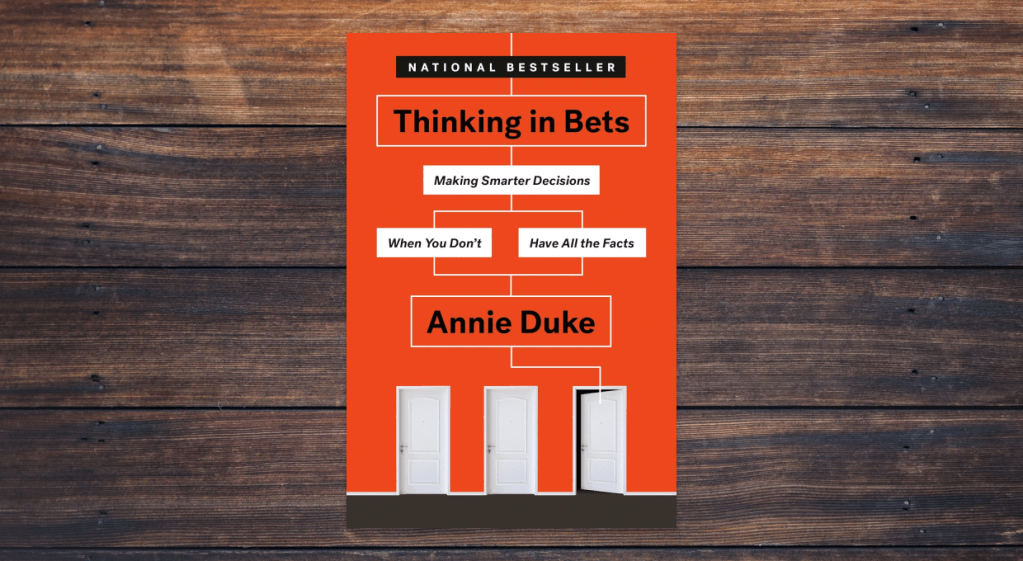
Most people evaluate their decisions by their outcomes. If something worked out well, it was a good decision. If it went badly, it was a poor one. Annie Duke’s Thinking in Bets: Making Smarter Decisions When You Don’t Have All the Facts, published in 2018, argues that this is one of the most pervasive and damaging cognitive errors we make, and that learning to separate the quality of a decision from the quality of its outcome is one of the most valuable intellectual skills a person can develop. For investors, financial planners, and anyone trying to make better decisions under uncertainty, this book offers a framework that is both practically useful and intellectually honest in ways that most decision-making literature is not.
Who Is Annie Duke?
Annie Duke was born in 1965 in Concord, New Hampshire, into an academically oriented family. Her father was a teacher and her brother Howard Lederer became a prominent poker player, which eventually drew her toward the game as well. She studied psychology at Columbia University and was pursuing a PhD in cognitive psychology at the University of Pennsylvania under Irv Gottesman when a fellowship fell through and she temporarily relocated to the southwest with her then-husband. That detour led her to poker, and what began as a way to make ends meet became a two-decade professional career.
Duke became one of the most successful poker players in the world, winning the World Series of Poker Tournament of Champions in 2004 and the NBC National Heads-Up Poker Championship in 2010. She earned more than four million dollars in tournament winnings before retiring from professional play in 2012. Since retiring, she has worked as a consultant, speaker, and author focused on decision-making, corporate strategy, and cognitive bias. She is also a co-founder of the Alliance for Decision Education, a nonprofit dedicated to improving decision-making skills in schools.
Her background in cognitive psychology combined with her experience making high-stakes decisions under uncertainty across thousands of hours of professional poker gives her an unusually credible platform for writing about decision-making. She is not a theorist describing the process from the outside. She is someone who spent two decades being financially rewarded or punished for the quality of her thinking in real time.
What the Book Is About
The central premise of Thinking in Bets is that most consequential decisions in life resemble poker more than chess. Chess is a game of perfect information. Both players can see the entire board. Skill is the dominant factor in outcomes. Poker, by contrast, is a game of incomplete information. You cannot see your opponents’ cards. Luck plays a significant role in any individual outcome. The best player will not win every hand, and even poor decisions will sometimes produce good results. Over a large enough sample, skill dominates, but in any given instance, the relationship between decision quality and outcome quality is loose and unreliable.
Duke argues that life, investing, careers, and relationships all work this way. We make decisions based on incomplete information, and chance plays a real role in how those decisions turn out. The investor who puts money into a well-researched company that subsequently fails due to an unforeseen event did not necessarily make a bad decision. The investor who bought a poorly researched stock that happened to triple did not necessarily make a good one. Evaluating decision quality by outcome quality, which Duke calls resulting, is a systematic error that prevents us from learning accurately from experience.
The book introduces the concept of thinking in bets as a corrective. A bet forces you to assign probabilities, acknowledge uncertainty, and commit to a position while recognizing that you could be wrong. Rather than saying something is true or false, the betting frame asks how confident you are and what evidence would change your mind. Duke argues that adopting this frame habitually produces better decisions, more accurate beliefs, and a healthier relationship with both success and failure.
The book also covers related concepts including motivated reasoning, the tendency to evaluate evidence based on whether it supports what we already believe; the distinction between luck and skill in outcomes; the value of seeking out people who will challenge your thinking rather than validate it; and the importance of thinking about decisions from the perspective of your future self rather than your present emotional state.
Lessons Readers Can Take Away
The most immediately applicable lesson for personal finance and investing is the separation of decision quality from outcome quality. Markets are full of noise. Even excellent investment decisions, made with careful research and sound reasoning, will sometimes produce poor short-term results. Even terrible investment decisions will sometimes produce good ones. The investor who abandons a well-reasoned long-term strategy after a bad quarter because the outcome was bad, and concludes the strategy itself was wrong, is committing exactly the error Duke describes. So is the investor who doubles down on a poorly reasoned strategy because it happened to work once.
The practical implication is that evaluating your financial decisions should focus primarily on the quality of your reasoning at the time you made them, the information you had access to, the process you used, and whether your assumptions were sound, rather than primarily on whether they produced good outcomes. A well-reasoned decision to contribute consistently to a diversified S&P 500 index fund is a good decision regardless of what the market does in any given year. Judging it by short-term results rather than by the soundness of the underlying reasoning is how investors make avoidable mistakes.
A second valuable lesson concerns the concept of resulting as it applies to financial regret. Many investors carry significant regret about financial decisions that turned out badly and tend to attribute those outcomes entirely to their own failure of judgment. Duke’s framework invites a more honest accounting. How much of the bad outcome was foreseeable given what you knew at the time? How much was attributable to genuinely unpredictable chance? Separating those two components is uncomfortable because it requires accepting that you cannot always control outcomes, only processes. But that acceptance is exactly what allows you to improve your decision-making over time rather than simply feeling bad about results.
A third lesson involves the value of what Duke calls a truth-seeking pod, a group of people who are committed to giving you honest feedback rather than validation. In investing and personal finance, the equivalent might be a trusted financial advisor who will tell you what you need to hear rather than what you want to hear, or a community of investors who hold each other accountable to process rather than celebrating each other’s wins and minimizing each other’s losses. The most reliable path to better financial decisions runs through honest feedback, not comfortable agreement.
A fourth lesson involves temporal discounting and the conflict between your present and future self. Duke argues that many poor decisions happen because we give too much weight to our present emotional state and too little to the interests of our future self. The person who cashes out their retirement account to cover a short-term expense, the investor who sells during a market panic, and the consumer who takes on high-interest debt for an immediate purchase are all, in Duke’s framework, making decisions that their future self will pay for. Building financial systems that reduce the influence of present-self emotional states, through automatic savings, long investment time horizons, and clear written investment policies, is a direct application of her thinking.
Criticisms of the Book
Thinking in Bets is a strong and genuinely useful book, but it has limitations worth acknowledging.
The most common criticism is that the book’s central insight, separating decision quality from outcome quality, is introduced clearly and compellingly in the early chapters but is then stretched across a book-length treatment that occasionally feels like it is repeating the same core point in slightly different contexts. Some readers find that the book’s ideas are fully absorbed within the first third and that the later chapters, while adding supporting material, do not substantially deepen the framework. A tighter, shorter book might have served the ideas better.
A second criticism is that the poker metaphors, while illuminating in many contexts, occasionally strain when applied to personal and financial situations that differ from poker in important ways. Poker is a zero-sum game with clear rules and quantifiable probabilities. Many real-world decisions involve genuine moral dimensions, relationship dynamics, and uncertainties that are not reducible to probability estimates in the way Duke’s framework sometimes implies. The betting frame is a useful heuristic, but it is not a complete theory of decision-making under uncertainty.
A third criticism is that the book’s advice, while sensible, is easier to articulate than to implement. Knowing that you should separate outcomes from decisions, seek honest feedback, and think probabilistically does not automatically produce the behavioral changes those habits require. The gap between intellectual understanding and actual behavioral change is significant, and Thinking in Bets does not engage as deeply with the mechanics of that change as books specifically focused on habit formation, such as Atomic Habits by James Clear, tend to do.
A fourth criticism is that Duke’s examples occasionally favor cases where her framework applies cleanly and underrepresent the messier situations where the lines between skill, luck, process, and outcome are genuinely difficult to draw. The real world of investing and personal finance is full of those messier situations.
Should You Buy This Book?
Yes, particularly for anyone who invests money, makes significant financial decisions, or is interested in understanding the cognitive mechanisms that lead to poor choices under uncertainty.
Thinking in Bets belongs on the same shelf as Thinking, Fast and Slow by Daniel Kahneman and The Psychology of Money by Morgan Housel. All three books approach human decision-making from different angles but arrive at overlapping and mutually reinforcing insights about why smart people make avoidable financial mistakes and what can be done about it. Duke’s contribution is the most accessible of the three in terms of pacing and readability, and her poker background gives her examples a vividness and credibility that purely academic treatments of the same material sometimes lack.
For investors specifically, the book’s core insight about resulting has immediate and practical value. The single most destructive pattern in retail investing is abandoning sound long-term strategies in response to short-term outcomes, buying after markets rise and selling after they fall, based on the implicit assumption that recent results are reliable signals of decision quality. Duke gives you a clear and memorable framework for recognizing and resisting that error.
At its length and price, it is a reasonable investment of both money and time, and it is likely to pay dividends in the quality of your financial thinking for years after you finish it.
Final Thoughts
Thinking in Bets is a book about intellectual honesty under uncertainty. It asks you to accept that you will never have all the information you want before making consequential decisions, that luck will always play a role in how those decisions turn out, and that the only thing genuinely within your control is the quality of your reasoning process. That is an uncomfortable message in a culture that tends to celebrate outcomes regardless of process and blame individuals for results that were substantially determined by chance.
But it is an accurate message, and accuracy is exactly what good financial decision-making requires. The investor who understands this distinction approaches the market with a fundamentally different, and considerably healthier, psychology than one who does not. They stay the course during downturns because they understand that a falling portfolio does not necessarily mean a poor investment decision was made. They avoid chasing performance because they understand that a rising portfolio does not necessarily mean a good one was. They build their financial lives around sound processes and give those processes the time they need to work, which is precisely what decades of evidence on long-term investing consistently recommends.
Annie Duke did not set out to write a personal finance book, but she produced one of the most useful frameworks for financial thinking published in the past decade. That is worth recognizing and worth reading.











You must be logged in to post a comment.