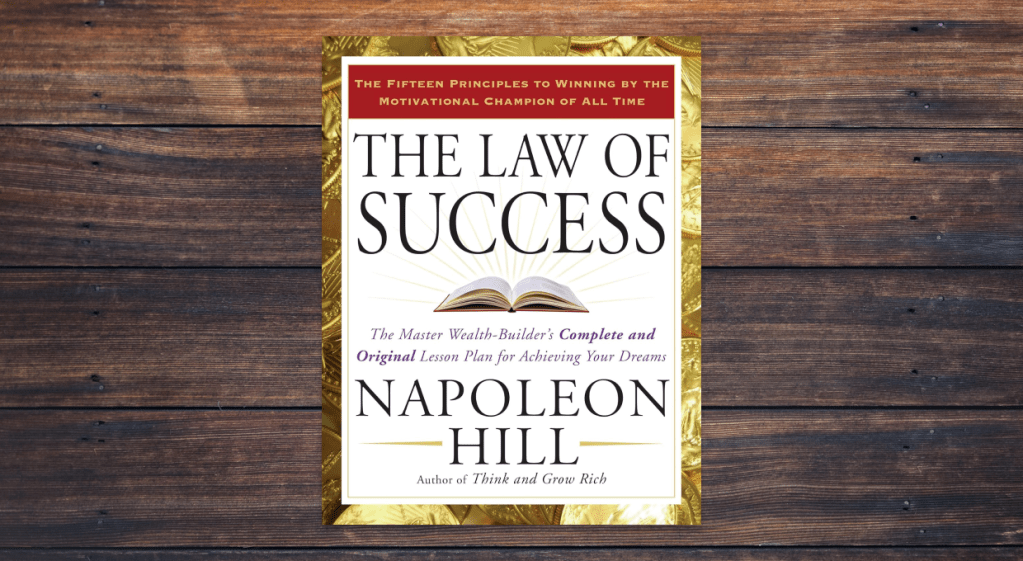
Before Think and Grow Rich became one of the best-selling self-help books in history, there was The Law of Success. Originally published in 1928 as a multi-volume course and later condensed into a single volume, it represents Napoleon Hill’s first major attempt to codify what he believed were the universal principles behind wealth and achievement. It is a longer, more sprawling, and in some ways more honest book than its famous successor, and for readers who want to understand Hill’s thinking at its most unfiltered, it is the more illuminating of the two works. Whether it is the more useful one is a separate question.
Who Is Napoleon Hill?
Napoleon Hill was born on October 26, 1883, in a one-room cabin in Pound, Virginia. He grew up in poverty in rural Appalachia and began writing for small newspapers as a teenager. His trajectory changed in 1908 when he was assigned to interview Andrew Carnegie, then one of the wealthiest men in the world, for a magazine profile. According to Hill’s own account, Carnegie was so impressed by the young journalist that he spent three days with him and then commissioned him to spend the next twenty years interviewing successful people to identify the common principles behind their achievements.
That origin story, the poor mountain boy chosen by Carnegie to unlock the secrets of success, is central to Hill’s personal mythology and to the authority his books claim. It is also largely unverifiable. No independent documentation has been found to confirm that Carnegie formally commissioned Hill or that Hill had the extensive access to figures like Henry Ford, Thomas Edison, and Theodore Roosevelt that he repeatedly claimed throughout his career.
What is documented is that Hill spent decades writing, lecturing, and selling courses on success philosophy. He founded several magazines and organizations, many of which failed. He was investigated for fraud on multiple occasions and made and lost money several times over. He died in 1970, leaving behind a complicated legacy that includes books that have genuinely inspired millions of readers and a personal history that is considerably messier than the success gospel he preached.
What the Book Is About
The Law of Success is organized around fifteen principles that Hill argues are the foundation of all lasting achievement. These include having a definite chief aim, developing self-confidence, forming a habit of saving, developing a pleasing personality, practicing self-control, cultivating accurate thinking, concentrating attention, cooperating with others, benefiting from failure, practicing tolerance, and what Hill calls the golden rule of doing unto others as you would have them do unto you.
The book is didactic in structure, more like a course than a narrative. Each chapter addresses one principle, providing explanation, supporting anecdotes drawn from Hill’s interviews and research, and practical exercises meant to help readers internalize and apply the principle. The tone throughout is confident to the point of certainty, which is characteristic of Hill’s writing voice generally.
The overarching argument is that success is not primarily a matter of circumstance, inheritance, or luck. It is the result of a specific set of habits, attitudes, and mental practices that anyone can develop through deliberate effort. Hill believed that the mind has powers that most people never access, and that definiteness of purpose combined with persistent effort and the right mental orientation will eventually produce material results.
Compared to Think and Grow Rich, The Law of Success is more grounded and more practical. The metaphysical elements, the mastermind principle, the role of the subconscious, and the idea that thoughts have a kind of magnetic attraction toward corresponding physical realities, are present but less dominant. The book spends more time on concrete habits and behaviors, which gives it more durable practical value than Hill’s later, more mystical work.
Lessons Readers Can Take Away
The most valuable lesson in the book, and the one that holds up best under scrutiny, is the principle of definiteness of purpose. Hill argues with considerable force that most people fail not because they lack ability but because they lack a clear, specific goal around which they organize their efforts. Vague aspirations produce vague results. The person who decides precisely what they want, writes it down, and organizes their daily decisions around pursuing it is operating from a fundamentally different position than the person who wants things generally but pursues nothing specifically.
For personal finance readers, this translates directly. The research on financial goal-setting consistently shows that people who have specific, written financial goals, a target retirement date, a specific savings rate, a defined investment strategy, consistently outperform those who invest and save in a general, unstructured way. The mechanism Hill is describing, the focusing power of a clear objective, is real even if his explanation of why it works is more mystical than modern behavioral science would endorse.
A second lesson worth keeping is what Hill calls the habit of saving. He is emphatic that financial security requires paying yourself first, living below your means, and building a cushion before spending on wants. This is foundational personal finance advice that predates the modern emergency fund concept by decades, and Hill articulates it clearly. The specifics of where to park savings have obviously changed since 1928, but high-yield savings accounts and short-term treasury bills are the modern equivalents of the disciplined saving habit Hill describes.
A third lesson concerns the psychology of failure. Hill devotes significant attention to the idea that every failure contains the seed of an equivalent benefit, that setbacks are information rather than verdicts. This is not original to Hill, versions of this idea appear in Stoic philosophy, in the work of Emerson, and in countless other traditions but he makes it accessible and repeatable in ways that have clearly resonated with readers for nearly a century. For anyone navigating financial difficulty, the reorientation from failure as permanent to failure as instructive is practically valuable.
A fourth lesson is about the compound effect of habits. Hill consistently emphasizes that the principles he describes are not tricks or shortcuts but habits that must be practiced until they become automatic. That framing is more honest than much of the self-help genre, which tends to promise transformation through insight alone. The actual mechanism of behavioral change, which modern psychology understands considerably better than Hill did, is repetition and system-building rather than revelation.
Criticisms of the Book
The Law of Success carries all of the problems that attend Hill’s work generally, plus a few specific to its age and format.
The most fundamental criticism is the verification problem. Hill’s authority rests almost entirely on his claimed relationships with Carnegie, Ford, Edison, and other titans of the Gilded Age and Progressive Era. Academic researchers and investigative journalists who have examined Hill’s biography in detail have found that many of his claims about these relationships are either exaggerated or fabricated. His son Blair, who was born deaf, appears in Hill’s books as a success story about the power of positive thinking. The actual details of Blair’s life, as documented by family members and journalists, are considerably more complicated and less triumphant than Hill’s telling. When the evidentiary basis of an entire philosophy turns out to be unreliable, it raises legitimate questions about how much weight to give the philosophy itself.
A second criticism is the book’s racial and social views. Written in the late 1920s, it reflects the prejudices of that era in ways that modern readers will find uncomfortable and that deserve acknowledgment rather than simply being skipped past. Hill’s worldview is explicitly built around the idea that success is available to anyone who applies his principles, but his conception of anyone was considerably narrower than the universal language implies.
A third criticism is the book’s length and repetition. The original multi-volume format inflated the content significantly, and even the condensed single-volume version covers the same conceptual ground multiple times from slightly different angles. A more rigorous editorial hand would have produced a considerably shorter and more useful book.
A fourth criticism is the metaphysical framework. Hill’s claim that thoughts literally attract corresponding physical realities through some kind of mental magnetism has no scientific support and has caused real harm when readers have interpreted it to mean that poverty, illness, or failure are simply the result of not thinking correctly. That interpretation shifts blame onto individuals for systemic conditions entirely outside their control.
Should You Buy This Book?
It depends significantly on where you are in your reading on this subject.
If you have already read Think and Grow Rich and found it useful, The Law of Success offers a more grounded version of the same ideas that rewards the additional reading time. The practical chapters on saving, self-control, and organized effort hold up better than Hill’s more mystical writing and give you more to actually apply.
If you have not yet read widely in the personal development and personal finance space, there are better starting points. The Psychology of Money by Morgan Housel, Atomic Habits by James Clear, and Thinking, Fast and Slow by Daniel Kahneman all address the psychological dimensions of achievement and financial behavior with more rigorous evidence and more honest framing. Think and Grow Rich itself is a more focused and efficient introduction to Hill’s ideas than The Law of Success.
Where The Law of Success earns its place is as a historical document. It is one of the founding texts of the success philosophy genre, and understanding it gives you context for everything that came after, from Dale Carnegie to Tony Robbins to the contemporary self-help industrial complex. Reading it critically, with awareness of its limitations and its historical context, is a genuinely educational experience.
Final Thoughts
Napoleon Hill is one of the most influential and most contested figures in the history of personal development writing. His ideas have genuinely helped millions of people reorient their thinking about what is possible in their own lives, and that is not nothing. His personal history and the factual reliability of his books are considerably less impressive than his sales figures suggest.
The Law of Success sits in that tension without resolving it. It contains real wisdom about the importance of clear goals, consistent habits, disciplined saving, and resilience in the face of failure. It also contains claims that are unverifiable, metaphysics that are unsupported, and social attitudes that reflect the prejudices of its era.
The appropriate response to that tension is neither uncritical adoption nor wholesale dismissal. It is the same response that serves readers well with any book in this genre: extract what is useful, test it against your own experience and against more rigorously researched sources, and discard what does not hold up. That approach, applied to Hill’s work, will leave you with a handful of genuinely valuable principles about purpose, habit, and persistence that are worth keeping.
Read it alongside Think and Grow Rich, which you will find reviewed separately on this site, and alongside Mindset by Carol Dweck for a more evidence-based examination of how beliefs about ability and effort shape outcomes over time.











You must be logged in to post a comment.