
Most books about money focus on what to do: budget your income, invest in index funds, build an emergency fund. Those are good instructions. But fewer books ask a more fundamental question: why do so many people struggle to follow through, even when they know exactly what they should do?
That is where Carol S. Dweck comes in. She is not a personal finance author. She is a research psychologist. But her work sits at the center of a question that anyone trying to improve their finances will eventually face: do you believe you can change?
Who Is Carol Dweck?
Carol Susan Dweck was born on October 17, 1946, in New York City. She grew up in Brooklyn and attended Barnard College, where she earned a bachelor’s degree in psychology in 1967. She then moved to Yale University to pursue graduate studies, earning her Ph.D. in psychology in 1972.
Her academic career took her through the University of Illinois, Harvard’s Laboratory of Human Development, and Columbia University before she joined Stanford University in 2004. She currently holds the Lewis and Virginia Eaton Professorship of Psychology at Stanford, one of the most prestigious chairs in her field.
Dweck has been elected to both the American Academy of Arts and Sciences and the National Academy of Sciences. She has received numerous lifetime achievement awards, including the Distinguished Scientific Contribution Award from the American Psychological Association. Her work has been covered in the New York Times, the Wall Street Journal, Time, and Newsweek, and she has appeared on Today and Good Morning America.
What Is She Known For?
Dweck is best known for her research on what she calls mindset, which she defines as the core beliefs a person holds about whether their abilities are fixed or capable of growth.
Her framework identifies two distinct orientations. People with a fixed mindset believe that intelligence, talent, and capability are essentially predetermined. If you were not born with an aptitude for math or money or business, that is just the way it is. Effort is seen as a sign of low ability, and failure is treated as evidence of permanent limitation.
People with a growth mindset believe that abilities can be developed through dedication and learning. They treat setbacks as feedback rather than verdicts. They are more likely to persist through challenges because they believe the challenge itself is where learning happens.
Dweck’s research showed that these orientations are not just personality quirks. They predict meaningful differences in how people respond to difficulty, whether they pursue challenges, and whether they ultimately improve over time.
The Book That Made It Famous
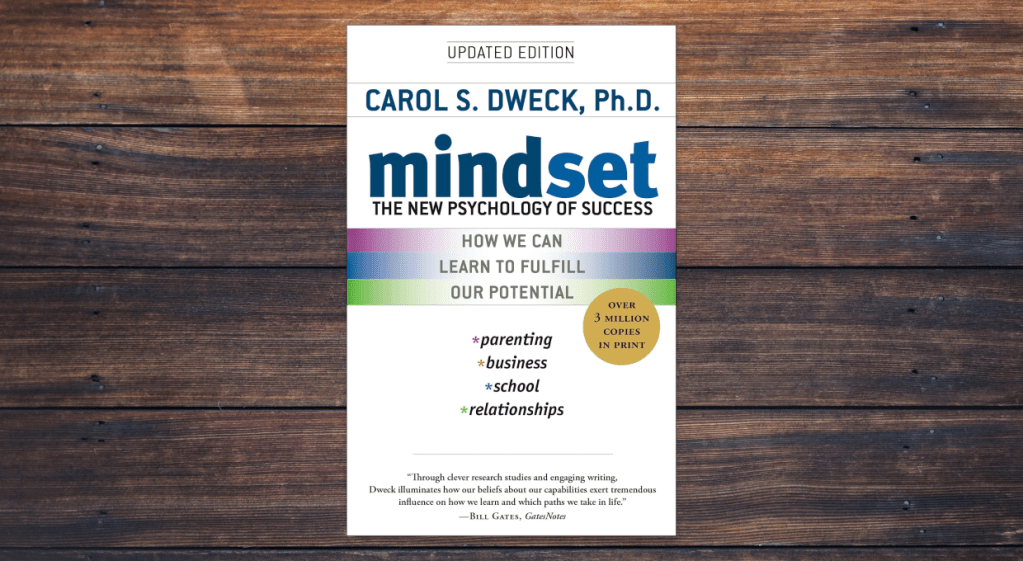
In 2006, Dweck published Mindset: The New Psychology of Success, which translated her decades of academic research into accessible language for a general audience. The book became a million-copy bestseller and has been endorsed by figures including Bill Gates, who has cited it as among the most influential books he has read on learning and human potential.
The book walks through how fixed and growth mindsets show up across different domains: school, sports, business, relationships, and parenting. In the business section, Dweck examines how leaders who believe talent is fixed tend to surround themselves with people who validate them rather than challenge them, which can lead to organizational stagnation. Leaders with a growth mindset are more likely to seek honest feedback and build teams that learn and adapt.
A later updated edition added material on what Dweck calls the false growth mindset, a superficial adoption of the language of growth without genuinely embracing its implications. Saying “I believe I can improve” while avoiding any situation that might reveal a gap is not a growth mindset. It is a fixed mindset dressed up in better vocabulary.
Why This Matters for Your Finances
Dweck never wrote a personal finance book, and applying her framework to money requires a step that she did not take herself. But the connection is not much of a stretch.
People who approach their finances with a fixed mindset often assume they are simply “not good with money.” That belief, once adopted, tends to be self-fulfilling. They avoid learning about investing because they expect not to understand it. They skip budgeting because they have already decided they cannot stick to one. They stay away from conversations about money because those conversations might confirm their worst assumptions about themselves.
A growth mindset in a financial context means treating financial literacy as a skill to be built rather than a talent you either have or do not have. It means viewing a past money mistake as information rather than identity. It means picking up a book on personal finance or investing not because you are already financially sophisticated, but precisely because you are not yet.
This is relevant to how many people approach the basics of building wealth. Learning to read a financial statement, understanding how compound interest works, setting up automatic savings, choosing between a high-yield savings account and a Treasury bill for your short-term cash, figuring out what expense ratio you are paying on an index fund: none of this is intellectually out of reach. The barrier is usually not complexity. It is the belief that this kind of thinking belongs to other people.
Her Legacy in Education, Business, and Beyond
Dweck’s influence has spread well beyond psychology departments. Her research has shaped how many schools think about praise and feedback, with teachers trained to emphasize the process of learning rather than the outcome. Businesses have incorporated growth mindset training into management development. Athletes and coaches have used the framework to help players develop resilience in competition.
Not all of the enthusiasm has been uncritical. Some researchers have struggled to replicate her findings, and Dweck has acknowledged that poorly designed interventions often fail to produce the results that careful laboratory work suggests are possible. The debate is worth knowing about. It does not invalidate the core insight, but it is a good reminder that no single framework explains everything about human motivation.
What does hold up is the basic premise: the story you tell yourself about your own capacity to learn shapes what you are willing to try. That is true in school, in business, in athletics, and in the unglamorous but consequential work of managing your own money.
The Praise Experiment That Started It All
The mindset idea did not come from a theory. It came from an experiment with fifth graders.
In 1998, Dweck and her colleague Claudia Mueller gave children problems from an IQ test and praised them for doing well. One group heard, “You must be smart at this.” The other heard, “You must have worked really hard.” That was the only difference, and it changed everything.
When the researchers offered a harder task the children could learn from, the ones praised for intelligence mostly chose the easier one, the one where they could avoid mistakes. The ones praised for effort wanted the challenge. Then everyone was given problems designed to make them fail. The intelligence-praised children lost confidence, lost enjoyment, and performed worse than they had at the very start. The effort-praised children held steady and improved, ending up roughly 30 percent ahead of where they began.
Across six studies published in the Journal of Personality and Social Psychology, the pattern held: praising intelligence taught children that ability is a fixed trait to be defended, while praising effort taught them it is a quality to be built. Dweck later found the effect across ages, backgrounds, and even preschoolers.
The money version of this experiment runs in your own head every day. “I am just not a numbers person” is a fixed identity wearing different clothes. It protects you from the discomfort of a confusing spreadsheet the same way the easier test protected those fifth graders from looking foolish. The growth mindset alternative is not positive thinking. It is the far less comfortable choice of the harder task: opening the confusing account statement, asking the embarrassing question, and treating the mistake as the study session.
A One-Sentence Practice for a Growth Mindset About Money
Dweck’s research suggests that mindsets show up in sentences, and sentences can be rewritten. Here is a practice that costs nothing and takes about a minute.
Catch one fixed-mindset sentence you say about money and add the word “yet.” “I do not understand investing” becomes “I do not understand investing yet.” “I can never stick to a budget” becomes “I can never stick to a budget yet.” The addition sounds trivial, and that is the point. It is small enough to survive contact with a bad day.
Then attach one small action to the rewritten sentence, something that takes less than ten minutes. Read one page about expense ratios. Look up what your savings account actually pays. Cancel one subscription you forgot you had. The action matters less than the loop it creates: a belief that you can change, followed by evidence that you did. Dweck’s fifth graders did not become better at math by being told they were smart. They improved by working at problems they were allowed to get wrong. Your finances work the same way.
Should You Read Mindset?
Mindset is not a personal finance book, and you will not find advice on index fund selection or debt payoff strategies between its covers. What you will find is a clear, research-backed argument for why some people keep improving and others plateau, and what separates the two groups is less about raw ability than about how they think about ability itself.
If you have ever told yourself that you are not a numbers person, that investing is for people who understand that stuff, or that you have just always been bad with money, this book is worth your time. It may not change your portfolio. But it might change the story you are telling yourself about why you have not started yet.
The Correction She Had to Make: the “False Growth Mindset”
By 2015, the growth mindset had escaped Dweck’s control. Schools were praising sheer effort and calling it a growth mindset, and she thought most of it was missing the point. In September 2015 she wrote a widely read commentary for Education Week — “Carol Dweck Revisits the ‘Growth Mindset’” — to set the record straight. “If we ‘ban’ the fixed mindset, we will surely create false growth-mindsets,” she wrote. Her point: we are all a mixture of fixed and growth mindsets, and pretending otherwise produces exactly the shallow version of the idea she was trying to fix.
The harder correction was about effort. “Certainly, effort is key for students’ achievement, but it’s not the only thing,” she wrote. Students also need new strategies to try when they are stuck, plus honest feedback — grinding away at an approach that isn’t working is not a growth mindset, it’s just grinding. Her advisee Kyla Haimovitz found the family version of the same problem: parents who endorsed a growth mindset but reacted to their children’s mistakes as though they were harmful rather than helpful ended up raising children with more of a fixed mindset about their intelligence. Kids watch what you do, not what you say.
There is a financial version of the false growth mindset too. Telling yourself you are “trying harder” with money — the same broken budget, the same willpower — feels like growth but changes nothing. The Dweck-approved move is the one she prescribed for students: when the approach keeps failing, change the strategy, not the volume. A budget that has failed three months in a row doesn’t need more effort. It needs a different budget. For more on the psychology behind money decisions, see the psychology archive.










You must be logged in to post a comment.