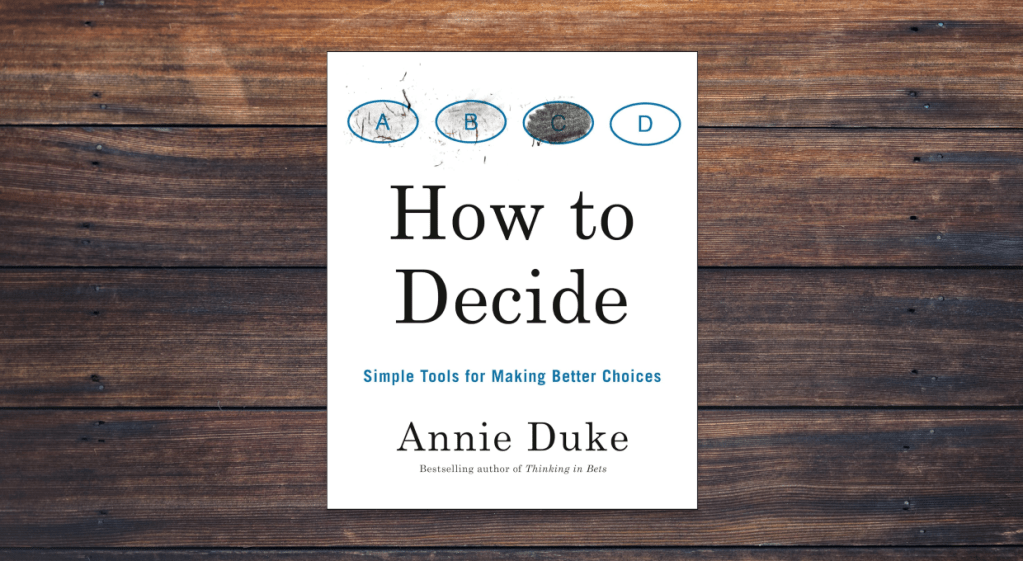
Making good decisions is one of the most underrated financial skills you can develop. You can read every investing book, track every budget line, and still blow it when it comes time to actually choose — whether that’s picking a stock, deciding when to sell, or figuring out how much risk you can stomach. How to Decide: Simple Tools for Making Better Choices by Annie Duke is one of the few books that treats decision-making as a learnable skill rather than a personality trait.
Brief Summary
How to Decide, published in 2020, is a practical guide to improving the quality of your decisions before you make them. Duke argues that most people evaluate decisions based on their outcomes — a mistake she calls “resulting.” A bad outcome doesn’t mean you made a bad decision, and a good outcome doesn’t mean you made a good one. The book introduces a set of tools and frameworks to help readers think more clearly under uncertainty, separate luck from skill, and build better decision habits over time.
The book covers topics like how to identify your own biases, how to think in probabilities rather than certainties, how to use pre-mortems and decision trees, and how to get better feedback from the outcomes you do experience. It’s structured with exercises throughout, which makes it feel less like a lecture and more like a workbook.
Who Is Annie Duke?
Annie Duke spent nearly two decades as a professional poker player, winning millions of dollars and becoming one of the most decorated players in the game’s history. She won a World Series of Poker bracelet and, in 2004, won the Tournament of Champions — beating out nine other past world champions including Phil Hellmuth and Doyle Brunson.
She left poker in 2012 and transitioned into consulting, speaking, and writing. Her first major book, Thinking in Bets published in 2018, brought her widespread recognition outside of poker circles. It became a business bestseller and introduced many readers to the idea that good decision-making is probabilistic rather than binary.
Duke has since worked with organizations in finance, healthcare, and sports, helping them build better decision processes. Her academic background is in cognitive psychology — she studied at the University of Pennsylvania under Amos Tversky collaborator Jonathan Baron before leaving to pursue poker professionally.
Key Lessons from the Book
Outcomes are not the same as decisions
This is the central idea of the book. When you judge your choices by how they turned out, you get a distorted picture of your own skill. A decision made with solid reasoning can still produce a bad outcome due to luck, and a reckless decision can look brilliant in hindsight if things happen to go right. Duke pushes readers to evaluate the quality of their reasoning at the time the decision was made, using only the information that was actually available.
For personal finance, this reframe is useful. Buying a concentrated stock position that went up does not mean it was a wise bet. Putting money in a high-yield savings account during a period when the market also did well was still the right call for someone with a short time horizon. Outcome-based thinking leads to overconfidence and, eventually, preventable losses.
Think in probabilities
Duke encourages readers to replace binary thinking (“this will work” or “this won’t”) with probabilistic thinking (“there’s about a 70% chance this works out”). This is harder than it sounds, but the practice forces you to confront uncertainty honestly rather than defaulting to false confidence.
Investors who think probabilistically tend to diversify, size positions appropriately, and avoid the kind of overconcentration that wipes people out. It’s one reason index fund investing — owning a broad slice of the market rather than betting on individual winners — holds up so well against active stock picking over long time horizons.
Use pre-mortems
Before making a decision, imagine that it has already failed. Ask yourself: what went wrong? This technique, borrowed from organizational psychology, forces you to surface risks you might otherwise dismiss in the optimism of the moment. In financial terms, this is a useful tool before making any major move — taking on debt, making a large purchase, or shifting your investment strategy.
Identify what you know and what you don’t
Duke introduces a tool she calls the “knowledge tracker,” which helps you map out what you actually know, what you think you know but might be wrong about, and what you genuinely don’t know. Most financial mistakes fall into the second category. People are often not ignorant — they’re confidently wrong.
Seek out dissenting views
Duke makes a case for building what she calls a “decision pod” — a small group of people who will challenge your reasoning rather than validate it. This mirrors the advice many value investors give about finding people who push back rather than agree. Confirmation bias is one of the most well-documented and destructive forces in personal investing.
Criticisms of the Book
The most common criticism of How to Decide is that it covers ground Duke already covered in Thinking in Bets. Readers who came to this book as fans of her earlier work may find some of the core ideas familiar, with the main difference being the addition of structured exercises and more explicit frameworks.
Some readers also find the workbook format more useful in theory than in practice. The exercises are genuinely well-designed, but most people read books passively, and the value of this one depends significantly on whether you actually engage with the prompts. Without that engagement, it can feel like a lighter version of the ideas rather than a deepening of them.
A few critics have pointed out that Duke’s examples lean heavily on poker and business contexts, which may feel removed from the day-to-day financial decisions most people face. The frameworks are transferable, but the translation isn’t always done explicitly in the text.
Finally, some readers have noted that the book is relatively short on the psychological research behind its claims. Duke’s background is in cognitive psychology and she draws on legitimate behavioral science, but readers looking for the depth of something like Daniel Kahneman’s Thinking, Fast and Slow may want to supplement this book with primary sources.
Should You Buy This Book?
Yes, with a caveat. If you have already read Thinking in Bets and are looking for new ideas, manage your expectations — this book is more of a companion piece than a sequel. It operationalizes the ideas from her first book into usable tools rather than expanding the theoretical foundation.
If you haven’t read Duke before, or if you’ve struggled to apply the ideas from Thinking in Bets to your actual decisions, How to Decide is worth your time. The frameworks are practical, the writing is clear, and the subject matter is genuinely important. Most people make financial decisions — and life decisions — with far less rigor than they apply to other areas of their lives. This book makes a convincing case that the gap can be closed with practice.
For personal finance specifically, the mindset Duke teaches pairs well with the kind of long-term, low-drama investing approach that tends to produce good outcomes over time. Understanding that you cannot control outcomes, only the quality of your process, is a useful corrective to the anxiety that drives people to sell at the bottom or chase trends at the top.
Final Thoughts
How to Decide is not a personal finance book in the traditional sense. It won’t tell you how to budget, where to open a high-yield savings account, or which S&P 500 fund to buy. What it offers is something more foundational: a framework for thinking more clearly about any decision involving uncertainty, which describes nearly every financial decision you will ever make.
The best financial outcomes tend to come not from superior information but from superior process — the discipline to think clearly when it’s emotionally difficult, to size risk appropriately, and to avoid the cognitive traps that lead otherwise smart people into expensive mistakes. How to Decide is a useful tool for building that process. Read it with a pencil and actually do the exercises. That’s when it earns its place on the shelf.









 Winchell House
You must be logged in to post a comment.