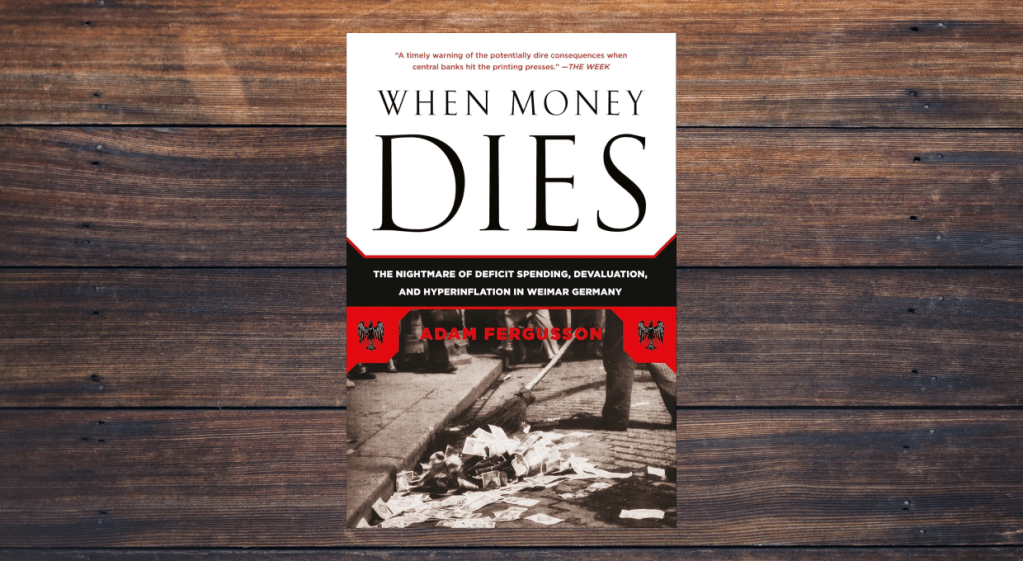
Few books about money are as unsettling as When Money Dies: The Nightmare of Deficit Spending, Devaluation, and Hyperinflation in Weimar Germany. First published in 1975, the book was reissued in 2010 and found a new audience in the wake of the 2008 financial crisis. It has since become something of a cult classic among investors, economists, and anyone curious about what happens when a government loses control of its currency. If you have been thinking about expanding your financial education beyond budgeting basics and S&P 500 fundamentals, this book will challenge you to think about money in ways you probably never have.
What Is the Book About?
When Money Dies is a detailed historical account of the hyperinflation that consumed the Weimar Republic of Germany in the early 1920s, culminating in the near-total collapse of the German mark in 1923. By December of that year, the exchange rate had reached one U.S. dollar to 4.2 trillion marks. Germany had become, in practical terms, a barter economy. People exchanged cigars, jewels, and artworks for basic staples like bread. A cinema ticket could be purchased with a lump of coal. Life savings evaporated overnight. Families that had spent generations building wealth watched it disappear within months.
Fergusson traces the roots of the crisis back further, to the abandonment of the gold standard in 1914 at the onset of World War I, and the devastating reparations imposed on Germany by the Treaty of Versailles. Unable to pay its debts, the German government resorted to printing money, a policy that compounded over time until the currency became essentially worthless. The book moves through this descent month by month, drawing on diaries, diplomatic correspondence, and contemporaneous accounts to give the story texture and weight.
Who Is Adam Fergusson?
Adam Fergusson is a British journalist, historian, and former member of the European Parliament. He has written for the Times and the Glasgow Herald, among other publications, and is the author of several nonfiction works and novels. He is not a professional economist, which actually works in the reader’s favor. His background in journalism means he writes accessibly, without leaning heavily on academic jargon. He approaches the subject as a storyteller first, and the result is a book that reads more like narrative history than a dry economics textbook.
Fergusson originally wrote the book during a period of significant inflation anxiety in the Western world, when stagflation was gripping major economies. That context gave the book urgency when it was first published. The 2010 reissue arrived at another moment of economic anxiety, when quantitative easing programs were prompting fresh debates about deficit spending and monetary discipline. Those conversations have never fully gone away.
Lessons Readers Can Take Away
The book is rich with lessons that go far beyond the historical. For anyone thinking about personal finance, investing, or the role of government in economic life, When Money Dies offers several takeaways worth considering.
The first and most obvious lesson is that inflation is not a theoretical risk. It is a real phenomenon with real consequences for people’s wealth, savings, and quality of life. The Germans who lived through hyperinflation did not see it coming with full clarity. Many assumed the situation would stabilize. Some even profited early on, particularly industrialists and those with access to foreign currency. But the middle class, particularly those who held their savings in cash or government bonds, were almost entirely wiped out.
This points to a second lesson: the importance of owning assets that hold value when a currency does not. During the Weimar inflation, people who owned farmland, foreign currency, physical commodities, or shares in productive businesses fared meaningfully better than those who held paper money. This is not an argument for panic or for abandoning sound financial planning. It is an argument for understanding why broad-based equity ownership, including index funds tied to the S&P 500, has historically served long-term investors better than holding cash alone.
Third, the book illustrates how quickly social and political stability can unravel when economic conditions deteriorate severely. Petty crime rose. Class resentment deepened. Political extremism found fertile ground. The hyperinflation of 1923 is widely regarded as one of the contributing factors to the political instability that followed in Germany over the next decade. Money is not just an economic instrument. It is a social one.
Finally, there is a lesson about the psychology of money that any reader focused on personal finance will recognize. People consistently underestimated how bad the situation would get. They normalized the abnormal. They delayed action until it was too late. This kind of cognitive bias, the tendency to assume the present trajectory will continue, is exactly the sort of mental trap that good financial planning is designed to counteract.
Criticisms of the Book
When Money Dies is not without its flaws. The most common criticism is that Fergusson leans heavily on diplomatic correspondence and exchange rate data at the expense of ordinary people’s experiences. The book does include excerpts from diaries and personal accounts, but many readers have found these too sparse. The result is that the human cost of the crisis can feel somewhat abstract at times, despite the extraordinary circumstances being described.
Some readers also find the narrative structure repetitive. By design, each chapter depicts a situation that continues to worsen, which mirrors the historical reality but can become numbing on the page. There is only so much the reader can absorb from successive rounds of currency devaluation before the numbers lose their meaning.
From a technical standpoint, critics have noted that Fergusson’s analysis of the underlying economic causes is somewhat simplified. The book accurately identifies deficit spending and money printing as primary drivers, but does not engage deeply with the more nuanced economic debates around reparations, war debt, and the structural weaknesses of the Weimar government’s fiscal institutions. For readers looking for a rigorous macroeconomic analysis, this book alone will not satisfy that need.
These are valid criticisms, but they do not significantly diminish the book’s value, particularly for a general audience.
Should You Buy the Book?
When Money Dies belongs on the shelf of anyone serious about understanding money. It is not a personal finance guide in the conventional sense. It will not help you build a budget or choose a high-yield savings account. But it will do something arguably more important: it will give you a visceral, historically grounded understanding of what money actually is, what it can do, and what happens when institutions fail to protect its value.
For readers who are early in their financial education, the book pairs well with more foundational texts on personal finance and investing. For more experienced readers, it provides the kind of historical context that sharpens your thinking about risk, asset allocation, and the limits of cash as a long-term store of value. Either way, it is a book that earns its place in your library.
It is also worth noting that the book is not long by historical nonfiction standards. It is a manageable read, and the writing moves at a reasonable pace despite the weight of the subject matter.
Final Thoughts
When Money Dies is a reminder that the rules governing money are not permanent or guaranteed. They depend on institutions, policies, and collective trust. When those things erode, the consequences can be catastrophic, and they tend to fall hardest on people who were not prepared.
That is not a reason for fear. It is a reason for financial literacy. Understanding what money is, how it has failed in the past, and what kinds of assets and behaviors have historically protected people during periods of economic stress is exactly the kind of knowledge that separates reactive financial decisions from intentional ones.









 Winchell House
You must be logged in to post a comment.