Treasury bills are one of the simplest investments to understand and one of the most tax-advantaged for people in high-tax states. But the way they’re taxed confuses a lot of first-time buyers, because Treasury bills don’t pay “interest” the way a savings account does.
The short answer
Treasury bill earnings are taxed as ordinary income at the federal level, but exempt from state and local income taxes. That’s the whole story in one sentence, but the details matter, especially the “how” of the federal taxation.
How the discount becomes taxable income
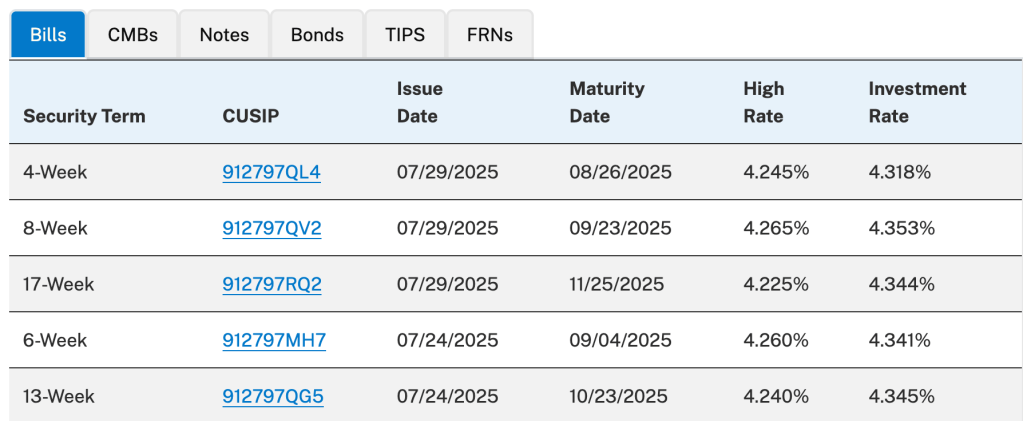
T-bills are sold at a discount to face value. You might pay $9,800 for a bill that matures at $10,000; the $200 difference is your earnings. The IRS treats that discount as interest income (technically “original issue discount”), taxed as ordinary income in the year the bill matures, not the year you buy it. So a bill bought in December 2025 that matures in March 2026 generates 2026 income, which surprises people doing year-end tax planning.

What you’ll see on your 1099-INT
Your broker (or TreasuryDirect) sends a 1099-INT showing the interest in Box 3 (“Interest on U.S. Savings Bonds and Treasury obligations”), not Box 1 like bank interest. That Box 3 distinction is what tells your state to leave it alone. If you use tax software, entering it correctly is usually automatic once the box is right; just don’t lump it in with bank interest.
Three tax mistakes to avoid
First, forgetting the timing rule. The discount is taxable in the year the bill matures, not when you buy it. A December purchase maturing in January creates next year’s income, so plan year-end purchases accordingly. Second, paying state tax you don’t owe. Some tax software doesn’t automatically exempt Treasury interest, so verify that Box 3 income is excluded from your state return. Third, holding T-bills in an IRA for the “tax advantage.” Inside an IRA, everything is tax-deferred anyway; the state exemption provides zero extra benefit there. Use T-bills in taxable accounts where the exemption actually counts.
Why the state exemption matters most in high-tax states
This is the real advantage. In a state with a 9% to 13% income tax (California, New York, New Jersey), a T-bill yielding 4.5% keeps the full 4.5% after state tax, while a CD yielding 4.5% nets you roughly 4.0% after state tax. On large cash balances, that gap is real money. In no-income-tax states (Texas, Florida, Washington), the exemption is worth nothing, so compare on yield alone.
A worked example: the California advantage
Run the numbers on a $50,000 cash position earning 4.5%. Over one year, that’s $2,250 in interest. In California (13.3% top state rate), a bank CD leaves you with $2,250 minus $299 in state tax, or $1,951 after state tax. The T-bill keeps the full $2,250 (before federal tax, which both pay). That’s a $299 annual bonus purely from the state exemption. On $100,000, it’s $598. In Texas, with no state income tax, the advantage is zero. The higher your state rate and the larger your cash balance, the more T-bills win on an after-tax basis.
T-bills vs. CDs vs. high-yield savings: after-tax
Compare three $10,000 investments at 4.5% for one year, for a New Yorker in the 24% federal bracket. High-yield savings: $450 interest, minus $108 federal, minus $31 state = $311 net. Bank CD: identical $311, since CD interest is fully taxable at the state level too. T-bill: $450 minus $108 federal, $0 state = $342 net. The T-bill wins by $31, purely from the state exemption. Scale that to $100,000 and it’s $310 per year, every year, for doing nothing different except choosing the Treasury. In a no-tax state, all three tie before fees. This is why T-bills are the default cash vehicle for high-tax-state residents.
When the state exemption doesn’t help
The exemption is worthless in three cases. One: you live in a state with no income tax. Two: you hold T-bills inside an IRA or 401(k), where withdrawals are taxed as ordinary income regardless of the source. Three: your cash balance is small enough that the dollars don’t matter. A $2,000 T-bill position at 4.5% generates $90 of interest; in a 9% state, the exemption saves you $8. Worth knowing, not worth obsessing over. The exemption matters most for five- and six-figure cash positions in high-tax states, which is exactly when getting it right pays.
Putting it together
T-bills won’t make you rich, but for cash you need to keep safe, the state-tax exemption is an edge most savers overlook. If you want to get systematic about keeping more of what you earn, our review of Be Smart Pay Zero Taxes is a good next read on tax planning.









 Winchell House
You must be logged in to post a comment.