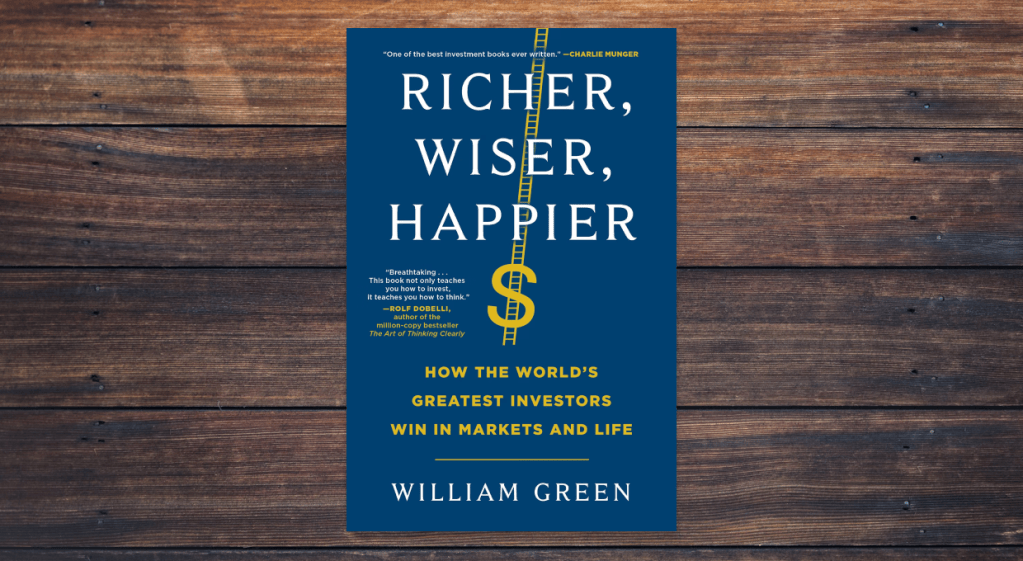
Most investing books teach you a system. William Green’s Richer, Wiser, Happier does something rarer: it asks what the best investors have figured out about living well, and whether the two are even separable. Green, a journalist who’s spent 25 years interviewing legends like Charlie Munger, Howard Marks, and Mohnish Pabrai, turns those conversations into a book that’s as much about temperament as technique.
Brief Book Summary
What the book is
The structure is simple: chapters organized around the investors and the ideas they embody. Mohnish Pabrai on cloning: the shameless, brilliant art of copying what already works. Howard Marks on second-level thinking and the discipline of knowing where you stand in a cycle. Sir John Templeton on buying at the point of maximum pessimism. Charlie Munger on rationality as a moral duty. Green doesn’t just summarize their strategies; he shows how they think, how they handle loss, and what they’d tell you about a life well spent.
What it’s not
This isn’t a how-to manual. You won’t find stock screens, valuation formulas, or a portfolio to copy. If you want mechanics, look elsewhere. And at 300+ pages of interviews, some chapters overlap; the same lessons echo across investors, which is either reinforcing or repetitive depending on your patience.
Who is William Green?
William Green is a financial journalist who spent 25 years interviewing the world’s best investors for publications like Fortune and Money. Richer, Wiser, Happier distills those conversations with Charlie Munger, Howard Marks, Mohnish Pabrai, Sir John Templeton, and others into a book about temperament as much as technique. He’s not a fund manager or guru; he’s a writer who asked smart questions and listened carefully, which is why the book reads like wisdom rather than a sales pitch.
What are some lessons readers can take away from the book?
The ideas that stick
Three themes kept resurfacing for me. First, temperament beats intellect: every investor in the book says some version of this, and Munger’s line that a lot of people with high IQs are terrible investors because they have terrible temperaments is the thesis in miniature. Second, simplicity wins: the best investors do fewer things, say no constantly, and let compounding do the work. Third, the game is avoiding stupidity, not seeking brilliance: don’t lose money, don’t do anything you don’t understand, and let time be your edge.
Inversion: the mental model that matters most
Munger’s signature contribution to Richer, Wiser, Happier is inversion: instead of asking how to succeed, ask how to fail, then avoid those things. Don’t lose money. Don’t invest in what you don’t understand. Don’t let ego drive decisions. It’s a profoundly frugal way to think. Wealth comes less from brilliant moves than from the steady avoidance of dumb ones. For a regular investor, inversion translates to a short checklist: automate savings, buy broad index funds, keep fees low, and do nothing dramatic when markets wobble. Boring, effective, and the opposite of what Wall Street wants you to do.
The case for doing nothing
The book’s quiet radicalism is its defense of inaction. The best investors in Green’s pages aren’t trading furiously. They’re waiting, reading, and saying no to almost everything. That maps directly onto the frugal investor’s playbook: set up automatic contributions to an S&P 500 index fund, then get on with your life. Compounding does the heavy lifting, but only if you don’t interrupt it. The hard part, as the book keeps showing, isn’t the strategy. It’s the temperament to stick with a simple plan for decades while everyone around you chases the next hot thing.
What are some criticisms of the book?
Where the book falls short
Two honest caveats. First, survivorship bias. Green interviews winners, and winners’ stories always sound like wisdom in hindsight. The investors who followed similar principles and failed don’t get chapters. Second, the book is long on inspiration and short on implementation. You’ll finish motivated but without a concrete next step, which is why pairing it with a simple system (a budget, automatic investing, an emergency fund) matters. None of this diminishes the book. But read it for the mindset shift, not a manual.
Should readers buy the book or not?
Who should read it
Anyone who invests (or wants to) and suspects the hard part isn’t the math, it’s the mindset. It’s also a genuinely enjoyable read, which is rare for the genre. Green’s a real writer, not a guru with a ghostwriter.
Buy it if you invest and want to improve your temperament, not just your technique. It’s especially valuable for index fund investors who need the patience to stick with a simple plan through market cycles. Skip it if you want stock picks, valuation formulas, or a step-by-step system; this is about mindset, not mechanics. At around $20, it’s cheaper than a single emotional trading mistake.
Final thoughts.
Richer, Wiser, Happier won’t make you rich by itself. But it might make you wiser about why you invest, happier with a simpler approach, and richer over time by helping you avoid the dumb mistakes that derail most investors. For a frugal investor building wealth slowly, that’s a worthwhile trade.









 Winchell House
You must be logged in to post a comment.