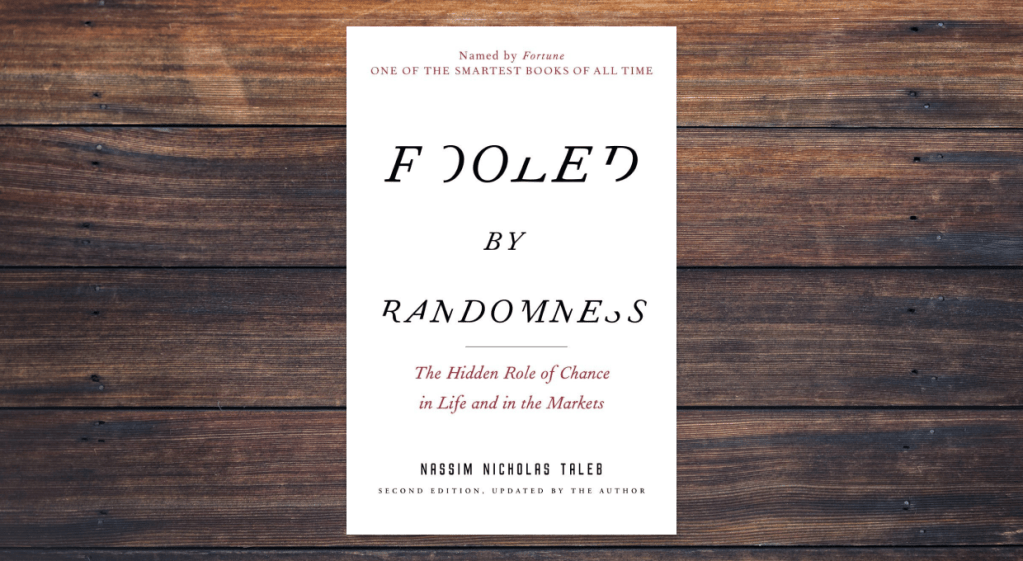
A former derivatives trader turned philosopher of uncertainty, Nassim Nicholas Taleb argues that we systematically underestimate randomness, and that this blindness shapes everything from stock picking to career success. Fooled by Randomness, his 2001 debut, is the book that launched the Incerto series and introduced the world to the Black Swan problem.
Book Summary
The core idea: we mistake luck for skill
Taleb’s central claim is that humans are wired to see patterns in noise. A trader who beats the market for three years is more likely lucky than skilled, but we invent narratives to explain the success. He calls this “survivorship bias”: we study winners and ignore the thousands of losers who took the same risks.
The Black Swan connection
Fooled by Randomness is the prequel to Taleb’s more famous The Black Swan. Read this one first: it’s shorter, funnier, and more personal.
Who is Nassim Nicholas Taleb?
Nassim Nicholas Taleb is a former derivatives trader turned essayist and scholar of uncertainty. Fooled by Randomness (2001) launched his Incerto series, followed by The Black Swan, Antifragile, and Skin in the Game. He’s known for combative prose and a deep distrust of experts, forecasts, and anyone who confuses luck with skill.
Lessons from Fooled By Randomness
The cemetery of failed traders
Survivorship bias deserves its own section because it’s the mechanism that fools us. Imagine 10,000 fund managers flipping coins. After five years, a few will have “beaten the market” five times in a row by pure chance. Those few get magazine covers, massive inflows, and bestselling books. The 9,990 who flipped tails disappear. We study the survivors and conclude they have skill. Taleb’s point: in any large population, extreme success is guaranteed by randomness alone. Before you pay a financial advisor for “alpha,” ask how many advisors started the same year and quietly closed shop.
Why investors should read it
The book is a sustained attack on financial journalism and forecasting. Taleb shows how pundits make predictions that are never scored, how backtests overfit, and why “experts” who are right once become famous while their misses are forgotten. It’s the intellectual foundation for index investing: if outcomes are dominated by randomness, stop paying for stock-picking skill that doesn’t exist.
The barbell: Taleb’s actual portfolio advice
Taleb isn’t just a critic. He offers a strategy: the barbell. Put most of your money in extremely safe assets (Treasury bills, cash) and a small portion in extremely speculative bets with huge upside. Nothing in the middle. The logic: the middle, “moderate risk” investments, expose you to randomness without compensating you for it. For a regular investor, the barbell translates to something familiar: an emergency fund and T-bills on one end, a broad index fund (or a tiny speculative allocation) on the other. It’s not about predicting. It’s about positioning so that randomness can’t ruin you but can occasionally make you rich.
The takeaway
You can’t eliminate randomness, but you can stop being fooled by it. Size your bets so that bad luck can’t ruin you, ignore financial noise, and judge decisions by their process, not their outcome. It’s a short book that will permanently change how you think about risk.
Criticisms of the Book
The honest criticism: Taleb is exhausting
Two caveats. First, the tone. Taleb is brilliant and combative, and the book’s disdain for “imbeciles” (his word for most finance professionals) gets wearying. You’ll either find it refreshing or insufferable. Second, the book is better at diagnosis than prescription. “Don’t be fooled by randomness” is wise but vague. The practical implementation, boring as it sounds, is what this site recommends anyway: diversify broadly, keep costs low, size positions so no single loss matters, and ignore the noise. Taleb gives you the why. The how is an index fund and patience.
Who is This Book For?
Buy it if you invest and want a permanent antidote to financial noise. It’s short, funny, and will change how you judge both experts and your own results. Skip it if Taleb’s combative tone will put you off; the core message (index, diversify, ignore noise) can be found in calmer books. At around $15, it’s cheap intellectual insurance.
Final Thoughts
Fooled by Randomness won’t make you money directly. It will make you harder to fool, which over decades is worth far more. Read it, then automate an index fund and stop checking prices.











You must be logged in to post a comment.