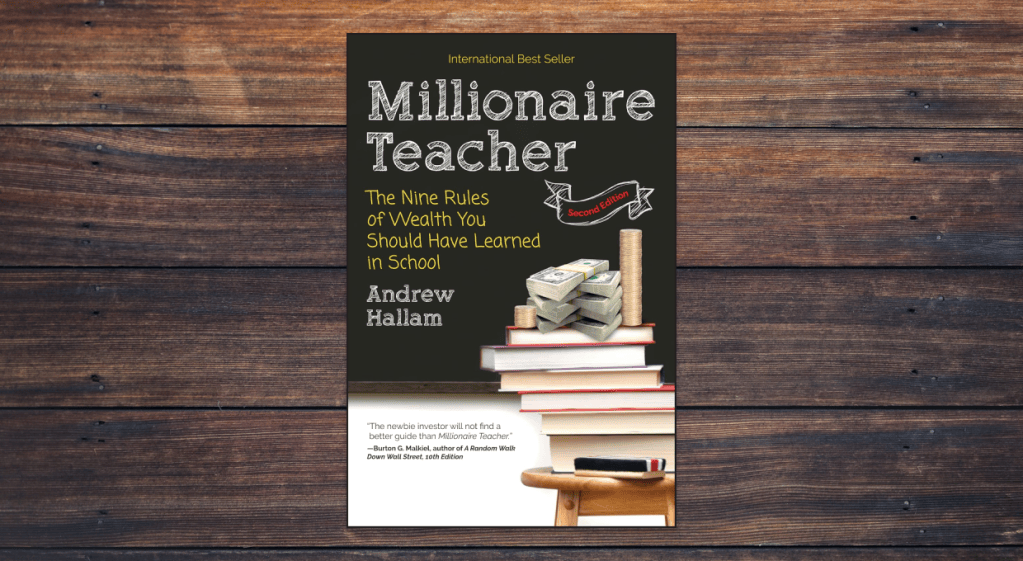
Most millionaire stories involve a high salary, a startup exit, or an inheritance. Millionaire Teacher is about a schoolteacher who built a seven-figure portfolio on a middle-class salary by following nine simple rules. Andrew Hallam’s book is one of the most encouraging personal finance books ever written: proof that ordinary income, handled with discipline and invested in index funds, can quietly compound into extraordinary wealth.
Book Summary
Millionaire Teacher is built around nine rules of wealth that Hallam learned by doing, not by theorizing. The book’s central argument is that building wealth has almost nothing to do with how much you earn and almost everything to do with how much of what you earn you keep, and what you do with what you keep. Hallam became a millionaire on a teacher’s salary by spending less than he earned, avoiding debt, and investing the difference in low-cost index funds.
The nine rules cover the full journey: spend less than you earn and invest the surplus, understand why index funds beat most active managers, keep investment fees as low as possible, avoid the financial salespeople who profit from your ignorance, build a globally diversified portfolio, and stay the course when markets fall. Hallam is blunt that the financial industry is structured to transfer money from your pocket to theirs, and much of the book is about recognizing who is actually on your side.
What makes the book unusual is its tone. Hallam writes like the rare teacher who actually wants you to learn, using stories, humor, and simple analogies instead of jargon. The second edition, published in 2017, updates the advice and adds new material, but the core message is unchanged: wealth is built slowly, by ordinary people, through boring investments held for a long time.
Who is Andrew Hallam?
Andrew Hallam is a Canadian personal finance writer and former schoolteacher. He spent years teaching abroad, living well below his means on a teacher’s salary and investing the difference, and retired as a millionaire far earlier than most people in far better-paid professions. His story gives the book its credibility: he isn’t a fund manager explaining wealth from above, he’s someone who built it from a classroom salary.
Hallam has gone on to write more books and speak widely about financial independence, but Millionaire Teacher remains his defining work. His appeal is that he never asks readers to do anything he didn’t do himself, and he never pretends any of it was fast or exciting. Frugality and index funds: that was the whole trick.
Lessons From Millionaire Teacher
The first lesson of Millionaire Teacher is that your savings rate matters more than your salary. Hallam shows how a teacher saving diligently can end up wealthier than a doctor or lawyer who spends everything. Wealth is the gap between what you earn and what you spend, and widening that gap is the single most powerful financial move most people can make.
Second, index funds are the ordinary investor’s greatest invention. Hallam walks through the evidence, in the spirit of John Bogle, that most actively managed funds underperform simple index funds after fees over long periods. The market’s average return, captured cheaply, beats the professional stock-picker’s return after costs, almost every time. For a teacher with no interest in analyzing companies, the index fund is the perfect tool.
Third, fees are a silent wealth-killer. Hallam is relentless on this point: a 2% annual fee doesn’t sound like much, but compounded over thirty years it can devour a huge share of your returns. Choosing funds that charge 0.1% instead of 2% is one of the highest-return decisions an investor will ever make, and it requires no skill at all.
Fourth, beware the people selling you financial products. Much of Millionaire Teacher is devoted to unmasking the conflicts of interest in the financial industry: advisors paid on commission, actively managed funds with hidden costs, and the marketing machine that makes investing look complicated so you’ll pay someone to do it for you. Hallam’s rule is simple: understand what you’re buying, know what it costs, and never buy from someone whose paycheck depends on your confusion.
Fifth, stay invested through the storms. Hallam argues that market crashes are the price of admission for long-term returns, and that the investors who panic and sell lock in the losses that patient investors eventually recover. His own wealth was built by buying through downturns and holding, the least glamorous and most profitable strategy in the book.
Criticisms of the Book
The most common criticism of Millionaire Teacher is that Hallam’s path, while inspiring, depended on conditions not everyone can replicate. Teaching abroad gave him low living costs and, in some years, tax advantages; a teacher with a mortgage, kids, and high-cost-city rent faces a much harder version of the same math. The principles scale, but the timeline doesn’t transfer directly to every life.
A second criticism is that the book can feel repetitive. Nine rules is a lot of rules, and several of them, spend less, avoid fees, buy index funds, hold through downturns, are variations on a single theme: be disciplined and keep costs low. Readers already convinced of index investing may find the middle chapters belaboring points they accepted in chapter one.
Finally, the book is light on the specifics of portfolio construction compared to what a hands-on investor might want. Hallam gives model allocations, but readers looking for deep guidance on asset location, rebalancing mechanics, or tax strategy will need a second book. Millionaire Teacher is a book about behavior and philosophy, not a technical manual.
Who is This Book For?
Millionaire Teacher is for anyone who assumes building wealth requires a big income. It’s ideal for young professionals, teachers, and anyone early in their career who wants proof that ordinary salaries can produce extraordinary results. It’s also a great gift book: the rare finance title that a non-investor will actually finish.
It is less useful for experienced index investors, who will find little they don’t already know, and for anyone looking for advanced portfolio tactics or stock-picking guidance, which the book deliberately refuses to provide. This is a book about the foundation, not the penthouse.
Final Thoughts
Millionaire Teacher earns its place among the best beginner investing books because it removes every excuse. No high salary required, no financial genius needed, no luck involved: just nine rules, followed for decades, by a schoolteacher. Hallam’s achievement wasn’t picking the right stocks at the right time. It was doing the boring things consistently while everyone around him chased excitement.
If you know someone who believes wealth is out of reach on their income, hand them this book. And if that someone is you, Millionaire Teacher is the most encouraging place to start: proof that the gap between an ordinary salary and a million-dollar portfolio is nothing but time, discipline, and low fees.











You must be logged in to post a comment.