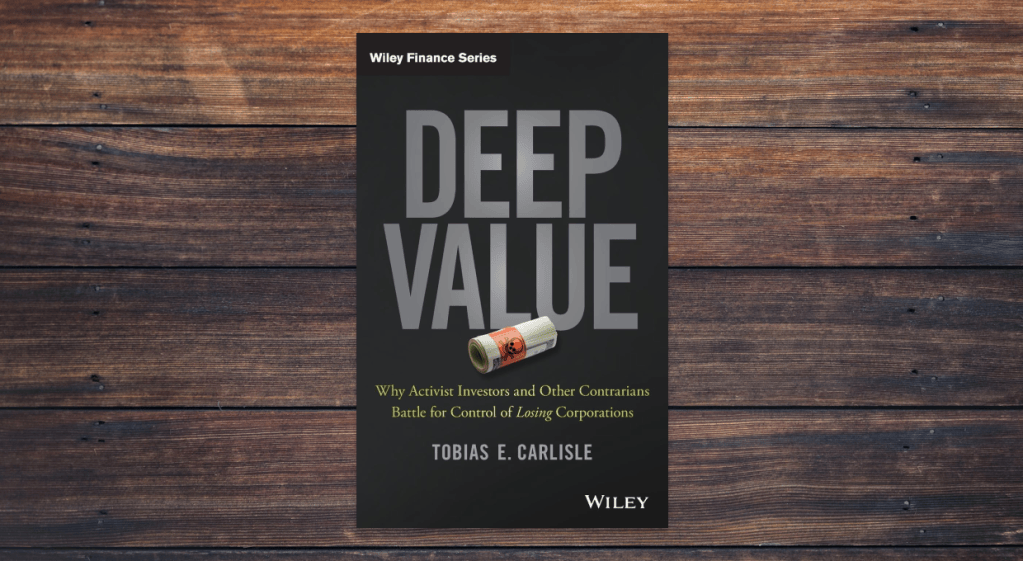
Tobias Carlisle’s Deep Value makes a case that sounds almost rude in its simplicity: investors aren’t rewarded for picking winners. They’re rewarded for uncovering mispricings — the gaps between what a company is worth and what the market will pay for it. And the best place to find those gaps, Carlisle argues, is in calamity: among the unloved, the ignored, the neglected, the shunned, and the feared.
Published in 2014, Deep Value is part investing history, part statistical argument, and part field guide to the world of activist investors — the Carl Icahns of the market who buy big stakes in beaten-down companies and then force change. Carlisle’s central claim is that losing stocks, the ones in crisis with failing businesses and uncertain futures, offer unusually favorable prospects. The evidence he assembles suggests it’s close to an axiom: the uglier the stock, the better the return.
Book Summary
Deep Value traces the intellectual lineage of deep value investing from Benjamin Graham — who bought companies at a discount to liquidation value and agitated for shareholder rights — through Warren Buffett, and on to the modern activist investors like Carl Icahn and Bill Ackman. Carlisle shows how Graham’s original approach, buying “net-nets” trading below the value of their current assets minus liabilities, worked extraordinarily well but has mostly disappeared from modern markets. Today’s deep value investors had to adapt: same spirit, new methods.
The heart of the book is Carlisle’s argument about where mispricings live. He presents statistical evidence that the cheapest stocks — measured by metrics like earnings yield, cash flow, and book value — outperform over time, and that the effect is strongest among the most distressed companies. He then lays out the valuation metrics that activist investors actually use to find targets: deep undervaluation, large cash holdings, and low payout ratios. These point to companies with “lazy balance sheets” — businesses sitting on cash they refuse to return to shareholders. Activists buy in, demand dividends, buybacks, restructurings, or outright sales, and the discount to intrinsic value closes.
One of the book’s most useful insights is that you don’t actually need an activist to show up. Carlisle argues that if no activist emerges, other forces — mean reversion in business performance, industry restructuring, or simple market reappraisal — tend to close the gap anyway. The activist is a catalyst, not a prerequisite. The strategy works because the possibility of disaster is already priced in: when a stock is priced for bankruptcy and the company merely survives, the returns can be enormous.
Who is Tobias Carlisle?
Tobias Carlisle is the founder of Acquirers Funds and the author of the well-known value investing blog Greenbackd. Before writing Deep Value, he worked as an analyst at an activist hedge fund, served as general counsel of a company listed on the Australian Stock Exchange, and practiced as a corporate advisory lawyer specializing in mergers and acquisitions. That background matters: unlike most investing authors, Carlisle has sat on both sides of the activist table.
He is also the author of Quantitative Value (with Wesley Gray), Concentrated Investing, and The Acquirer’s Multiple, and he hosts a long-running investing podcast. His work sits at the intersection of academic research and practitioner experience — he backs his claims with data, but he’s also managed money and knows what it feels like to hold a hated stock while everyone else is getting rich on the popular ones.
Lessons From Deep Value
You’re paid for mispricings, not for picking winners. This is the book’s thesis in one sentence. The market doesn’t hand out extra returns to people who correctly identify great companies — it hands them to people who buy something for less than it’s worth. Everything in Deep Value flows from that distinction. Stop asking “is this a good business?” and start asking “is this price wrong?”
Hunt where it hurts. Mispricings cluster in calamity. Carlisle’s phrasing is memorable: look among the unloved, the ignored, the neglected, the shunned, and the feared. When a whole sector or company is radioactive, the sellers aren’t doing analysis — they’re doing risk management, redemptions, or career protection. That’s when prices detach from value.
Trust the numbers, not the story. Carlisle is firmly in the Graham camp: quantitative factors first, qualitative narratives last. Growth stories revert to the mean; cash on the balance sheet doesn’t. His summary of the crowd’s error is sharp — investors obsess over earnings projections while ignoring cash generation, “the eggs rather than the golden goose.” A struggling business with a fortress balance sheet can be a better investment than a beloved grower at thirty times earnings.
Mean reversion is the engine. Carlisle reaches back to the Roman myth of Fortuna’s wheel to make a statistical point: both business performance and valuations revert to the mean, and the wheel is more likely to lift a crushed stock than to crush a beloved one. The practical rule he draws from this: maximize your margin of safety, buy the most undervalued stocks you can find, and make sure they survive long enough to mean-revert. Survival is the qualifier most deep value tourists forget.
Activists are a catalyst, not a requirement. The Icahn-style playbook — buy a big stake, demand buybacks or a sale, watch the discount close — is one way value gets unlocked. But Carlisle’s data suggests the strategy earns its returns even when no activist appears. That matters for individual investors, who can’t exactly launch a proxy fight from a brokerage account. You get paid for the mispricing; the catalyst just determines how fast.
Zig when the crowd zags. Carlisle’s first principle of deep value is behavioral: attractive opportunities only emerge when the crowd wants to sell. If you’re comfortable owning what everyone else is desperate to unload, you’re fishing where the mispricings are. If you need the comfort of consensus, this strategy will be miserable — which is precisely why it keeps working.
Criticisms of the Book
The honest knock on Deep Value is that it’s a strategy almost nobody can stomach. Buying the ugliest stocks in the market means enduring long stretches where you look — and feel — wrong. The book’s statistics describe portfolios, not people; a diversified basket of net-nets mean-reverting over five years is a very different experience from watching your own holding fall another 30% while the market rallies. Carlisle acknowledges the behavioral difficulty, but reading about it and living it are different sports.
There’s also the value-trap problem, which the book arguably underplays. Some cheap stocks are cheap because the business is genuinely dying, and “survive to mean-revert” does real work in Carlisle’s framework without getting quite the operational detail it deserves. An individual investor running a concentrated portfolio of deep value stocks without a systematic process is taking on more idiosyncratic risk than the book’s backtests suggest.
Finally, the Buffett and Munger objection hangs over the whole project and never quite gets answered: wonderful businesses at fair prices have compounded better, with far less misery, than fair businesses at wonderful prices. Carlisle’s reply — that regular investors can’t reliably identify wonderful businesses in advance, so price is the only edge they can count on — is reasonable but won’t satisfy everyone. And the 2014 publication date means some of the activist case studies feel like dispatches from a different market era.
Who is This Book For?
Deep Value is for investors who already live in the value tradition — readers of The Intelligent Investor and Security Analysis who want the modern, data-driven extension of Graham’s ideas. It’s also for anyone fascinated by activist investing who wants to understand what Icahn and his descendants actually look for, beyond the headlines about proxy fights.
It’s probably not for beginners. The book assumes comfort with financial statements and a working knowledge of valuation, and its strategy demands a temperament most people don’t have. If the idea of owning a portfolio of companies everyone else considers doomed sounds like a nightmare rather than an opportunity, take that reaction seriously — Carlisle would.
Final Thoughts
Deep Value is the rare investing book that is both intellectually honest and practically useful. Carlisle doesn’t promise that buying hated stocks is easy or pleasant — he argues it’s profitable precisely because it’s neither. The central distinction, between being paid for picking winners and being paid for finding mispricings, is one of the most clarifying ideas in the value investing literature, and worth the price of the book on its own.
For the Buffett-style investor, it’s a useful counterweight: a reminder that price is the one edge you can measure, and that the crowd’s revulsion is often the raw material of returns. For the quant-minded, it’s a well-evidenced playbook. Either way, it’s earned its place on the value investing shelf — right next to Graham, with the lights turned low.











You must be logged in to post a comment.