Book Summary
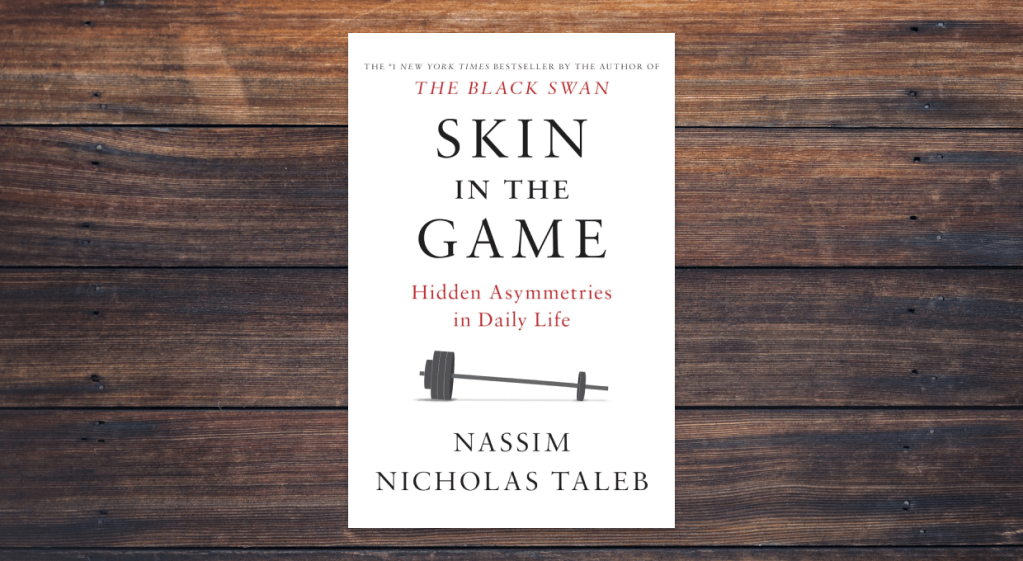
Skin in the Game is Nassim Nicholas Taleb’s 2018 finale to the Incerto series, and it asks the question that Fooled by Randomness, The Black Swan, and Antifragile were all building toward: who should you trust? Taleb’s answer is disarmingly simple. Trust people who bear the consequences of their own decisions — who have skin in the game — and distrust everyone who doesn’t. The banker who collects a bonus when bets pay off but sticks taxpayers with the losses has no skin in the game. The general who sends soldiers into wars his own children will never fight has none either. The pundit who forecasts on television and pays no price for being wrong is the purest case of all.
The book’s central principle is symmetry of risk: anyone who takes risks on behalf of others, or makes decisions that affect others, should be exposed to the downside themselves. This is Taleb’s filter for the entire expert class. He reserves his sharpest contempt for what he calls “intellectuals yet idiots” — academics, policy wonks, and commentators who mistake credentials for competence, theorize about systems they don’t participate in, and never pay for their errors. A plumber who misdiagnoses your pipes loses your business; an economist who misdiagnoses an economy gets tenure. Skin in the Game argues this asymmetry is not a minor flaw in modern institutions but the defining corruption of them.
Along the way Taleb develops several ideas that have since entered the wider vocabulary. The minority rule: a small, intransigent minority — three or four percent — can impose its preferences on a flexible majority, which is why so many American soft drinks are kosher even though almost nobody buying them keeps kosher. Soul in the game: a deeper commitment than mere skin, where artisans and entrepreneurs stake their reputation and honor on their work rather than just their money. And a definition of rationality as whatever aids survival over time, which is why ancient practices that persist (the Lindy effect again) deserve more respect than the latest peer-reviewed intervention. The book closes with Taleb’s starkest moral line: “If you see fraud and don’t say fraud, you are a fraud.”
Who is Nassim Nicholas Taleb?
Nassim Nicholas Taleb is a Lebanese-American essayist, mathematical statistician, and former derivatives trader. Born in Amioun, Lebanon in 1960, he spent more than two decades on Wall Street trading options — a career that gave him a practitioner’s contempt for academic theories of risk — before becoming Distinguished Professor of Risk Engineering at NYU’s Tandon School of Engineering. His five-volume Incerto series on uncertainty unfolded over seventeen years: Fooled by Randomness (2001), The Black Swan (2007), The Bed of Procrustes (2010), Antifragile (2012), and finally Skin in the Game (2018).
Taleb practices what the book preaches, at least by his own account: he has publicly stated that he keeps the bulk of his wealth in extremely safe assets while taking small, highly speculative bets — the barbell strategy from Antifragile — and he built his reputation as a trader who profited from the 1987 crash rather than as an academic who modeled it afterward. He is also one of the most combative public intellectuals alive, famous for picking fights with economists, journalists, and fellow authors on social media. Whether you find that refreshing or exhausting will determine a lot about how you receive this book.
Lessons From Skin in the Game
The first and most directly useful lesson is for investors: follow incentives, not credentials. When a fund manager’s own money is in the fund alongside yours, his interests are aligned with yours in a way no disclosure document can replicate. When a CEO’s compensation is mostly stock he can’t sell for years, he thinks like an owner. When neither is true — when the manager gets two-and-twenty regardless of performance, or the executive cashes out options quarterly — treat every statement from them as advertising. Taleb’s framework turns the usual due-diligence question (“is this person smart?”) into a better one: “what does this person lose if he’s wrong?”
The second lesson is the minority rule, which has real explanatory power beyond Taleb’s food examples. Norms don’t require majority support — they require an intransigent minority and an indifferent majority. Investors can use this: you don’t need most market participants to be rational for prices to eventually reflect reality; you need a small core of arbitrageurs with actual capital at risk. It also explains why corporate cultures and online communities get captured by their most extreme members while the moderates shrug and comply.
The third is the distinction between skin in the game and soul in the game. Skin is financial exposure — the trader whose bonus is clawed back when trades blow up. Soul is reputational and existential — the craftsman who signs his work, the entrepreneur whose name is on the door, the writer who can’t hide behind an institution when he’s wrong. Taleb argues that much of what we call “professionalism” is actually a technology for avoiding soul in the game: committees diffuse responsibility, bureaucracies diffuse blame, and nobody’s name is ever on the failure. For your own life, the lesson is to structure your work so your name is on it.
Fourth is Taleb’s redefinition of rationality. An idea or practice is rational, he argues, not if it can be derived from first principles but if it has survived — if it kept its practitioners alive and functioning across generations. This is the Lindy effect applied to behavior: religions, traditional cuisines, and time-tested heuristics encode trial-and-error wisdom that no model captures. The investor’s version: strategies that have survived multiple full market cycles deserve more weight than backtests, and anyone selling you a strategy optimized on the last five years of data is selling you the turkey’s risk model the day before Thanksgiving.
Criticisms of the Book
The most common criticism is the tone. Taleb doesn’t argue with his opponents so much as declare them idiots, frauds, and bureaucrats — sometimes in the same paragraph where he’s making a genuinely interesting point. Readers who need their authors to be charitable will bounce off Skin in the Game hard, and even sympathetic readers may find the insults wearing by the final chapters. The combativeness is deliberate — Taleb considers politeness a luxury of people with no skin in the game — but it costs him readers who would otherwise agree with him.
Substantively, several of the book’s signature claims are looser than they look. The minority-rule examples are vivid but cherry-picked; real-world norm formation usually involves power and enforcement, not just intransigence. The chapter on GMOs, where Taleb argues against them on precautionary grounds, was sharply criticized by biologists who noted he was opining outside his domain — ironically, the exact sin he attributes to the intellectual-yet-idiot class. And the symmetry principle, powerful as a heuristic, doesn’t resolve the hard cases: surgeons can’t have “skin in the game” for your operation in any literal sense, yet we still want them operating. Like much of Taleb’s work, the book is better as a corrective lens than as a complete system.
Who is This Book For?
Skin in the Game is for investors who want a better bullshit detector for managers, executives, and forecasters — the symmetry-of-risk test is genuinely useful due diligence. It’s for entrepreneurs and anyone building something under their own name, since the soul-in-the-game chapters read as a defense of craftsmanship against bureaucracy. And it’s the natural next read for anyone who finished Antifragile and wondered how the ethics were supposed to work. It is not for readers who need their nonfiction calm, footnoted, and free of personal vendettas, and it assumes at least passing familiarity with the earlier Incerto books — newcomers should start with Fooled by Randomness instead.
Final Thoughts
As the closing volume of a seventeen-year project, Skin in the Game is the most directly applicable of Taleb’s books. The Black Swan told you the world is unpredictable; Antifragile told you how to position for it; this one tells you whom to trust while you do. The core heuristic — ask what someone loses if they’re wrong — is worth the price of admission on its own, and it will permanently change how you read financial media, listen to CEOs, and evaluate your own decisions.
It’s also the angriest and least disciplined of the five, and the criticisms above are real. But Taleb at his most undisciplined is still thinking harder about risk and responsibility than almost anyone writing today. For a money audience, this is the rare philosophy book with immediate portfolio applications: align incentives, distrust the unexposed, and put your own name on your work. Read it, argue with it, and keep the one question it teaches you to ask about everyone selling you anything: what’s their downside?











You must be logged in to post a comment.