Book Summary
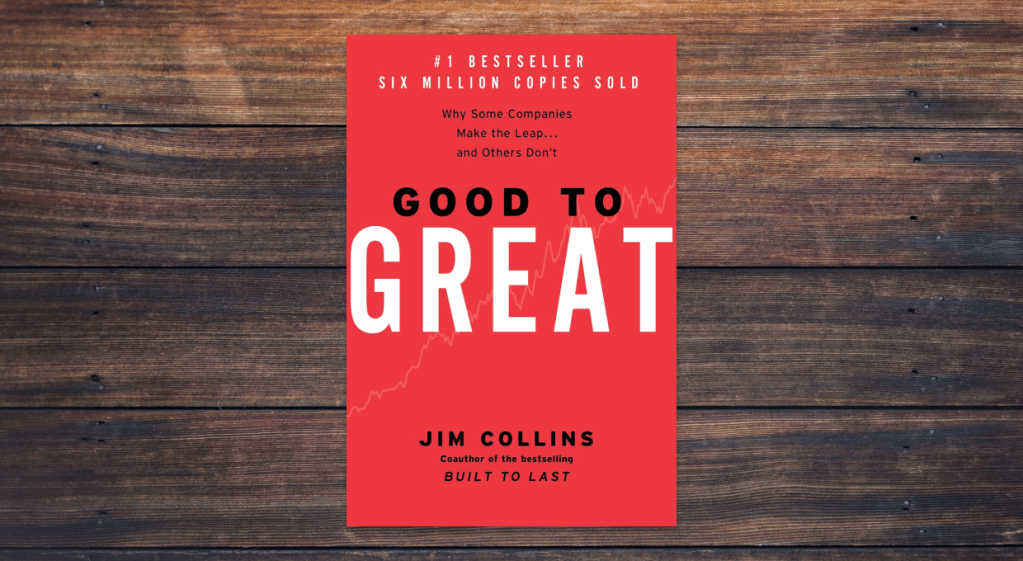
Good to Great: Why Some Companies Make the Leap…and Others Don’t is Jim Collins’s landmark study of how ordinary companies became extraordinary ones. Collins and his research team spent five years identifying eleven companies — including Abbott, Gillette, Nucor, and Wells Fargo — that went from mediocre stock performance to sustained market-beating returns, then compared each against a matched company in the same industry that failed to make the leap. The result is a set of counterintuitive principles: Level 5 leaders who blend humility with ferocious resolve, the discipline to confront brutal facts, the Hedgehog Concept of focusing on what you can be best at, and a culture of discipline rather than bureaucracy. It’s one of the best-selling business books of all time, and its ideas have seeped so thoroughly into management thinking that many readers will recognize them without knowing the source.
Who is Jim Collins?
Jim Collins is a researcher, author, and former Stanford Graduate School of Business faculty member who has spent his career studying what makes companies — and leaders — exceptional. Good to Great (2001) followed his earlier Built to Last (co-authored with Jerry Porras) and became a phenomenon, selling millions of copies. His later books include Great by Choice and How the Mighty Fall. Collins’s method is distinctive: large research teams, years of data, matched-pair comparisons, and conclusions drawn from evidence rather than anecdote. He’s the rare management guru whose ideas come with footnotes.
Lessons From Good to Great
Level 5 leadership. The leaders who engineered the leap from good to great were not charismatic visionaries. They were a paradoxical blend: personally humble and professionally ferocious — modest about themselves, ambitious for the company. They credited others for success and took personal responsibility for failure. Collins’s finding cuts against the cult of the celebrity CEO: the quiet, disciplined operator beats the flamboyant genius.
First who, then what. The good-to-great companies didn’t start with strategy. They started by getting the right people on the bus — and the wrong people off — before deciding where to drive. “If you have the wrong people, it doesn’t matter whether you discover the right direction; you still won’t have a great company.” For investors, the analogue is blunt: bet on management teams, not just business plans.
Confront the brutal facts. Great companies maintained unwavering faith that they would prevail while simultaneously confronting the most brutal facts of their reality — the Stockdale Paradox, named for the POW who survived by balancing optimism with realism. Companies that sugarcoated reality (or shot the messenger) failed. As an investor, this is a due-diligence principle: distrust management teams that can’t name what’s going wrong.
The Hedgehog Concept. The fox knows many things; the hedgehog knows one big thing. Great companies found the intersection of three circles: what they could be the best in the world at, what drove their economic engine, and what they were deeply passionate about — then focused relentlessly on it. Everything else was a distraction. Abbott Labs, for instance, stopped trying to be a mini-Merck and focused on what it could dominate.
A culture of discipline. The leap didn’t come from heroic action or dramatic restructuring. It came from disciplined people taking disciplined action, consistently, over years — the flywheel effect. Each turn of the flywheel builds momentum; there’s no single defining moment. This is the business equivalent of compounding, and it’s why the transformations looked boring from the outside and inevitable in hindsight.
Technology as accelerator, not driver. The good-to-great companies were not technology pioneers — they were thoughtful adopters. Technology accelerated momentum they already had; it never created it. Eighty percent of the comparison companies chased technology fads and failed. For investors dazzled by AI, crypto, or whatever comes next, this is the cautionary chapter: technology in service of a hedgehog concept wins; technology as strategy loses.
Criticisms of the Book
The most serious criticism of Good to Great is survivorship bias with a time bomb attached: several of the eleven “great” companies later stumbled badly. Circuit City went bankrupt. Fannie Mae imploded in 2008. Wells Fargo became synonymous with fake accounts. Critics argue the research identified companies at the peak of a cycle and mistook luck and timing for timeless principles. Collins’s defense — that the principles describe how the leap happened, not a guarantee of permanence — is fair but doesn’t fully answer the charge. Other criticisms: the matched-pair method can cherry-pick comparisons, the “Level 5 leader” concept is hard to identify in advance (it’s mostly visible in hindsight), and the book’s corporate examples feel dated in an era of software eating everything. Still, the core ideas — humility plus resolve, brutal facts, disciplined focus — have held up better than the stock picks.
Who is This Book For?
This book is for anyone who leads people — CEOs, managers, founders — and for investors who want a framework for judging management quality. If you pick stocks, the Level 5 leader profile and the “first who, then what” principle are directly useful screens: look for humble, long-tenured operators with skin in the game, and beware the celebrity CEO on the magazine cover. It’s less useful if you’re looking for valuation techniques or market timing — Good to Great is about business quality, not stock prices. And if you run a startup, much of it applies at a different scale: the principles travel, but the examples are all big public companies.
Final Thoughts
Twenty-five years after publication, Good to Great remains the most useful single book on what separates excellent companies from merely good ones. Yes, some of its poster children fell from grace — that’s the nature of business, and arguably proves the book’s deeper point that greatness requires constant discipline, not a one-time leap. The ideas that survive are the ones that were never about stock picking: hire the right people, face reality, focus on what you can be best at, and let the flywheel turn. For the investor, it’s a quality checklist disguised as a management book. For the leader, it’s the rare business bestseller that respects your intelligence. Either way, it earns its place on the shelf.










