
MJ DeMarco’s The Millionaire Fastlane is a bold, no-nonsense personal finance book that challenges conventional wisdom about wealth-building. Unlike the traditional “slow lane” approach—working for decades, saving diligently, and retiring in old age—DeMarco presents an alternative: the “fast lane” to wealth. He argues that financial freedom should be achieved in years, not decades, through entrepreneurship and high-value asset creation.
This book is a favorite among those interested in financial independence and early retirement, as it provides a fresh perspective on building wealth beyond just saving and investing in the stock market. But does it live up to its hype? Let’s dive in.
Who is MJ DeMarco?
MJ DeMarco is an entrepreneur, investor, and self-made millionaire who reached financial independence in his early 30s. Unlike many personal finance gurus, he did not follow the typical career path of climbing the corporate ladder. Instead, he built and sold an online business, which allowed him to retire young and live a life of financial freedom.
DeMarco’s experiences shape the philosophy of The Millionaire Fastlane, where he encourages readers to seek control over their income by creating scalable businesses rather than relying on traditional employment. His perspective is particularly appealing to those who feel trapped in the cycle of working 9-to-5 while hoping for financial security decades down the line.
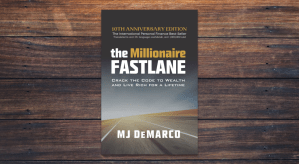
Lessons from The Millionaire Fastlane
The Slow Lane vs. The Fast Lane
DeMarco argues that most financial advice (saving diligently, avoiding debt, and investing in index funds) is a “slow lane” strategy that takes too long to yield significant results. Instead, he advocates for the “fast lane,” where individuals create wealth through business ownership, automation, and scalability.
The Importance of Control
One of the book’s main lessons is that wealth comes from controlling income streams. Instead of relying on an employer or passive stock market gains, DeMarco urges readers to build assets that they can directly influence, such as businesses, intellectual property, or scalable online platforms.
The Five Commandments of Wealth
The Millionaire Fastlane introduces five principles that define a strong wealth-building strategy:
- Need – Serve a real market need.
- Entry – Avoid easy-to-enter markets with high competition.
- Control – Own and control your income source rather than relying on others.
- Scale – Ensure your business can grow beyond your personal efforts.
- Time – Separate your earnings from your time to create passive income.
Rejecting Get-Rich-Slowly Advice
DeMarco criticizes the idea that people should work for 40 years, live below their means, and hope that compound interest will make them wealthy. Instead, he emphasizes speed, efficiency, and taking calculated risks to accelerate wealth creation.
Criticisms of the Book
While The Millionaire Fastlane is an inspiring read, it is not without its drawbacks.
- Entrepreneurship is not for everyone. Starting a business requires risk tolerance, creativity, and perseverance. Not all readers may be suited for or interested in this path.
- The tone can be aggressive. DeMarco takes a strong stance against traditional financial advice, which may be off-putting to some readers who prefer a balanced approach.
- Overlooks the value of steady investing. While DeMarco dismisses the “slow lane,” strategies like investing in the S&P 500 and real estate remain valid and proven ways to build wealth.
Final Thoughts
The Millionaire Fastlane offers a refreshing and often contrarian take on financial independence. For those tired of the conventional path and willing to take entrepreneurial risks, DeMarco’s principles can be life-changing. However, for readers who prefer a more stable, predictable route to wealth, the book’s aggressive stance against traditional investing may not resonate.
We believe in a balanced approach (investing in the S&P 500, maintaining a high-yield savings account, and keeping spending in check. While DeMarco’s philosophy leans heavily toward entrepreneurship, elements of his strategy (like focusing on income growth and scalability) can complement a solid financial plan.
For those interested in financial independence, The Millionaire Fastlane is a worthwhile read. Even if you don’t follow all of DeMarco’s advice, his perspective might just inspire you to rethink your approach to wealth-building.









 Winchell House
You must be logged in to post a comment.