
A question that frequently comes up in the Financial Independence/Retire Early community is something along the lines of, “I’ve saved up $100,000. Should I put it in the stock market or use it to buy a house?”
The question itself is flawed. Despite what you may have been told growing up, your house is not the best monetary investment.
Consider this: an investment in the S&P 500 will, on average, give you an annual return of 7%. That means any money you put in the S&P 500 will double every 10 years.
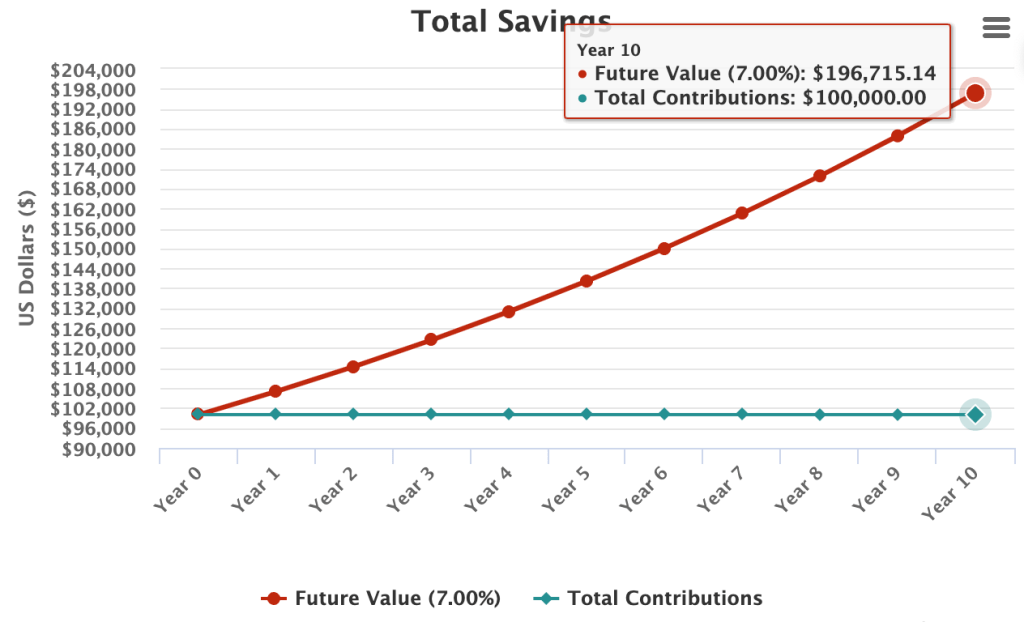
Your house will likely not double in value every 10 years. Does that mean it’s a bad investment? No, it just means it won’t make you as much money as you would if you had put that down payment money in the S&P 500.
The 5% Rule of Thumb
Here is the math the post skips. Owning a home costs roughly 5 percent of its value every year in unrecoverable costs: about 1 percent in property tax, about 1 percent in maintenance, and about 3 percent in the cost of capital (the return your down payment and equity could have earned elsewhere). On a $500,000 house, that is $25,000 a year you never get back, before a dime of principal is paid. Compare that to annual rent for a comparable place. If rent is well under 5 percent of the purchase price, renting and investing the difference usually wins financially. If rent is near or above it, buying starts to look smart. Taxes, leverage, and how long you stay tilt the answer, but the 5 percent rule keeps the comparison honest.

But here’s the thing, owning your home is still a good psychological investment. You can’t shelter your family in the S&P 500. You can sleep well at night knowing a landlord won’t suddenly raise your rent or, worse, kick you out on the street.
And owning your home may free you up to take more risks than you normally would if you didn’t own your home which may then lead to more financial success.
When Buying Wins Anyway
The math above is not the whole story, and the post is right to say so. A fixed mortgage is an inflation hedge: your payment stays flat while rents rise. Forced savings are real: every principal payment is money your renter self would probably have spent. And control has value no spreadsheet captures. Nobody renovates a rental kitchen with joy. Buy when the life reasons are strong and the 5 percent math is close, not when a calculator alone says yes.
So if we consider the question again, the answer might be: “What’s more important to you, more money or a place to call your own?”
This article is part of the Winchell House Original Articles series.









 Winchell House
You must be logged in to post a comment.