
Like the simple humans we are, we crave certainty. Will I have enough to retire? Will my daughter be okay going to that party? Will my marriage last?
The reality is that, no matter how you crunch the numbers (if there’s even numbers to be crunched), no prediction is entirely accurate. Sorry to say, that applies to The 4% Rule as well.
In fact, a rule regarding predictions I try to keep in mind is that, the further out a prediction is and the more specific the prediction is, the less likely it’ll be true. There’s just too many things that we don’t know of that can go wrong or right.
“The greatest enemy of knowledge is not ignorance, it is the illusion of knowledge.” – Daniel J. Boorstin
That brings me to prediction markets.
Folks look at prediction markets, like Polymarket, and say “Well, since the predictors are putting money on the line” then they must be right.

Another way to think about it is: these predictors don’t know they can’t predict the future, but they do know they have money to burn.
The 2024 election changed the conversation
When this post was written, prediction markets were a curiosity. The 2024 election made them the story. Kalshi won its court fight with the CFTC in September 2024 and launched election contracts, and Polymarket’s presidential market drew enormous volume and attention through the fall. For weeks, the market-implied odds moved ahead of the polls, and when the results came in, the markets had called it more accurately than most forecasters. That is what the “money on the line” argument was always supposed to mean, and for once it worked in public.
One good election does not prove prediction markets are oracles. The academic record is mixed: markets aggregate information well on questions with many informed participants and clear resolution criteria, and badly on everything else. But 2024 moved prediction markets from a thought experiment to a fixture. The question is no longer whether these markets matter. It is what they are: financial instruments, gambling, or something new that the law has not caught up with.
Bitcoin predictions for example. Bitcoin is in fact a speculative asset (like art). There is no predicting what the price may be since it isn’t tied to any sort of intrinsic value.
But here on Polymarket is a bet trying to predict what the price will be:
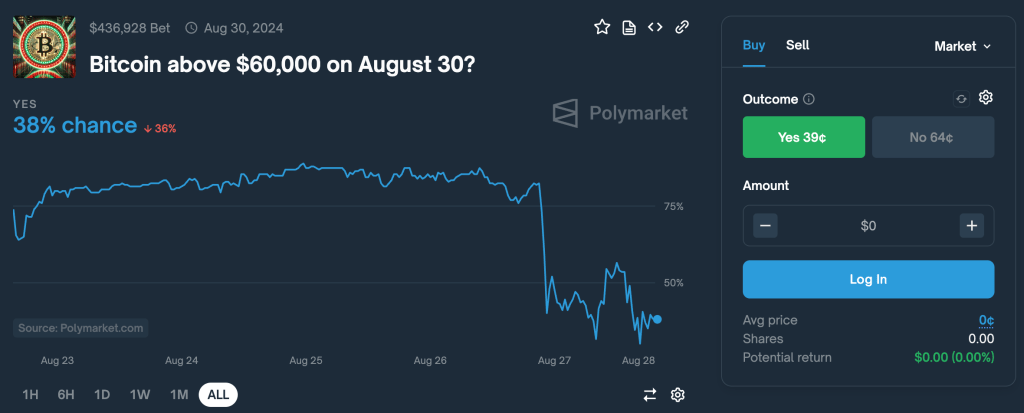
Remember, regardless of how informed someone may feel they are:
“There are two kinds of forecasters: those who don’t know, and those who don’t know they don’t know.” – John Kenneth Galbraith
Where prediction markets stand in 2026
Two years later, the industry has split in two. Kalshi, federally regulated as a derivatives exchange, controls the large majority of U.S. volume and operates in all 50 states, framing its contracts as financial instruments. Polymarket runs its main exchange offshore on crypto rails, closed to U.S. residents, and launched a separate regulated U.S. product in beta in late 2025 after acquiring a registered exchange.
Bank of America estimated in April 2026 that Kalshi held roughly 89 percent of measured U.S. prediction market volume. Regulators are still fighting over the whole category. The CFTC proposed new rules in June 2026 that would restrict certain event contracts, while several states have sued to treat sports contracts as unlicensed gambling and the federal government has sued right back, claiming exclusive jurisdiction. The legal answer will decide whether prediction markets grow under one federal framework or fragment state by state.
Either way, the original warning on this page stands: trading on Polymarket is not investing. It is gambling with better data.
This article is part of the Winchell House Original Articles series.









 Winchell House
You must be logged in to post a comment.