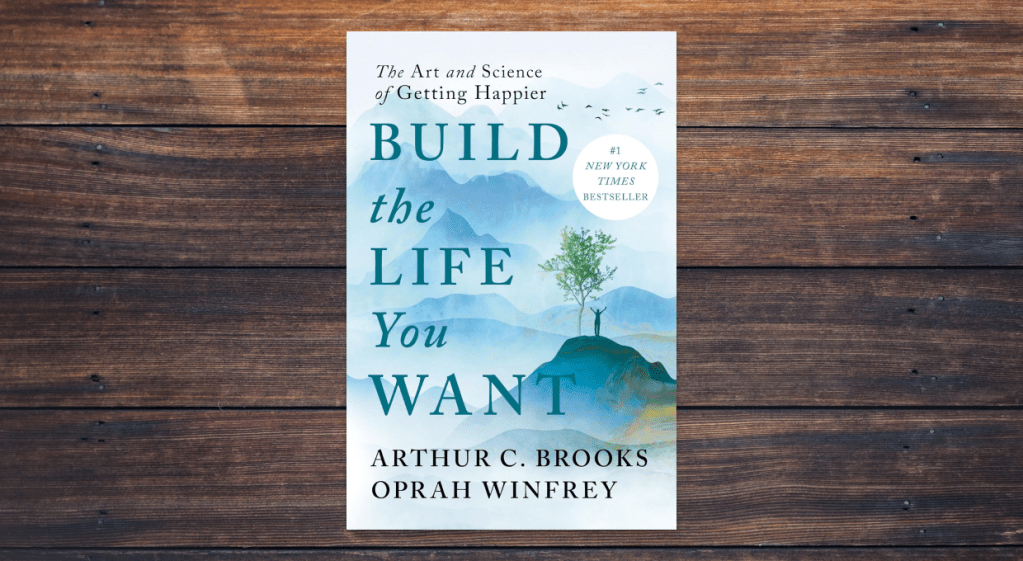
Happiness is one of the most searched topics on the internet and one of the least understood in daily life. Everyone wants it, most people feel they do not have enough of it, and the self-help industry has built an enormous business around the gap between those two facts. Build the Life You Want: The Art and Science of Getting the Happier, published in 2023 by Arthur C. Brooks and Oprah Winfrey, enters that crowded space with more intellectual credibility than most of its competitors. It is grounded in actual happiness research, written with genuine warmth, and structured around practical tools rather than vague inspiration. Whether it fully delivers on its ambitious premise is worth examining honestly.
Who Are Arthur C. Brooks and Oprah Winfrey?
Arthur C. Brooks is a social scientist, professor, and author who has spent much of his career studying the relationship between human behavior, policy, and wellbeing. He earned a PhD in policy analysis from the Pardee RAND Graduate School and served as president of the American Enterprise Institute from 2009 to 2019. He currently holds professorships at Harvard Business School and Harvard Kennedy School, where he teaches courses on leadership and happiness. His Atlantic column on happiness and human flourishing has reached millions of readers, and his previous book, From Strength to Strength, which is reviewed separately on this site, established him as one of the most thoughtful voices in the applied happiness space.
Oprah Winfrey needs considerably less introduction (no offense Arthur, but come on… she’s Oprah). Born in 1954 in rural Mississippi in poverty, she became the host of one of the most successful talk shows in television history, built a media empire that includes television, film, publishing, and digital platforms, and became the first Black female billionaire in American history. She is one of the most recognizable and influential figures in American public life and has spent decades using her platform to champion books, ideas, and conversations about personal growth and human potential. Her book club, launched in 1996, has made bestsellers of dozens of titles and introduced millions of Americans to serious literature and nonfiction they might not otherwise have encountered.
The collaboration between Brooks and Winfrey began when Brooks appeared on Winfrey’s podcast and the two discovered a shared framework for thinking about happiness that felt worth developing into a book. Their voices are genuinely distinct throughout, with Brooks providing the research scaffolding and Winfrey providing personal experience and emotional grounding, and that distinction is one of the book’s genuine strengths.
What the Book Is About
Build the Life You Want is organized around what Brooks and Winfrey call the four pillars of happiness: family, friendship, work, and faith or philosophy. The argument is that genuine, lasting happiness is not a feeling you pursue or a destination you arrive at. It is a set of practices you build into your life through deliberate choices about how you invest your time, energy, and attention across these four domains.
The book opens by challenging what the authors call the happiness myth, the widespread belief that happiness is a stable state that some people have and others lack, or a condition that arrives when circumstances are right. Drawing on research in neuroscience and psychology, Brooks explains that human beings are not neurologically wired for sustained happiness. We are wired for survival, which means we are wired to notice threats, register dissatisfaction, and return relatively quickly to a hedonic baseline after both positive and negative events. Understanding that architecture is the starting point for working with it rather than against it.
From that foundation the book moves through each of the four pillars, examining what research shows about how each contributes to wellbeing, where people commonly go wrong in each domain, and what practical changes produce meaningful improvement. The work section, for example, addresses the difference between a job, a career, and a calling, and examines how to find more meaning in work at any level rather than treating meaning as something only available in prestigious or passion-driven occupations.
The faith and philosophy pillar is handled carefully, acknowledging that not all readers share a religious framework while arguing that some form of transcendent meaning, a belief that life points toward something larger than individual comfort and achievement, is consistently associated with greater wellbeing across cultures and research populations.
Throughout the book Winfrey weaves in personal stories from her own life that illustrate the research Brooks presents. Her account of growing up in poverty and chaos, of building professional success without initially understanding how to build personal happiness alongside it, and of the specific work she has done on each of the four pillars gives the book an emotional credibility that pure research writing rarely achieves.
Lessons Readers Can Take Away
The most practically valuable lesson in the book is the distinction between feeling happy and being happy, which Brooks frames using the research concept of subjective wellbeing. Feeling happy is an emotional state, pleasant but transient and largely outside your direct control. Being happy is a more stable orientation toward life that emerges from specific habits and investments in the four pillars. The implication is that the goal is not to maximize pleasant feelings but to build the structures that support durable wellbeing, a reorientation that changes how you think about both daily choices and long-term planning.
For readers thinking about money and financial decisions, this distinction has direct relevance. Research consistently shows that beyond a moderate income threshold, additional money produces rapidly diminishing returns in terms of actual wellbeing. The person who sacrifices relationships, health, and meaningful work in pursuit of additional wealth accumulation is almost certainly making a bad trade by any objective wellbeing measure. Brooks and Winfrey are not arguing that money does not matter. They are arguing, with solid evidence behind them, that it matters much less than most Americans behave as if it does, and that the domains that matter most, close relationships in particular, tend to be systematically underinvested by people focused primarily on financial achievement.
Another lesson concerns what the authors call the relationship portfolio. They argue that healthy social lives are not just about having a best friend or a romantic partner. They require a range of relationships at different levels of intimacy and commitment, from close family and deep friendships to the looser connections of acquaintances and community ties. Research suggests that the weaker ties, neighbors, colleagues, and casual regulars at the places you frequent, contribute meaningfully to daily wellbeing in ways that most people do not anticipate and therefore fail to cultivate deliberately.
A third lesson is about the role of gratitude and what Brooks calls the subtract, do not add approach to happiness. Rather than constantly pursuing new sources of pleasure or achievement, research suggests that deliberately noticing and appreciating what you already have produces more reliable wellbeing gains than acquiring more. That is a message with obvious financial implications for anyone trying to live below their means and avoid lifestyle inflation.
The book also addresses the relationship between happiness and adversity. Brooks and Winfrey both draw on research and personal experience to argue that the path through genuine suffering, loss, failure, disappointment, is not avoidance or positivity performance but what psychologists call post-traumatic growth. The capacity to find meaning in difficulty rather than simply surviving it is one of the most reliable predictors of long-term wellbeing, and it is something that can be developed deliberately rather than waiting for it to happen.
Criticisms of the Book
Build the Life You Want is a genuinely good book, but it has real weaknesses that a fair review should name.
The most substantive criticism is that the four pillars framework, while useful as an organizing structure, can feel somewhat arbitrary. Why these four domains and not others? The book does not make a rigorous case for why work, family, friendship, and faith constitute a complete and exhaustive account of what matters for human wellbeing, and readers with different life arrangements may find that their most important sources of meaning do not map cleanly onto the framework provided.
A second criticism is that the practical guidance, while generally sensible, is not always as specific or actionable as the book promises. Telling readers to invest more in relationships is good advice. Telling them exactly how to do that when they are working long hours, geographically separated from family, or socially anxious is harder, and the book is better at identifying the goal than at mapping the route for people facing real structural obstacles.
A third criticism concerns the collaboration dynamic. While the combination of Brooks’s research and Winfrey’s personal narrative is generally effective, there are moments where the two voices feel less integrated than juxtaposed. Readers who are primarily interested in the science may find Winfrey’s sections less essential, while readers drawn primarily to Winfrey’s perspective may find Brooks’s research sections overly academic. The seams show occasionally.
A fourth criticism, consistent with critiques of the broader happiness research field, is that much of the science Brooks cites is correlational rather than causal. The finding that people with strong relationships report greater happiness does not definitively establish that building stronger relationships will make a specific person happier. The gap between population-level findings and individual prescription is a genuine limitation of the evidence base that the book does not always acknowledge.
Should You Buy This Book?
Yes, for most readers, and particularly for those who want an accessible, research-grounded introduction to the happiness literature that does not sacrifice intellectual honesty for inspirational packaging.
The book is especially worth reading alongside From Strength to Strength, Brooks’s previous book, which covers adjacent territory with more depth and more personal candor. Together they form a coherent two-book examination of how to build a meaningful life in both its first and second halves. The Psychology of Money by Morgan Housel is a natural third companion, addressing the financial dimension of a meaningful life with comparable seriousness and accessibility.
For readers who have already spent time with the happiness research literature, through books like The Happiness Hypothesis by Jonathan Haidt or the work of researchers like Sonja Lyubomirsky, the book will cover familiar ground. But the combination of Brooks’s clarity as an explainer and Winfrey’s personal honesty gives it an emotional texture that more academic treatments lack.
The book is widely available, reads quickly, and is priced modestly. The investment of time and money is low relative to what it offers.
Final Thoughts
Build the Life You Want is a book about something that matters enormously and gets surprisingly little serious attention in personal finance circles: the relationship between how you manage your money and whether you actually end up happy. The research Brooks presents consistently shows that the financial decisions most Americans make, working more to earn more, deferring relationships and leisure and meaning in exchange for greater professional achievement and financial accumulation, are not producing the wellbeing those sacrifices are implicitly supposed to purchase.
That is not an argument against financial responsibility, disciplined saving, or long-term investing. It is an argument for being deliberate about what you are building financial security toward. A high-yield savings account, a fully funded S&P 500 nest egg, and a well-tracked budget are tools in service of a life. They are not the life itself. The four pillars Brooks and Winfrey describe, the relationships, the meaningful work, the community, and the sense of transcendent purpose, are what financial security is supposed to protect and enable. Building those pillars with the same intentionality you bring to your investment strategy is not optional. It is the whole point.
That message, delivered with genuine warmth and solid research, is what makes this book worth the few hours it takes to read.











You must be logged in to post a comment.