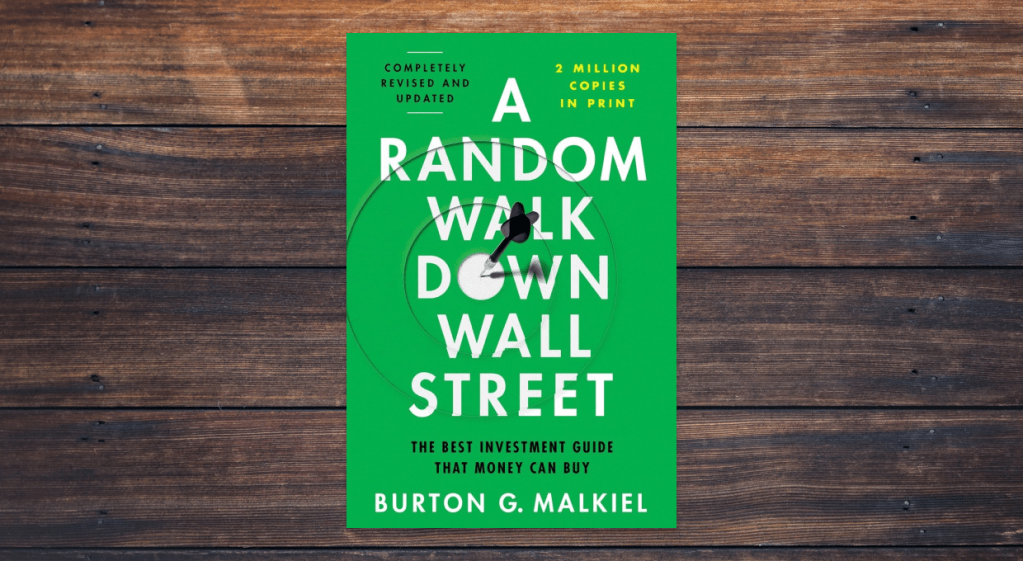
If you could read only one book about investing and had to choose it sight unseen, the argument for A Random Walk Down Wall Street by Burton Malkiel would be difficult to beat. First published in 1973 and now in its thirteenth edition, it has remained continuously in print and continuously relevant across more than five decades of market history that have included oil shocks, Black Monday, the dot-com bubble, the 2008 financial crisis, a global pandemic, and everything in between. Its central argument has not only survived those events but has been substantially vindicated by them. That is a rare thing in financial publishing, where the shelf life of most investment books is measured in market cycles rather than generations.
Who Is Burton Malkiel?
Burton Malkiel was born in 1932 in Boston, Massachusetts. He earned his undergraduate degree from Harvard College and his MBA and PhD from Princeton University, where he spent the majority of his academic career as a professor of economics. He served as dean of the Yale School of Management from 1981 to 1988 and was a member of the President’s Council of Economic Advisers under Gerald Ford. He also served on the board of directors of several major financial institutions including Vanguard, the index fund company whose philosophy aligns closely with the argument he has made throughout his career.
Malkiel is an economist in the classical sense, someone who takes market efficiency seriously as an empirical claim rather than an ideological commitment, and his work reflects decades of careful engagement with the evidence on how markets actually behave rather than how market participants believe or hope they behave. He has published extensively in academic journals and has been a consistent and credible voice for evidence-based investing in public discourse for fifty years.
He retired from his full professorship at Princeton but has remained active as a writer, speaker, and investor. He spent time as chief investment officer of a robo-advisory firm, which reflects his genuine belief that low-cost, systematic, broadly diversified investing is not just theoretically sound but practically superior for the vast majority of investors.
What the Book Is About
The title comes from the random walk hypothesis in mathematics and statistics, which describes a path that follows no predictable pattern because each step is independent of the ones before it. Applied to financial markets, the hypothesis holds that stock prices incorporate all available information so rapidly and so completely that future price movements cannot be reliably predicted from past movements. The next price change is, in an important sense, random from the perspective of anyone trying to predict it.
This is the efficient market hypothesis expressed in accessible language, and Malkiel makes it the foundation of the book’s central practical argument: if prices already reflect everything that is publicly known, then neither technical analysis, which attempts to predict future prices from historical price patterns, nor fundamental analysis, which attempts to identify undervalued stocks through careful study of business financials, can consistently produce returns that beat the market after accounting for the costs of the research and trading required to implement them.
The book is organized into four major sections. The first examines the history of speculative manias, from tulip bulbs in seventeenth-century Holland through the South Sea Bubble, the 1920s stock market boom, the Nifty Fifty era, the dot-com bubble, and the housing bubble of the 2000s. This historical tour is one of the most valuable sections of the book because it demonstrates with uncomfortable clarity how reliably intelligent, educated, financially sophisticated people convince themselves that this time is different, and how reliably it is not.
The second section examines the theoretical foundations of both technical and fundamental analysis and evaluates the evidence for and against each. The third section covers modern portfolio theory, the capital asset pricing model, and the practical implications of academic finance research for individual investors. The fourth and most practical section offers concrete guidance on how to construct and maintain a diversified, low-cost investment portfolio appropriate for different stages of life.
Throughout all four sections Malkiel writes with unusual clarity and an evident commitment to helping readers understand and apply the ideas rather than simply impressing them with the author’s sophistication.
Lessons Readers Can Take Away
The most important lesson in the book, and the one with the most direct practical application, is that the expected return of the average actively managed fund is the market return minus fees and trading costs. This is not an empirical observation that might change with circumstances. It is a mathematical identity. All investors collectively own the entire market. For every investor who outperforms the market in a given period, there must be another investor who underperforms by the same amount. After subtracting the costs of active management, the average active investor must underperform the index. The data on actual fund performance over long periods confirms this with remarkable consistency.
For readers building a long-term investment strategy, this lesson has an immediate and actionable implication. Low-cost index funds tracking broad market indexes like the S&P 500 or the total stock market will outperform the majority of actively managed alternatives over long periods simply by eliminating the cost drag that active management imposes. This is not a matter of passive investing being brilliant. It is a matter of the arithmetic being unavoidable.
A second lesson is about the extraordinary destructive power of investment costs over long periods. Malkiel is meticulous about illustrating how even small differences in annual expense ratios compound into enormous differences in wealth over decades. A fund charging one percent annually versus one charging a tenth of a percent does not seem like a meaningful distinction in any given year. Over thirty years of compounding the difference is staggering. Understanding this point changes how you evaluate investment products for the rest of your life.
A third lesson comes from the historical tour of speculative manias. Malkiel’s history of bubbles is not simply entertaining, though it is that. It is a practical inoculation against the most dangerous investing behavior, which is abandoning a systematic strategy in response to the compelling narrative of an exceptional moment. Every bubble in history looked different from every previous bubble to the people living through it. The argument that this time is different has been wrong consistently enough that hearing it should function as a warning rather than an invitation.
A fourth lesson is about the relationship between risk and return over time. Malkiel explains with characteristic clarity how stocks have historically provided higher returns than bonds over long periods precisely because they are more volatile in the short term. Investors who accept short-term volatility in exchange for long-term growth are being compensated for bearing that risk. Investors who cannot tolerate volatility and sell during downturns give up the long-term premium without avoiding the short-term pain, because they typically sell after the decline and buy back after the recovery. The prescription is to match your asset allocation to your genuine risk tolerance and time horizon, not to the risk tolerance you imagine you have when markets are rising.
Criticisms of the Book
A Random Walk Down Wall Street has been influential enough to attract serious and sustained criticism from serious people, and engaging with those criticisms honestly makes for a better understanding of both the book and the investing landscape.
The most substantive criticism is that the efficient market hypothesis, while broadly correct as a description of large, liquid, heavily analyzed markets, may be less applicable to smaller, less liquid, or less covered markets where information inefficiencies are more likely to persist. Active value investors like Warren Buffett, Charlie Munger, and the investors profiled in books like The Outsiders and 100 Baggers, have produced records that are difficult to explain purely by luck. Malkiel acknowledges this but argues that identifying in advance which active managers will outperform is itself extremely difficult, which makes the case for indexing hold even if some degree of exploitable inefficiency exists.
A second criticism is that the book’s practical guidance, while generally sound, reflects the investment products available at the time each edition was written. Earlier editions predate the explosion of low-cost ETFs and the development of Vanguard-style total market funds that have made the book’s prescriptions dramatically easier and cheaper to implement than they were in 1973. Later editions have updated accordingly, but readers should be aware of when their copy was published.
A third criticism from behavioral economists is that the efficient market hypothesis pays insufficient attention to the role of investor psychology in creating pricing anomalies. The work of Daniel Kahneman, Richard Thaler, and others has documented systematic cognitive biases that affect investor behavior in ways that can create exploitable mispricings, at least temporarily. Malkiel engages with behavioral finance to a degree but remains more committed to the efficiency view than many researchers in that field would endorse.
A fourth criticism is simply that the book is long and that some sections, particularly the more technical discussions of portfolio theory, are demanding for readers without a quantitative background. The practical guidance in the later sections is accessible to anyone, but the theoretical scaffolding that precedes it requires patience.
Should You Buy This Book?
Yes, without significant qualification, for any reader who is building a long-term investment strategy or trying to understand why the strategy they have been recommended actually makes sense.
A Random Walk Down Wall Street is the most comprehensive and most rigorously argued case for index fund investing available to a general audience. It provides the theoretical foundation, the historical evidence, the behavioral context, and the practical implementation guidance that together make a complete and coherent investment philosophy. Reading it gives you a framework for evaluating every investment product, strategy, and financial recommendation you will ever encounter, which is a durable and compounding asset in itself.
It pairs naturally with The Little Book of Common Sense Investing by John Bogle which makes a similar argument with greater brevity. Together they form the most solid possible intellectual foundation for a low-cost, broadly diversified, long-term investment approach. The Psychology of Money by Morgan Housel addresses the behavioral dimension of why executing that approach is harder than it sounds, and Thinking, Fast and Slow by Daniel Kahneman provides the cognitive science behind the systematic errors that lead investors away from evidence-based strategies.
The current edition is the right one to buy, as Malkiel has consistently updated the text to engage with new research and new market developments.
Final Thoughts
Burton Malkiel published the first edition of A Random Walk Down Wall Street more than fifty years ago. In those five decades the American stock market has experienced ten recessions, multiple crashes, technological revolutions, geopolitical upheavals, and periods of extraordinary volatility. The central argument of the book, that broadly diversified, low-cost index investing will outperform the vast majority of actively managed alternatives over long periods, has been vindicated by virtually every major study of actual fund performance conducted in the intervening years.
That is a remarkable thing to be able to say about a financial book. Most investment advice is provisional, contingent on conditions that may not persist and on assumptions that may not hold. Malkiel’s core argument rests on arithmetic, on the unavoidable mathematics of costs and market returns, that does not have the same kind of expiration date.
For anyone who takes their long-term financial health seriously, this is essential reading. It will not make investing exciting or give you a hot stock tip. What it will do is give you a clear, well-reasoned, historically grounded case for the investment approach that the evidence consistently supports, and the confidence to stick with that approach when the inevitable arguments for abandoning it appear, as they always do and always will.











You must be logged in to post a comment.