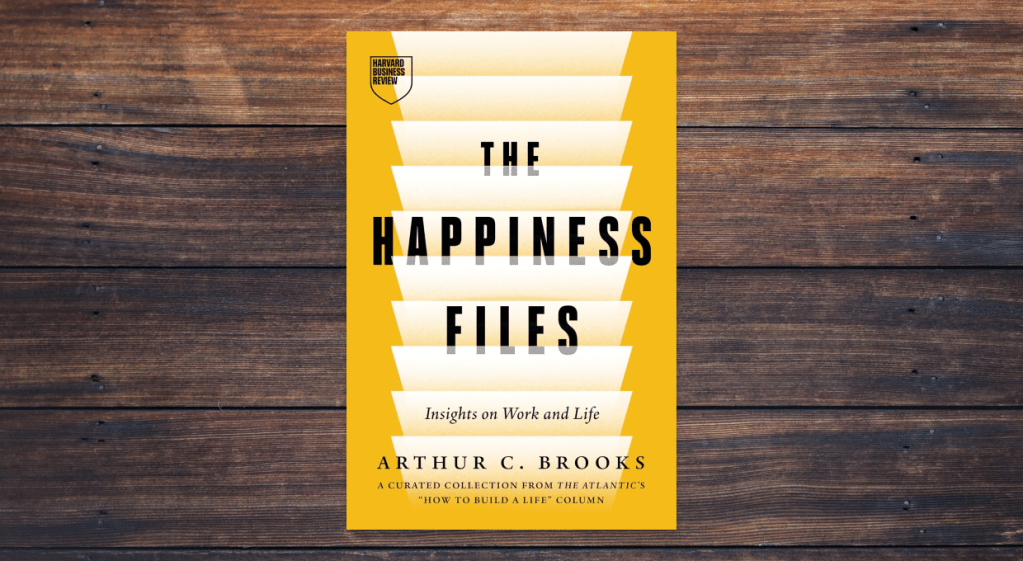
Most books about happiness tell you what to do. Arthur C. Brooks has spent years asking a harder question: why do so few people actually do it? The Happiness Files is a companion piece to his Atlantic column and podcast series of the same name, collecting and expanding on the conversations, research findings, and practical frameworks he has developed over years of writing about what social science actually knows about human flourishing. It is a shorter and more accessible entry point into Brooks’s thinking than either From Strength to Strength or Build the Life You Want, and for readers who want to understand the research landscape before committing to his longer works, it serves that purpose well.
Who Is Arthur C. Brooks?
Arthur C. Brooks was born in 1964 in Seattle, Washington. He trained as a classical French horn musician and played professionally before returning to academia, earning a PhD in policy analysis from the Pardee RAND Graduate School. He served as president of the American Enterprise Institute from 2009 to 2019, one of the longest and most productive tenures in that institution’s history, before joining Harvard University, where he currently holds professorships at both Harvard Business School and Harvard Kennedy School.
His column “How to Build a Life” in The Atlantic has become one of the most widely read regular features on happiness, meaning, and human flourishing in American journalism, drawing on research from psychology, neuroscience, economics, and philosophy to address questions that most serious publications treat as too soft for sustained attention. He has written twelve books across a career that has consistently resisted easy categorization, moving between policy analysis, social science, and what might broadly be called practical philosophy.
The Happiness Files represents Brooks at his most conversational, reflecting the format of his podcast work and the relatively compressed essay structure of his Atlantic columns. It is the most informal of his major works and in some ways the most immediately engaging.
What the Book Is About
The Happiness Files is organized as a series of interconnected explorations of specific findings from happiness research, each addressing a distinct question about what contributes to or undermines human wellbeing. Rather than building a single linear argument the way From Strength to Strength does, it moves through a range of topics including the neuroscience of enjoyment, the role of work in identity and meaning, the relationship between money and happiness, how social comparison damages wellbeing, the science of friendship and loneliness, the connection between gratitude and satisfaction, and the surprisingly powerful effects of small daily habits on long-term wellbeing.
The research Brooks draws on is substantial and carefully chosen. He is not a pop psychologist cherry-picking studies that confirm a predetermined conclusion. He engages with findings that complicate easy narratives and acknowledges uncertainty where it exists, which distinguishes his work from much of the happiness genre. At the same time the book is written for general readers rather than academics, and it maintains the warm, direct tone of someone who is genuinely interested in helping readers improve their lives rather than demonstrating his own expertise.
A recurring theme throughout is the gap between what people believe will make them happy and what research consistently shows actually does. That gap, which psychologists call affective forecasting error, is one of the most robust findings in happiness science and one of the most practically consequential. People systematically overestimate how much positive events like promotions, salary increases, and material acquisitions will improve their wellbeing, and underestimate how much they will adapt to those improvements and return to their baseline. Understanding that pattern changes how you allocate your time, energy, and money in ways that actually matter.
Lessons Readers Can Take Away
The most immediately useful lesson for anyone managing a budget or planning their financial future is the research on money and happiness. Brooks covers this territory carefully, engaging with the famous and frequently misunderstood findings on the income-happiness relationship. The research does not say money does not matter. It says that the relationship between money and wellbeing is strong at lower income levels, where additional income genuinely expands options and reduces sources of stress, and becomes significantly weaker at higher income levels, where additional money produces rapidly diminishing returns in terms of actual life satisfaction.
The practical implication for readers who are already financially stable is that the next dollar of income or the next increment of wealth accumulation is likely to improve your life substantially less than you expect it to, and that the attention and energy you are directing toward earning more might produce better wellbeing outcomes if redirected toward the domains that actually predict happiness at higher income levels, which are primarily relationships and meaning.
A second lesson concerns what Brooks calls the comparison trap. Social comparison is one of the most reliable destroyers of financial satisfaction. The person who evaluates their financial situation relative to their own past circumstances and their own values tends to feel considerably better than the person who evaluates it relative to peers, neighbors, or the curated wealth displays of social media. Brooks draws on research showing that relative income, how much you have compared to others in your reference group, is a better predictor of financial dissatisfaction than absolute income, which is both counterintuitive and practically important. Managing your media consumption and social environment is a genuine financial wellness strategy, not just a lifestyle preference.
A third lesson addresses the role of work in identity and wellbeing. Brooks covers the distinction between jobs, careers, and callings with particular clarity in this book, drawing on research that shows how people at every income level and in every type of work can find elements of meaning and craft that shift their relationship to what they do from obligation to engagement. This is not a recommendation to romanticize exploitative work conditions. It is an observation that the internal orientation you bring to work, the extent to which you can connect it to something larger than a paycheck, has measurable effects on your wellbeing that are partially within your control.
A fourth lesson is about the science of enjoyment versus pleasure. Brooks draws on research distinguishing between hedonic wellbeing, the presence of pleasant feelings and absence of unpleasant ones, and eudaimonic wellbeing, the sense of living a meaningful, engaged, and purposeful life. The research consistently shows that eudaimonic wellbeing is the more stable and more reliable predictor of long-term happiness, and that many of the pursuits Americans invest most heavily in, entertainment, consumption, convenience, are hedonic rather than eudaimonic. Building habits that produce engagement, connection, and meaning rather than simply comfort and stimulation is a reorientation that applies directly to how you spend both your time and your money.
Criticisms of the Book
The most significant criticism of The Happiness Files is also its most forgivable: it is a collection rather than a fully developed argument. The essay format means that the book does not build toward a comprehensive conclusion the way a more conventionally structured work would. Individual chapters are illuminating, but readers looking for a unified framework will find it less satisfying than From Strength to Strength or Build the Life You Want, both of which provide more architectural structure for Brooks’s ideas.
A second criticism is that the book assumes a reader who is already relatively privileged. The happiness research Brooks cites is drawn overwhelmingly from studies conducted in wealthy countries, and much of it reflects the concerns of people whose basic needs are met and who are navigating questions of meaning and flourishing rather than survival and security. Readers dealing with serious financial stress, food insecurity, or housing instability will find the book’s prescriptions less immediately applicable, and the book does not always acknowledge that limitation with the clarity it deserves.
A third criticism is that some chapters feel more fully developed than others. The collection format means that pieces written at different times for different contexts do not always sit together with equal weight. Some topics receive the depth of treatment they deserve. Others feel like sketches rather than completed arguments.
A fourth criticism echoes concerns raised about the broader happiness research field: much of the science is correlational, and the translation from population-level findings to individual prescriptions is not always as clean as the confident writing style implies. Brooks is more careful about this than most popular writers on happiness, but the epistemological challenge remains real.
Should You Buy This Book?
It depends on where you are in your engagement with Brooks’s work and with happiness research generally.
If you are new to Brooks as a writer, The Happiness Files is actually a reasonable starting point precisely because of its brevity and accessibility. It gives you a broad survey of his thinking and the research he draws on without requiring the sustained attention that From Strength to Strength demands. If it resonates, you can move to his longer and more architecturally ambitious works.
If you have already read From Strength to Strength and Build the Life You Want, reviewed separately on this site, The Happiness Files will cover ground you have already visited. Some of the specific research findings and frameworks will be familiar, though the essay format occasionally surfaces angles that the more structured books treat less fully.
For readers specifically interested in the intersection of happiness research and personal finance, the chapters on money and wellbeing, social comparison, and the hedonic treadmill are worth reading regardless of familiarity with the other books. The research on why additional money above a certain threshold produces so little additional happiness is directly relevant to how anyone thinks about financial goals, lifestyle choices, and the relationship between earning, spending, and living well.
At its length and price point the book represents a modest investment of both.
Final Thoughts
Arthur Brooks has spent years translating difficult social science into practical wisdom for general readers, and The Happiness Files reflects that project at its most accessible. It will not change how you think about happiness as comprehensively as From Strength to Strength or as practically as Build the Life You Want, but it does something those longer books cannot quite do: it moves quickly, covers a lot of ground, and lets readers identify the specific questions and findings that are most relevant to their own lives before going deeper.
The financial relevance of Brooks’s work across all three books is ultimately the same: the way most Americans allocate their time and money is systematically misaligned with what research shows actually produces wellbeing. Earning more, spending more, accumulating more, and optimizing for hedonic comfort are not reliable paths to a happy life. Investing in relationships, finding meaning in work, practicing gratitude, and building habits that produce genuine engagement are. That is a message worth hearing regardless of where you are in your financial journey, whether you are building your first emergency fund, maximizing contributions to a retirement account, or figuring out what financial independence was actually for in the first place.
The books reviewed here alongside The Happiness Files, including The Psychology of Money by Morgan Housel, Die With Zero by Bill Perkins, Thinking, Fast and Slow by Daniel Kahneman, and Atomic Habits by James Clear, all approach the same fundamental territory from different angles. Together they form a reading foundation that addresses not just how to build financial security but what financial security is actually in service of. That question is worth taking as seriously as any other in your financial life.









 Winchell House
You must be logged in to post a comment.